Vehicle electricsInstalling battery
|
Battery
Installing battery
|
| |
|
 |
|
Note:
Batteries from the Audi parts range feature a base strip adapter for matching to different fastening strips.
When and how the base strip adapter is to be used is described in the battery operating instructions.
-
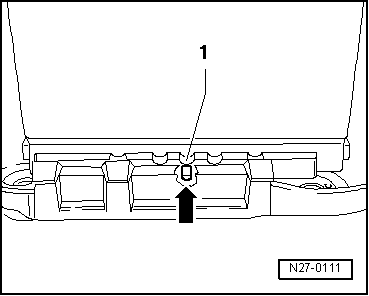
‒ → Insert battery in battery carrier such that lug of battery carrier at rear -arrow- engages in recess in battery base strip -1-.
-
‒ It should no longer be possible to move battery
|
| |
|
 |
-
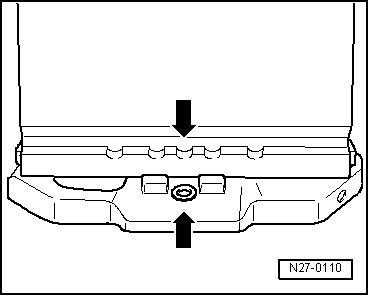
‒ → Battery has been properly inserted if centre recess in battery base strip coincides with tapped hole in battery carrier -arrows-.
Perform further installation in reverse order, paying attention to the following:
-
‒ Pay attention to notes on battery central gas venting system
.
|
| |
|
 |
|
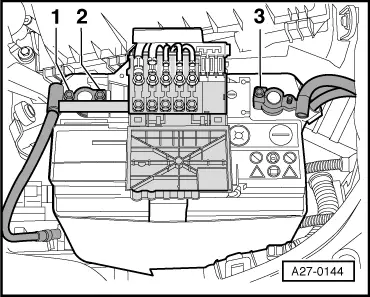
→ Connect up battery in the following sequence with ignition and electr. loads switched off:
-
‒ Attach pole shoe of positive wire by hand to battery positive terminal "+" and tighten nut -2- to 6 Nm.
-
‒ If applicable, screw busbar -1- for main fuse box to pole shoe of positive wire (6 Nm).
-
‒ Finally attach pole shoe of earth wire by hand to battery negative terminal "-" and tighten nut -3- to 6 Nm.
-
‒ Check tightness of battery following installation .
Notes:
-
◆ On re-connecting battery, remember to activate vehicle equipment (radio/radio navigation system, clock, electric window lifters) in line with owner's manual.
-
◆ Deactivate telematics control-unit service mode.
=> Radio, Telephone, Navigation; Repair Group 91
-
◆ For further operations after re-connecting power supply, refer to
=> Injection and Ignition System; Repair Group 24
Tightening torques
|
|
|
Component
|
Nm
|
|
Bolt to bracket
|
20
|
|
Battery terminal to battery post
|
6
|
|
Additional terminal to battery terminal
|
6
|
Batteries with central gas venting system
Attention:
Batteries of latest design with central gas venting system are always to be fitted.
Always use genuine battery caps. The caps must be fitted with an O-ring seal.
There are two types of battery with central gas venting system:
-
◆ Batteries with hose/connection at central gas venting system
-
◆ Batteries with no hose/connection at central gas venting system
Notes:
-
◆ The latest generation of batteries features a central gas venting system and a fine-mesh flame trap.
Function: The gas produced on charging escapes centrally through a hole in the top cover. The fine-mesh flame trap which prevents ignition of the flammable gas in the battery is also located here.
The fine-mesh flame trap consists of a small round fibre-glass mat with a diameter of approx. 15 mm and a thickness of 2 mm. It operates in a manner similar to a valve, i.e. it allows the gas produced by battery gassing to escape.
-
◆ Battery posts are no longer to be greased.
-
◆ Battery terminals are only to be connected by hand so as not to damage the battery casing.
|
| |
|
 |
|
Notes on operation of central gas venting system:
-
◆ On batteries with central gas venting hose/pipe, make sure that hose does not become disconnected as otherwise the battery will not be properly vented.
-
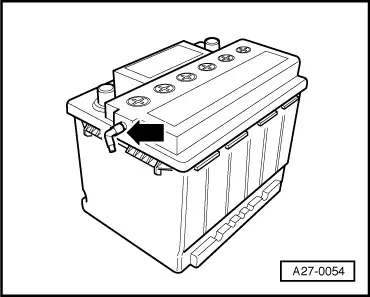
◆ → On batteries with no central gas venting hose/pipe, it is important to ensure that opening in top cover -arrow- is not clogged.
Checking firm attachment of battery
Possible dangers if battery is not firmly in position:
-
‒ Shorter service life due to vibration damage
-
‒ Damage to battery plates if battery not properly attached
-
‒ Damage to battery casing caused by bracket (possible electrolyte leakage, high subsequent costs)
-
‒ Reduced crash safety
-
‒ To ensure that battery does not leak, only fit genuine battery caps.
-
‒ In the event of loss or damage, make exclusive use of genuine caps of the same type.
-
‒ The caps must be provided with an O-ring.
|
05 General