audi Workshop Repair Guides

Audi Workshop Service and Repair Manuals

Dismantling and assembling fuel rail with injectors Engine code letters: AMM, BDV > < Procedure following interruption of power supply
Motronic injection and ignition system (6-cyl.)
Servicing Motronic injection system
Checking fuel pressure regulator and holding pressure

Note:

The fuel pressure regulator controls the fuel pressure as a function of intake manifold pressure. As a consequence, the pressure drop at the injectors remains the same in all engine speed and load ranges.

Special tools and workshop equipment required

 
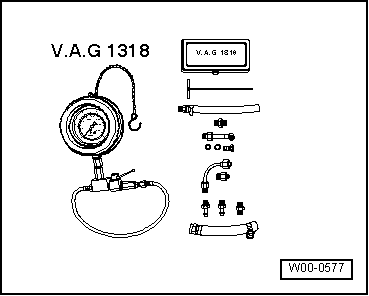
W00-0577
  • ◆ V.A.G 1318 with V.A.G 1318/7, V.A.G 1318/8 and V.A.G 1318/15

Test requirements:

  • ● Fuel pump relay OK
  • ● Fuel pump OK

=> Fuel Supply System - Petrol Engines; Repair Group 20

  • ● Fuel filter OK
  • ● Battery voltage at least 12.7 V
  • ● Vehicles with automatic gearbox: Selector lever set to P or N

Test sequence

 
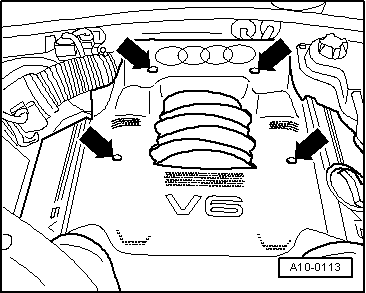
A10-0113

Engine code letters AMM, BDV

  • ‒ → Remove engine cover -arrows-.

 
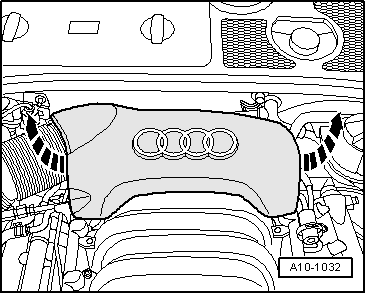
A10-1032

Engine code letters ASN

  • ‒ Remove engine cover -arrows-.

Checking system pressure

Attention:
Fuel system is pressurised. Wrap cloth around joint before disconnecting hoses or opening test connection (to measure fuel pressure). Then dissipate pressure by carefully unfastening hose connection.
 
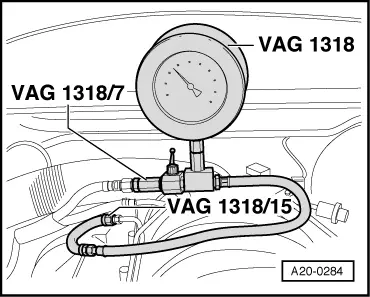
A20-0284

Engine code letters AMM, BDV

  • ‒ → Connect up pressure gauge V.A.G 1318 with adapters 1318/7, 1318/8 (pressure hose) and 1318/15 to supply pipe.

 
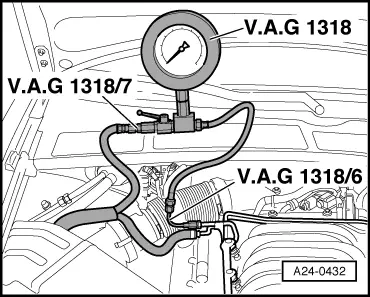
A24-0432

Engine code letters ASN

  • ‒ → Connect up pressure gauge V.A.G 1318 with adapters 1318/7, 1318/8 (pressure hose) and 1318/15 to supply pipe.
  • ‒ Disconnect vacuum pipe between pressure regulator and intake manifold at pressure regulator and seal pipe.

Note:

Replace pressure regulator if fuel emerges at vacuum connection of pressure regulator when performing the following pressure test.

  • ‒ Start engine and let it idle.
  • ‒ Measure fuel pressure.
    • ‒ Specification: 3.8 ... 4.2 bar
  • ‒ If reading does not match specification, try replacing pressure regulator and repeat pressure test.
  • ‒ If reading still does not match specification, check fuel pump/supply pipe for damage (e.g. crushing) and replace if necessary.
  • ‒ If specification is exceeded, check return pipe for damage (e.g. crushing) and replace if necessary.

Note:

In the course of the following test, the engine is not to be run for any longer than necessary with vacuum hose detached, as the higher fuel pressure enriches the fuel/air mixture, which could cause the Lambda control limits to be exceeded and a fault to be stored.

  • ‒ Start engine and let it idle.
  • ‒ Switch off electr. loads (air conditioner etc.).
  • ‒ Attach vacuum hose to pressure regulator and in doing so observe drop in pressure on pressure gauge.
  • ‒ Fuel pressure must decrease by roughly 0.5 bar when vacuum hose is connected.
  • Perform the following checks if there is no change in pressure:
    • ‒ Check vacuum hose for cracks and damage.
    • ‒ Check vacuum hose at intake manifold for blockage; to do so, pull off hose at pressure regulator and blow into it.
  • ‒ Replace pressure regulator if there is no leakage and vacuum hose is not blocked.

Checking holding pressure

  • ‒ Holding pressure 10 minutes after switching off engine (minimum pressure):
    • ‒ Specification with cold engine: approx. 2.2 bar
    • ‒ Specification with warm engine: approx. 3.0 bar

Note:

Increase in pressure with warm engine is normal on account of fuel expansion.

  • ‒ Start engine and let it idle.
 
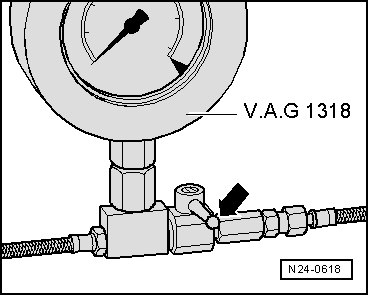
N24-0618
  • ‒ → Switch off ignition once pressure has built up. At the same time, close cut-off valve of pressure gauge V.A.G 1318 (lever at right angles to direction of flow -arrow-).

Possible faults if pressure does not decrease:

  • ◆ Leak in union between pressure gauge and fuel supply pipe
  • ◆ Leak in supply pipe at fuel tank
  • ◆ Non-return valve in fuel pump leaking

=> Fuel Supply System - Petrol Engines; Repair Group 20

Note:

After closing cut-off valve, pressure gauge indicates the pressure downstream of the cut-off valve "on the intake manifold end" (in direction of injectors, fuel-pressure regulator). If the pressure then drops upstream of the cut-off valve (in direction of tank), this cannot be detected by the gauge. This explains the use further up the page of the wording "If pressure does not decrease...".

Possible faults if pressure decreases again:

  • ◆ Fuel pressure regulator defective
  • ◆ Injectors leaking
  • ◆ Leak in pressure gauge unions downstream of cut-off valve

Note:

To remove pressure gauge, close cut-off valve, unfasten union at adapter V.A.G 1318/15 and drain off excess fuel into collector by opening cut-off valve.

Dismantling and assembling fuel rail with injectors Engine code letters: AMM, BDV > < Procedure following interruption of power supply