
Alignment: Specifications (page 3 of 4)
- Make
- Buick
- Model
- Rendezvous AWD
- Engine
- V6-3.4L VIN E
- Year
- 2005
- Section
- Alignment
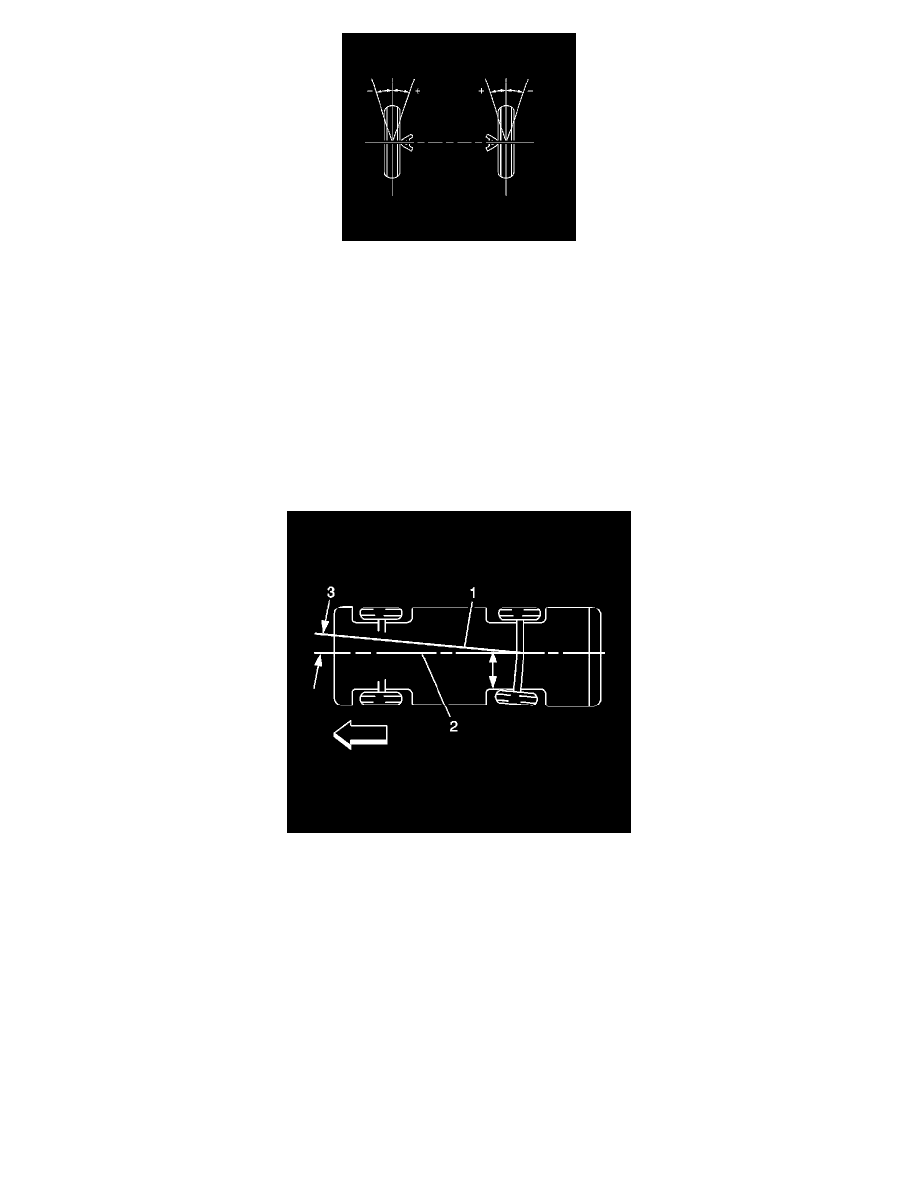
Toe is a measurement of how much the front and/or rear wheels are turned in or out from a straight-ahead position. When the wheels are turned in, toe
is positive (+). When the wheels are turned out, toe is negative (-). The actual amount of toe is normally only a fraction of a degree. The purpose of toe
is to ensure that the wheels roll parallel.
Toe also offsets the small deflections of the wheel support system that occur when the vehicle is rolling forward. In other words, with the vehicle
standing still and the wheels set with toe-in, the wheels tend to roll parallel on the road when the vehicle is moving.
Improper toe adjustment will cause premature tire wear and cause steering instability.
Setback Description
Setback applies to both the front and the rear wheels. Setback is the amount that one wheel may be aligned behind the other wheel. Setback may be the
result of a road hazard or a collision. The first clue is a caster difference from side-to-side of more than 1 degree.
Thrust Angles Description
The front wheels aim or steer the vehicle. The rear wheels control tracking. This tracking action relates to the thrust angle (3). The thrust angle is the
path that the rear wheels take. Ideally, the thrust angle is geometrically aligned with the body centerline (2).
In the illustration, toe-in is shown on the left rear wheel, moving the thrust line (1) off center. The resulting deviation from the centerline is the thrust
angle.
Lead/Pull Description
Definition: At a constant highway speed on a typical straight road, lead/pull is the amount of effort required at the steering wheel to maintain the
vehicle's straight path.
Lead/pull is usually caused by the following factors:
^
Tire construction
^
Wheel alignment
^
Unbalanced steering gear
The way in which a tire is built may produce lead/pull. The rear tires will not cause lead.
Pinch or Ctrl + scroll to zoom. Double-tap to reset.
Parts & tools for this job For 2005 Buick Rendezvous 3.4L
- TOOLTie rod end toolSearch: tie rod end puller
- TOOLBall joint separatorSearch: ball joint separator
- FLUIDPower steering fluidSearch: Buick power steering fluid
Links open Amazon search results in a new tab. As an Amazon Associate I earn from qualifying purchases.