
Sebring Coupe V6-3.0L VIN H (2005)
2. Install special tool MB991637 (fuel pressure gauge set) into assembled special tools MD998709 and MD998742 via a gasket.
3. Install the assembled fuel pressure measurement tools between the fuel rail and the fuel high-pressure hose.
CAUTION: To prevent damage to scan tool MB991502, always turn the ignition switch to the "LOCK" (OFF) position before connecting or
disconnecting scan tool MB991502.
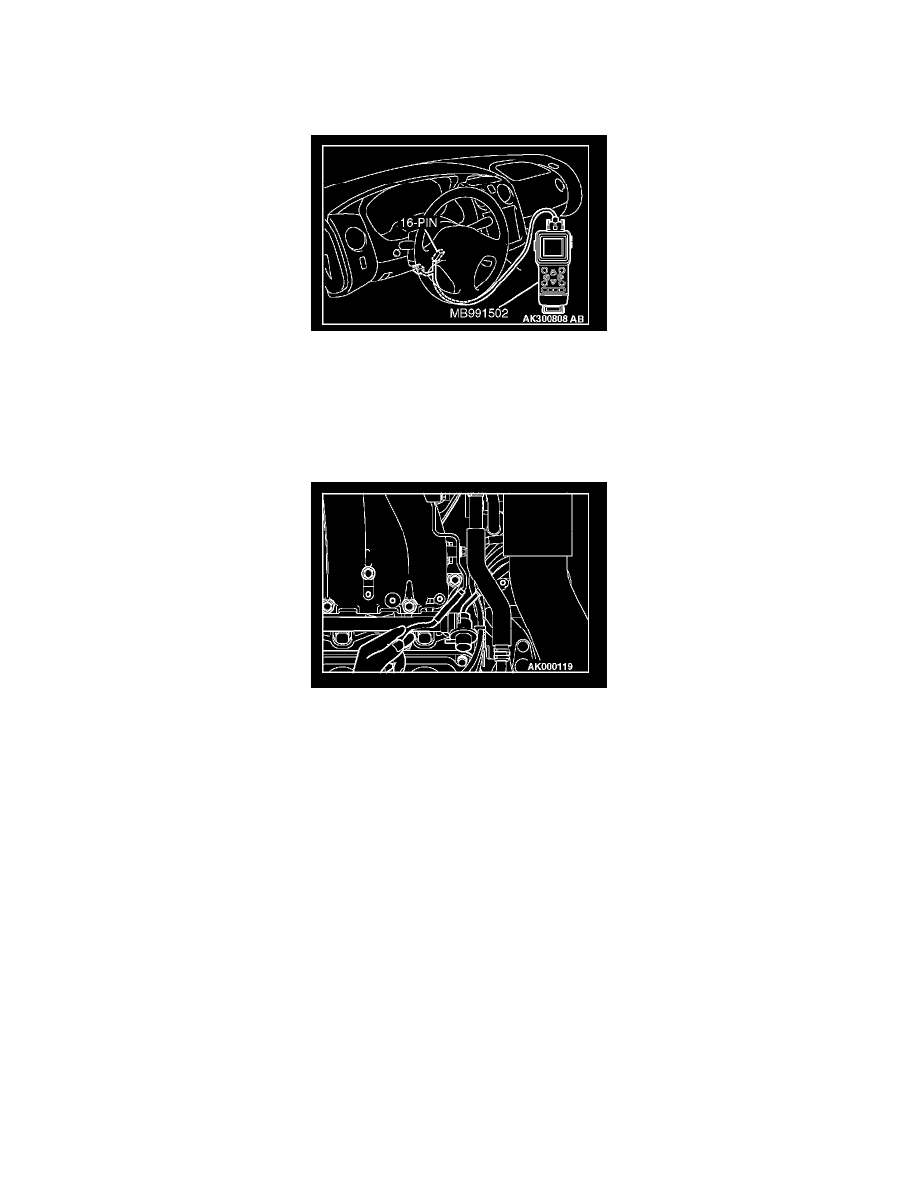
4. Connect scan tool MB991502 to the data link connector.
5. Use Actuator test 07 to drive the fuel pump. Check that there is no fuel leaking from any section when the fuel pump is operating.
6. Stop the fuel pump.
7. Start the engine and run at idle.
8. Measure fuel pressure while the engine is running at idle.
Standard value: Approximately 270 kPa (79.7 in.Hg) at curb idle
9
Disconnect the vacuum hose (blue stripe) from the fuel pressure regulator and measure fuel pressure with the hose end closed with your finger.
Standard value: 330 - 350 kPa (97.5 - 103 in.Hg) at curb idle
10. Check to see that fuel pressure at idle does not drop even after the engine has been revved several times.
11. Revving the engine repeatedly, hold the fuel return hose lightly with your fingers to feel that fuel pressure is present in the return hose.
NOTE: If the fuel flow rate is low, there will be no fuel pressure in the return hose.
12. If any of fuel pressure measured in steps 8 to 11 is out of specification, troubleshoot and repair according to the table below.