
Alignment: Specifications (page 5 of 6)
- Make
- Dodge
- Model
- SRT-4
- Engine
- L4-2.4L Turbo VIN S
- Year
- 2004
- Section
- Alignment
radius. As the vehicle encounters a turn, the outboard wheel must travel in a larger radius circle than the inboard wheel. The steering system is
designed to make each wheel follow its particular radius circle. To accomplish this, the front wheels must progressively toe outward as the steering is
turned from center. This eliminates tire scrubbing and undue tire wear when steering a vehicle through a turn.
DYNAMIC TOE PATTERN
Dynamic toe pattern is the inward and outward toe movement of the front and rear tires through the suspension's jounce and rebound travel. As the
vehicle's suspension moves up and down, the toe pattern varies. Toe pattern is critical in controlling the directional stability of the vehicle while in
motion. Front and rear dynamic toe pattern is preset by the factory at the time the vehicle is assembled.
It is not necessary to check or adjust front or rear dynamic toe pattern when doing a normal wheel alignment. The only time dynamic toe pattern needs
to be checked or adjusted is if the frame of the vehicle has been damaged.
STEERING AXIS INCLINATION (S. A. I.)
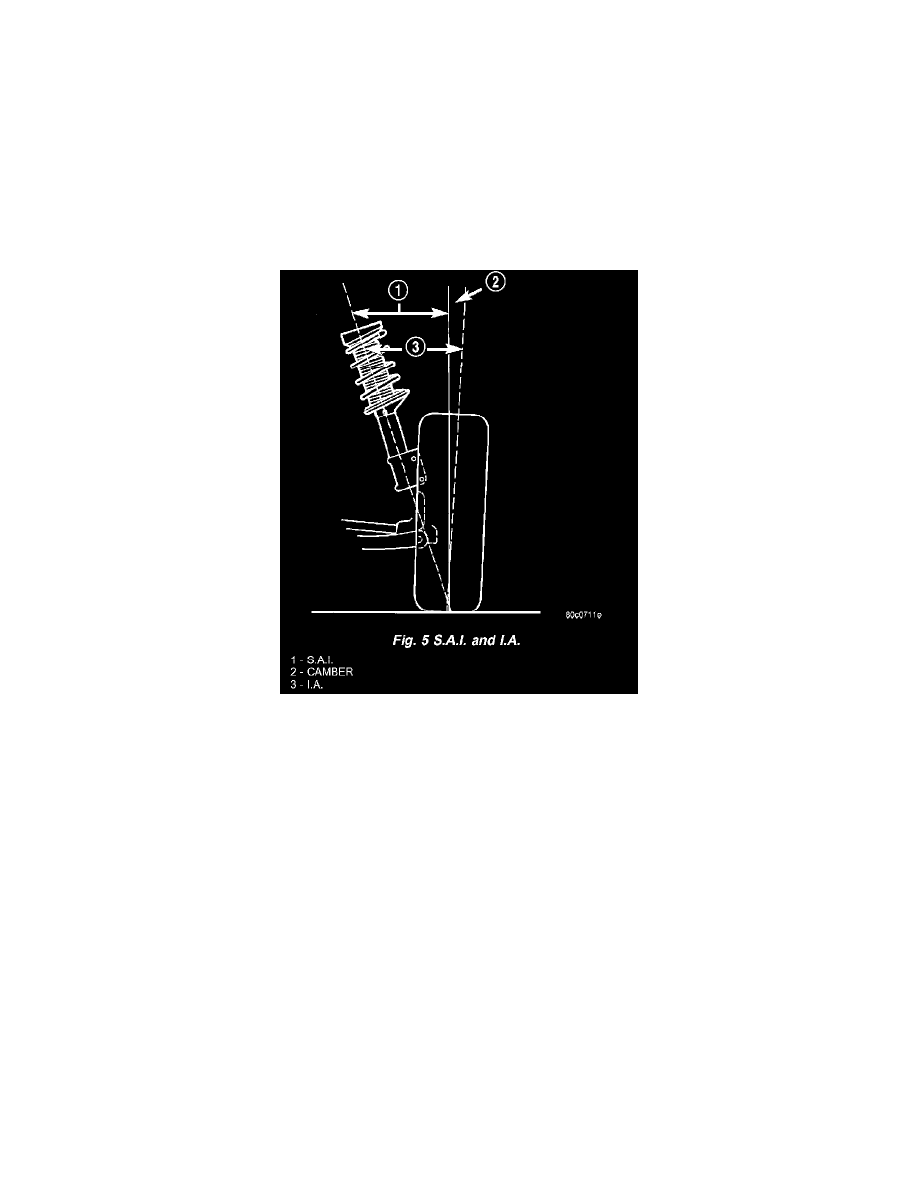
Steering axis inclination is the angle between a true vertical line starting at the center of the tire at the road contact point and a line drawn through the
center of the upper ball joint (or strut) and the lower ball joint (Fig. 5). S.A.I. is built into the vehicle and is not an adjustable angle. If S.A.I. is not
within specifications, a bent or damaged suspension component may be the cause.
INCLUDED ANGLE (I. A.)
Included angle is the sum of the S.A.I. angle plus or minus the camber angle, depending on whether or not the wheel has positive or negative camber
(Fig. 5). If camber is positive, add the camber angle to the S.A.I. angle. If camber is negative, subtract the camber angle from the S.A.I. angle.
Included angle is not adjustable, but can be used to diagnose a frame misalignment or bent suspension component (spindle, strut).
THRUST ANGLE
Pinch or Ctrl + scroll to zoom. Double-tap to reset.
Parts & tools for this job For 2004 Dodge SRT-4 2.4L
- TOOLTie rod end toolSearch: tie rod end puller
- TOOLBall joint separatorSearch: ball joint separator
- FLUIDPower steering fluidSearch: Dodge power steering fluid
Links open Amazon search results in a new tab. As an Amazon Associate I earn from qualifying purchases.