
Electronic Throttle Control Module: Description and Operation (page 2 of 6)
- Make
- Ford
- Model
- E 250
- Engine
- V8-4.6L VIN W
- Year
- 2006
- Section
- Computers and Control Systems › Electronic Throttle Control Module
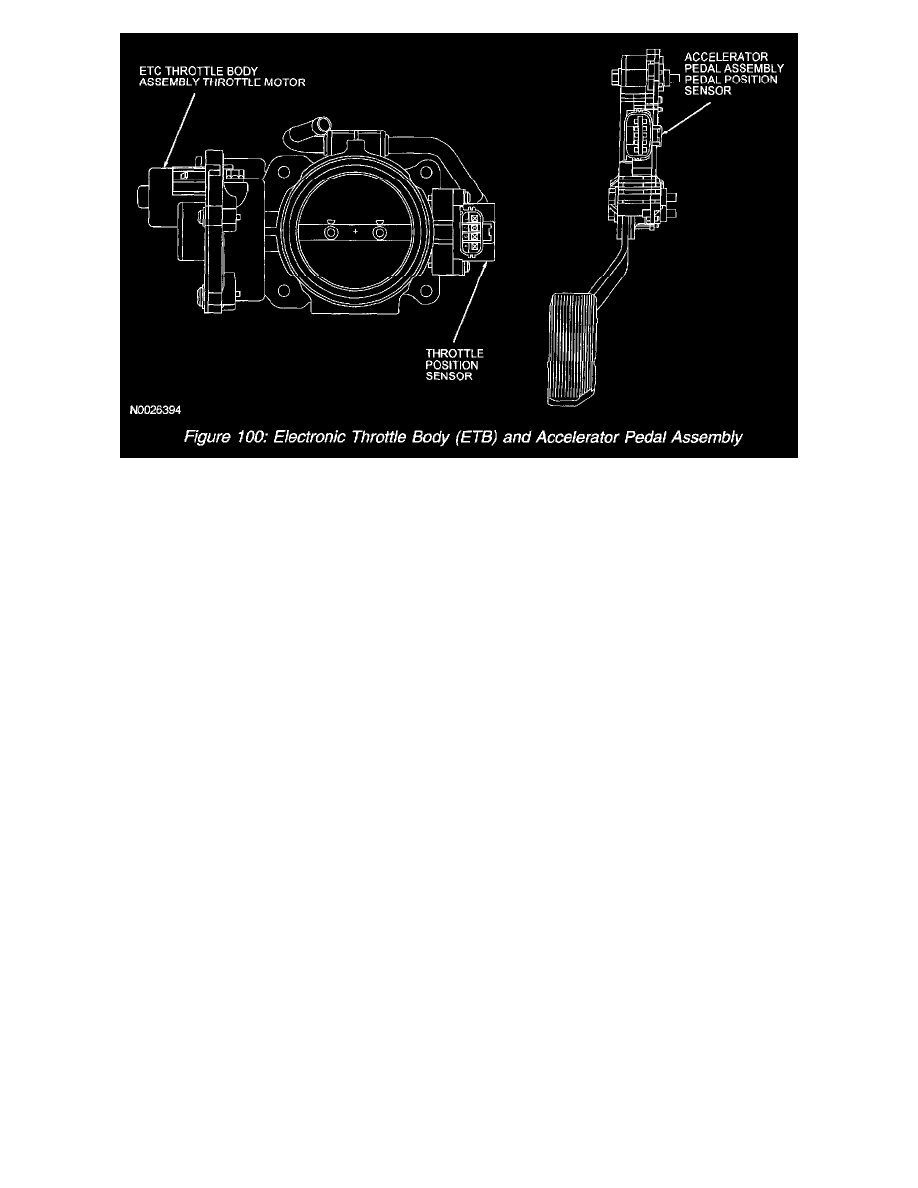
Electronic Throttle Body (ETB) And Accelerator Pedal Assembly
The ETC strategy uses pedal position sensors as an input to determine the driver demand.
1. There are 3 pedal position signals required for system monitoring. APP1 has a negative slope (increasing angle, decreasing voltage) and APP2 and
APP3 both have a positive slope (increasing angle, increasing voltage). During normal operation APP1 is used as the indication of pedal position
by the strategy.
2. There are 2 VREF circuits, 2 signal return circuits, and 3 signal circuits (a total of 7 circuits and pins) between the PCM and the APP sensor
assembly.
-
2 reference voltage circuits (5 volts)
-
2 signal return (ground) circuits
-
APP1 voltage with negative voltage slope (5-0 volts)
-
APP2 voltage with positive voltage slope (0-5 volts)
-
APP3 voltage with positive voltage slope (0-5 volts)
3. The pedal position signal is converted to pedal travel degrees (rotary angle) by the PCM. The software then converts these degrees to counts,
which is the input to the torque based strategy.
4. The 3 pedal position signals make sure the PCM receives a correct input even if 1 signal has a concern. The PCM determines if a signal is
incorrect by calculating where it should be, inferred from the other signals. A value is substituted for an incorrect signal if 2 of the 3 signals are
incorrect.
Electronic Throttle Control (ETC) System Strategy
Pinch or Ctrl + scroll to zoom. Double-tap to reset.
Parts & tools for this job For 2006 Ford E 250 4.6L
- TOOLOBD2 scannerSearch: OBD2 scanner
- TOOLDigital multimeterSearch: automotive digital multimeter
- TOOLBack-probe test leadsSearch: back probe test leads
Links open Amazon search results in a new tab. As an Amazon Associate I earn from qualifying purchases.