The Streetka is a two-seater cabriolet developed on the Ka production platform. The complete floor pan of the Ka serves as the basis for Streetka. In the front section, the side member with the wheelhouse and the crossmember with the hood lock panel have been taken over as such from the Ka, as have the rear section side member and the rear floor panel. All the other body components are specific to the Streetka.
Significant differences between the Streetka and the Ka in terms of the bodywork are shown in the comparative illustration:
Doors, door hinges and door sealing
The doors of the Streetka are frameless in the window area.
The door hinges are welded to the A-pillar and door.
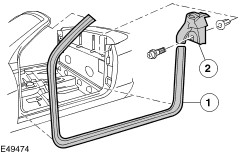
The weatherstrip (1) is attached to the body.
An end piece (2) connects the door sealing system to the convertible roof sealing system.
Door sealing
Front and rear bumpers and impact absorbers
The front and rear bumpers of the Streetka are painted in the vehicle body color and divided into three sections.
Inexpensive repair possibilities are achieved thanks to the individually replaceable bumper elements - left-hand fender cover, center section and right-hand fender cover. Bolted connections permit quick removal.
A two-piece foam impact absorber is integrated in the bumper between the bumper and the sheet-metal crossmember This absorbs the energy arising during minor impacts. Both impact absorbers are attached to the bumper by means of push fit fasteners.
NOTE:If no external damage to the impact absorbers (crash elements) is detected following impacts, these may be reused. Deformation and cracks should be checked for in particular during the visual inspection.
General design features
As, for functional reasons, a cabriolet body has a roof construction that is not integrated into the body structure, the floor pan and the A-pillars must be provided with additional reinforcements.
The A-pillars or the front roof frame have been reinforced primarily for reasons of passenger protection (vehicle rollover). Two rollover bars are firmly mounted to the bodywork behind the seats as a further passive safety feature.
The body has been reinforced in particular in the rocker panel area. The rocker panels in conjunction with the adjacent body assemblies form a reinforced box-type structure, preventing body weakness in the event of high stresses. These so-called composite connections provide a solid body pan structure.
General body reinforcement areas
1
-
A-, B-pillar and rocker panel
Steel panels
No high strength steel panels are used on the Streetka.
The high rigidity of the body is achieved by means of individual panel thicknesses of up to 2.5 mm and by special shaping of the statically important body panels and body components.
In the rocker panel area, this results in a total composite material thickness of up to 6 mm.
Panel layers and shaping in the rocker panel area
Corrosion prevention measures
Body components at risk of corrosion are zinc plated on both sides.
NOTE:During body repairs to zinc plated body panels, the instructions and working techniques contained in subsection 501-25A must be observed.
PVC coating
A permanently elastic PVC coating is applied to areas of the floor pan at risk of corrosion, protecting these in particular against mechanical influences such as stone chipping.
Wax injection
All the profiles of the floor pan as well as the cavities of pillars, rocker panels and frame side members are sealed with cavity wax.
NOTE:During body repairs, the repair-specific corrosion protection measures must be performed as described in lessons 2 to 4 of the Technician Information "Repairs after Accident Damage, Streetka, CG 8105".
Seam sealing and bonding
Joint areas of doors, hood and rear lid are adhesively bonded and sealed by means of clinched flange sealing.
Penetration of moisture is prevented thereby, significantly improving corrosion protection.
Plastic shields
Plastic shields in the front and rear wheelhouse areas protect the body panels from mechanical damage such as stone chipping.
Cabriolet-specific crash characteristics
Owing to the cabriolet construction (open design), the deformation paths arising during an impact are many times larger than the actual permanent deformations.
In the case of severe impacts to the front or rear end, deformations may even extensively deform the passenger cell with no recognizable permanent damage. This is referred to as a large compression characteristic.
Adjacent mechanical components may nevertheless be damaged owing to these deformations. The following should particularly be inspected:
- the doors
- the door hinges
- the lock pin and door guides
- the convertible roof linkage
NOTE:Visual and functional inspections of the doors and convertible roof must be performed during damage assessment.
Deformation paths during frontal and rear-end impacts
Fundamentals of damage assessment
During damage assessment, it must be ensured that the vehicle is standing on the wheels and loaded by the weight of the vehicle. Owing to the potential damage to the body structure, damage assessment on a vehicle hoist could falsify the results of the assessment.
If the Streetka is lifted with a vehicle hoist, the front end is lowered by 2 to 3 mm due to the weight of the vehicle.
The altered door position is clearly recognizable by stiffness of the lock; the door moves upwards. This causes the lock pin to contact the guide element of the door lock.
General repair information
Weight-bearing components can have a negative effect on strength of the entire body owing to deformation (buckling) (e.g. reinforcements in the underbody area, rocker panel).
NOTE:Accident repairs to a cabriolet with structural damage differs considerably in some respects from the conventional repair of closed vehicles:
- During straightening and repair work, a model-specific attachment set must always be used. Fastening with clamps in the rocker panel area is not always sufficient in the case of the cabriolet.
- In order to prevent damage to the doors, these must always be open during straightening work. In the case of more severe damage, tension and compression spindles must be used to stabilise the door cutouts (between the A- and B-pillars).
- In load-bearing areas such as the rocker panels, side members and floor pan, increased straightening forces are necessary due to the additional reinforcements.
- The relevant specifications and instructions outlined in subgroup 501-27 to 501-30 of the Repair Manual must always be observed prior to commencing the repair work.
Front-end deformation characteristics
In the event of a frontal impact up to approx. 4 km/h, the impact forces are absorbed by the bumper with the integrated foam impact absorbers. In the event of more severe damage, deformation is divided into 3 levels:
In the first level, damage is limited to the crossmember and perhaps the hood lock panel. These parts must be replaced completely. Depending on the damage, partial replacement is also possible.
Here, the crossmember, the hood lock panel and the front area of the side member are damaged. Partial replacement of the side member can be performed, the crossmember and the hood lock panel must be replaced completely.
Damage extending beyond level 2 requires complete replacement of the side member and the apron panel.
Front-end deformation levels
Rear-end deformation characteristics
In the event of a rear-end impact up to approx. 4 km/h, the impact forces are absorbed by the bumper with the integrated foam impact absorbers. In the event of more severe damage, deformation is divided into 3 levels:
Here, the back panel with reinforcement is damaged. These can also be replaced individually.
With the second level, the rear section of the rear floor panel and of the side member are damaged. Partial replacement of the rear floor panel and the side member can be performed, the back panel with reinforcement must be replaced. In the event of lateral rear-end impacts, the rear section of the quarter panel may be damaged. Partial replacement can also be performed here.
Damage extending beyond level 2 requires complete replacement of the side member and the rear floor panel.
Rear-end deformation levels