
Grand Cherokee 4WD V8-4.7L (2003)
Condenser HVAC: Service and Repair
REMOVAL
WARNING:
-
REVIEW THE WARNINGS AND CAUTIONS IN THE FRONT OF THIS SECTION BEFORE PERFORMING THE FOLLOWING
OPERATION.
-
REVIEW THE WARNINGS AND CAUTIONS IN THE FRONT OF THIS GROUP BEFORE PERFORMING THE FOLLOWING
OPERATION.
CAUTION: Before removing the condenser, note the location of each of the radiator and condenser air seals. These seals are used to direct air
through the condenser and radiator. The air seals must be reinstalled in their proper locations in order for the air conditioning and engine cooling
systems to perform as designed.
1. Disconnect and isolate the battery negative cable.
2. Recover the refrigerant from the refrigerant system.
3. Remove the screws attaching the grille and headlamp mounting module to the upper crossmember of the vehicle. Refer to Body for this and further
steps in the procedure.
4. Remove the headlamps from their mounts.
5. Remove the nuts that secure the hood latch and brace to the upper crossmember.
6. The radiator upper crossmember can be adjusted left or right through the use of its slotted mounting holes. Before removal, mark the original
position of the crossmember.
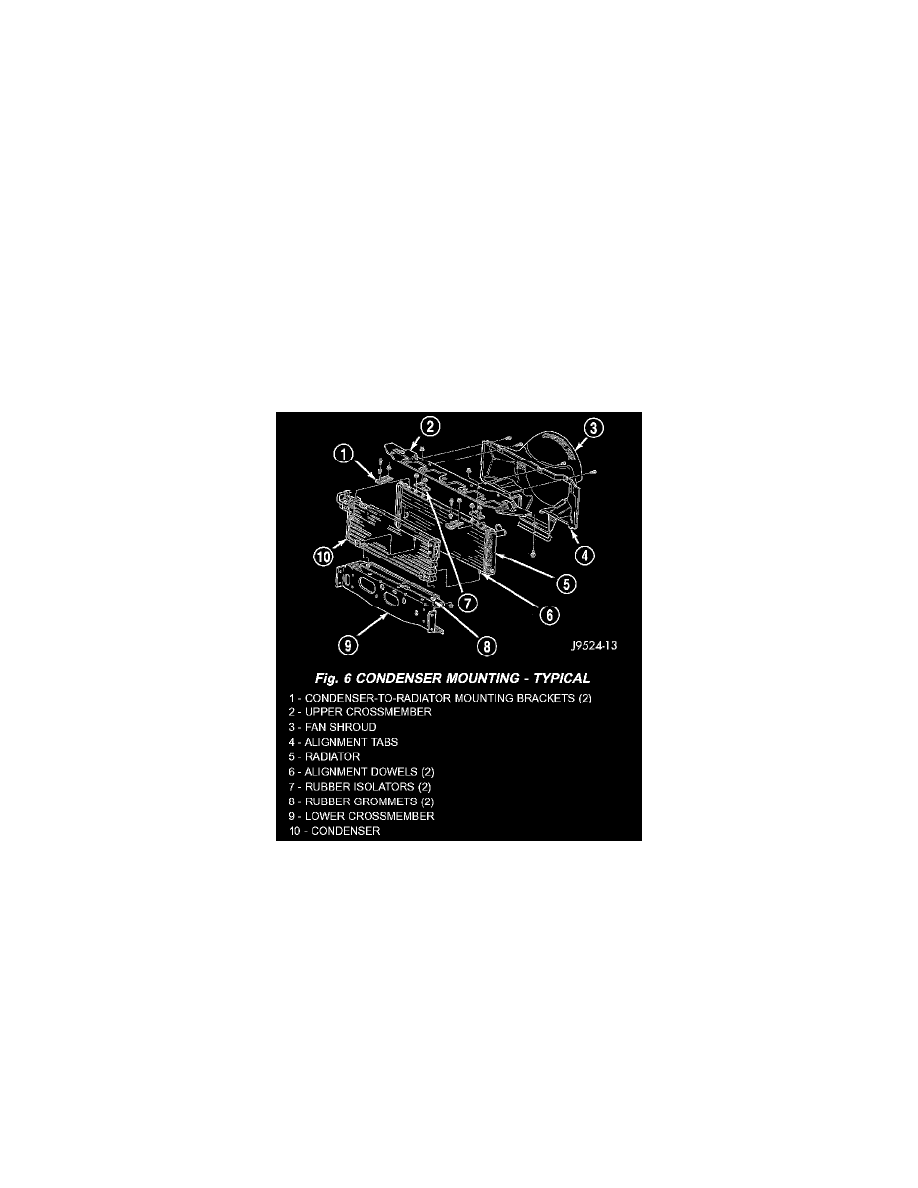
Fig.6 Condenser Mounting - Typical
7. Remove the bolts that secure the radiator to the upper crossmember and set it aside.
8. Remove the engine air filter inlet duct secured at the headlamp mounting module.
9. Remove the headlamp mounting module and front fascia for access to the condenser and fittings.
10. Disconnect the discharge line and liquid line refrigerant line fittings from the condenser. Install plugs in, or tape over all of the opened refrigerant
line fittings.
11. Remove the bolts that secure the upper condenser and transmission cooler.
12. Carefully lift the condenser out of the vehicle.
INSTALLATION
WARNING: REVIEW THE WARNINGS AND CAUTIONS IN THE FRONT OF THIS SECTION BEFORE PERFORMING THE
FOLLOWING OPERATION.
Any kinks or sharp bends in the refrigerant plumbing will reduce the capacity of the entire air conditioning system. Kinks and sharp bends reduce the
flow of refrigerant in the system. A good rule for the flexible hose refrigerant lines is to keep the radius of all bends at least ten times the diameter of