
Battery maintenance
- Make
- Land Rover
- Model
- Defender Technical Bulletins
- Section
- Battery maintenance › Battery maintenance
BATTERY MAINTENANCE
- Model
- New Range Rover Range Rover Classic Discovery Defender
- Affected vehicles
- All All All All
- Date
- 1995-05-10
- Reference
- 10/05/95
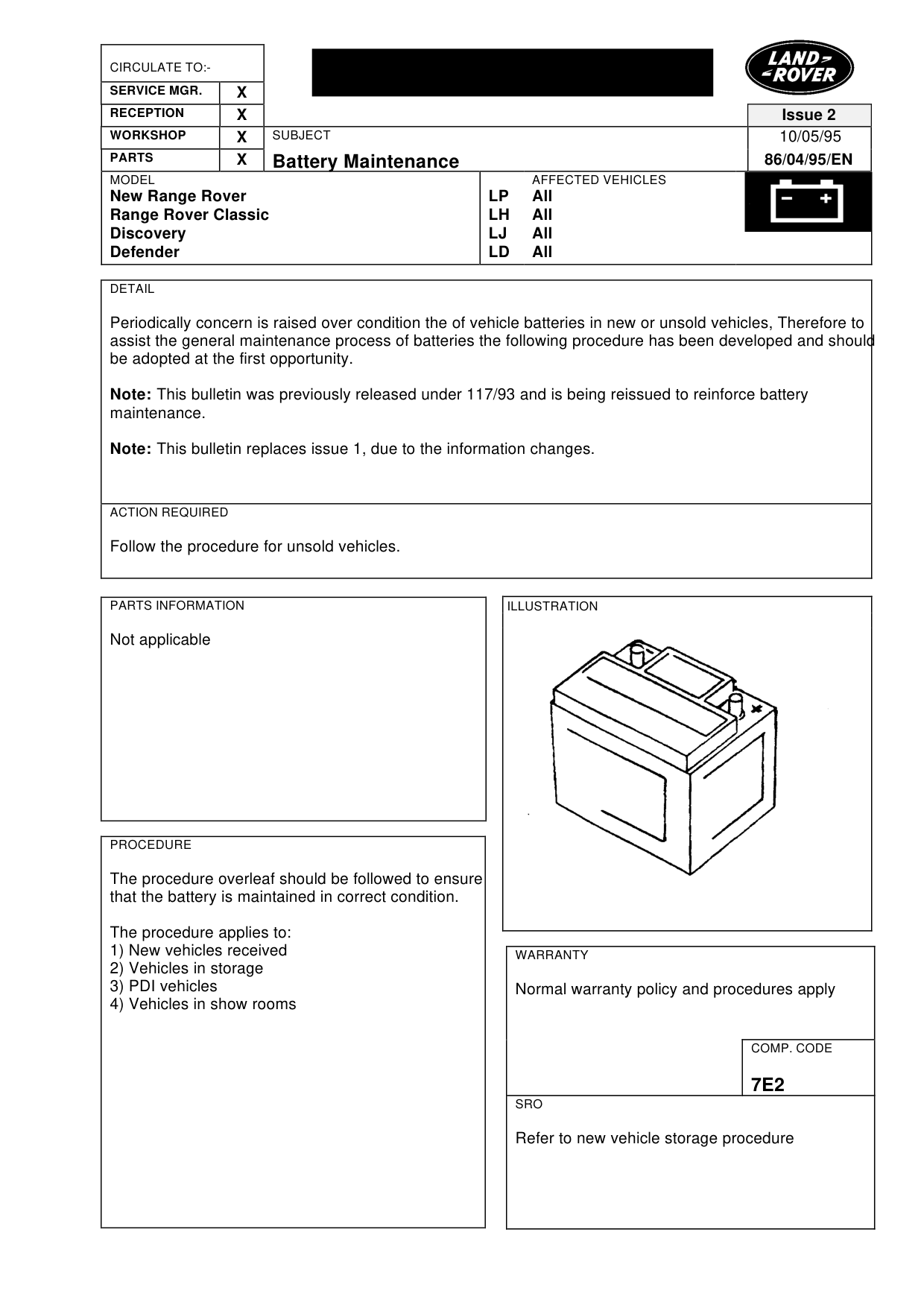
Bulletin text
Battery Maintenance
MODEL
New Range Rover Range Rover Classic Discovery Defender
DETAIL
Periodically concern is raised over condition the of vehicle batteries in new or unsold vehicles, Therefore to assist the general maintenance process of batteries the following procedure has been developed and should be adopted at the first opportunity.
Note: This bulletin was previously released under 117/93 and is being reissued to reinforce battery maintenance.
Note: This bulletin replaces issue 1, due to the information changes.
ACTION REQUIRED
Follow the procedure for unsold vehicles.
PARTS INFORMATION
Not applicable
PROCEDURE
The procedure overleaf should be followed to ensure that the battery is maintained in correct condition.
The procedure applies to: 1) New vehicles received 2) Vehicles in storage 3) PDI vehicles 4) Vehicles in show rooms
Issue 2 10/05/95 86/04/95/EN
AFFECTED VEHICLES
LP All LH All LJ All LD All
WARRANTY
Normal warranty policy and procedures apply
COMP. CODE
7E2
SRO
Refer to new vehicle storage procedure
Battery Maintenance
MODEL
New Range Rover Range Rover Classic Discovery Defender
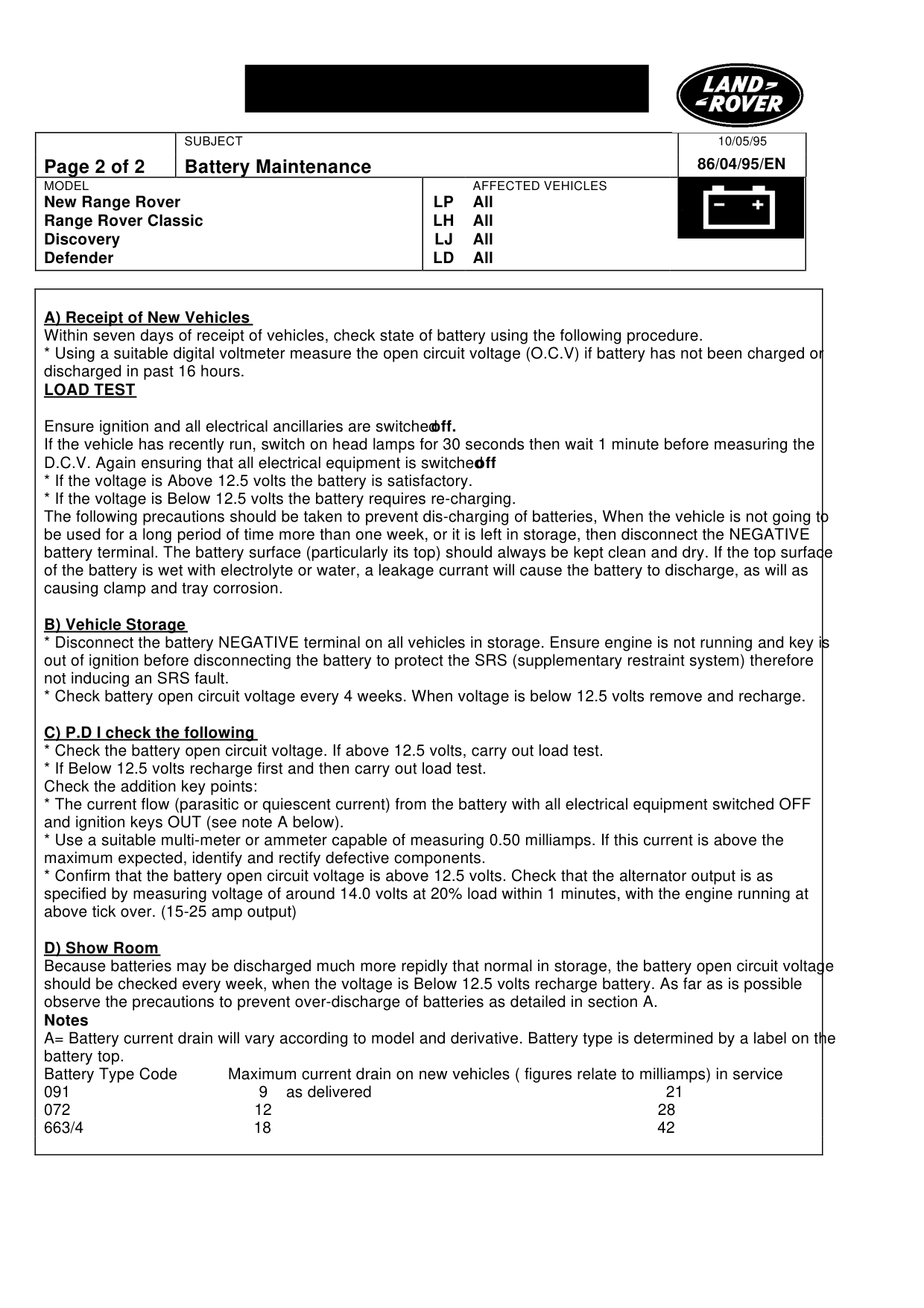
A) Receipt of New Vehicles Within seven days of receipt of vehicles, check state of battery using the following procedure. * Using a suitable digital voltmeter measure the open circuit voltage (O.C.V) if battery has not been charged or discharged in past 16 hours. LOAD TEST
Ensure ignition and all electrical ancillaries are switched off. If the vehicle has recently run, switch on head lamps for 30 seconds then wait 1 minute before measuring the D.C.V. Again ensuring that all electrical equipment is switched off * If the voltage is Above 12.5 volts the battery is satisfactory. * If the voltage is Below 12.5 volts the battery requires re-charging. The following precautions should be taken to prevent dis-charging of batteries, When the vehicle is not going to be used for a long period of time more than one week, or it is left in storage, then disconnect the NEGATIVE battery terminal. The battery surface (particularly its top) should always be kept clean and dry. If the top surface of the battery is wet with electrolyte or water, a leakage currant will cause the battery to discharge, as will as causing clamp and tray corrosion.
B) Vehicle Storage * Disconnect the battery NEGATIVE terminal on all vehicles in storage. Ensure engine is not running and key is out of ignition before disconnecting the battery to protect the SRS (supplementary restraint system) therefore not inducing an SRS fault. * Check battery open circuit voltage every 4 weeks. When voltage is below 12.5 volts remove and recharge.
C) P.D I check the following * Check the battery open circuit voltage. If above 12.5 volts, carry out load test. * If Below 12.5 volts recharge first and then carry out load test. Check the addition key points: * The current flow (parasitic or quiescent current) from the battery with all electrical equipment switched OFF and ignition keys OUT (see note A below). * Use a suitable multi-meter or ammeter capable of measuring 0.50 milliamps. If this current is above the maximum expected, identify and rectify defective components. * Confirm that the battery open circuit voltage is above 12.5 volts. Check that the alternator output is as specified by measuring voltage of around 14.0 volts at 20% load within 1 minutes, with the engine running at above tick over. (15-25 amp output)
D) Show Room Because batteries may be discharged much more repidly that normal in storage, the battery open circuit voltage should be checked every week, when the voltage is Below 12.5 volts recharge battery. As far as is possible observe the precautions to prevent over-discharge of batteries as detailed in section A. Notes A= Battery current drain will vary according to model and derivative. Battery type is determined by a label on the battery top. Battery Type Code Maximum current drain on new vehicles ( figures relate to milliamps) in service 091 9 as delivered 21 072 12 28 663/4 18 42
10/05/95 86/04/95/EN
AFFECTED VEHICLES
LP All LH All LJ All LD All
Parts & tools for this job For Land Rover Defender
- PARTOil filterSearch: Land Rover Defender oil filter
- TOOLOil filter wrenchSearch: oil filter wrench
- FLUIDEngine oilSearch: Land Rover Defender engine oil
Links open Amazon search results in a new tab. As an Amazon Associate I earn from qualifying purchases.