
Clicking noise from rear axle
- Make
- Land Rover
- Model
- Discovery II Technical Bulletins
- Section
- Clicking noise from rear axle › Clicking noise from rear axle
CLICKING NOISE FROM REAR AXLE
- Model
- Range Rover Discovery Series II
- Affected vehicles
- Hub/Axle shaft Differential Pinion Flange All Range Rover up to VIN: YA 434637 YA 435750 All Discovery II (System 2) up to VIN: Introduced at Job 1 YA 260194 All Discovery II (System 1) in VIN range: Introduced at Job 1 XA 900000 to XA 907212 RE - ISSUE INFORMATION: AFFECTED RANGE and WARRANTY CLAIMS amended, Loctite 640 deleted, Differential Pinion Flange information and Discovery Series II details added. Please destroy your existing copy and replace with this Issue 2.
- Date
- 2000-04-26
- Reference
- Bulletin 0001, CDS ref L8431bu
Bulletin text
Range Rover Discovery Series II
AFFECTED RANGE:
All Range Rover up to VIN:
All Discovery II (System 2) up to VIN:
All Discovery II (System 1) in VIN range:
RE - ISSUE INFORMATION:
WARRANTY
AFFECTED RANGE and Differential Pinion Flange information and Discovery Series II details added. Please destroy your existing copy and replace with this Issue 2.
PROBLEM:
CLICKING NOISE FROM REAR AXLE When pulling away from rest in either direction, a clicking noise may be heard from the rear of the vehicle.
CAUSE:
Excessive spline movement on either: a) The rear axle shaft to hub spline, (Range Rover). b) The rear differential flange to pinion spline, (Range Rover and Discovery II).
ACTION:
At the above VINs, the application of Loctite to the above spline locations was introduced during manufacture. In case of customer complaint on a vehicle within the affected range, apply Loctite • 648 to the axle shaft or pinion spline as detailed below. NOTE: Loctite 640, previously specified on Issue I of this bulletin, has been cancelled for use on vehicles in service due to its extended cure time. When reassembling rear hubs or rear diff flanges for any other reason, regardless • of VIN, apply Loctite 648 to splines as detailed below. NOTE: Loctite has been applied to Discovery II rear hub splines since the introduction of the model. Should a Discovery II rear hub be dismantled for any reason, regardless of VIN, Loctite 648 should be used on reassembly as detailed below.
Bulletin N o : 0001 L8431bu 2 26.04.2000
Hub/Axle shaft Differential Pinion Flange YA 434637 YA 435750 Introduced at YA 260194 Job 1 Introduced at XA 900000 to XA 907212 Job 1
CLAIMS amended, Loctite 640 deleted,
Clicking noise from rear axle shaft to hub spline:
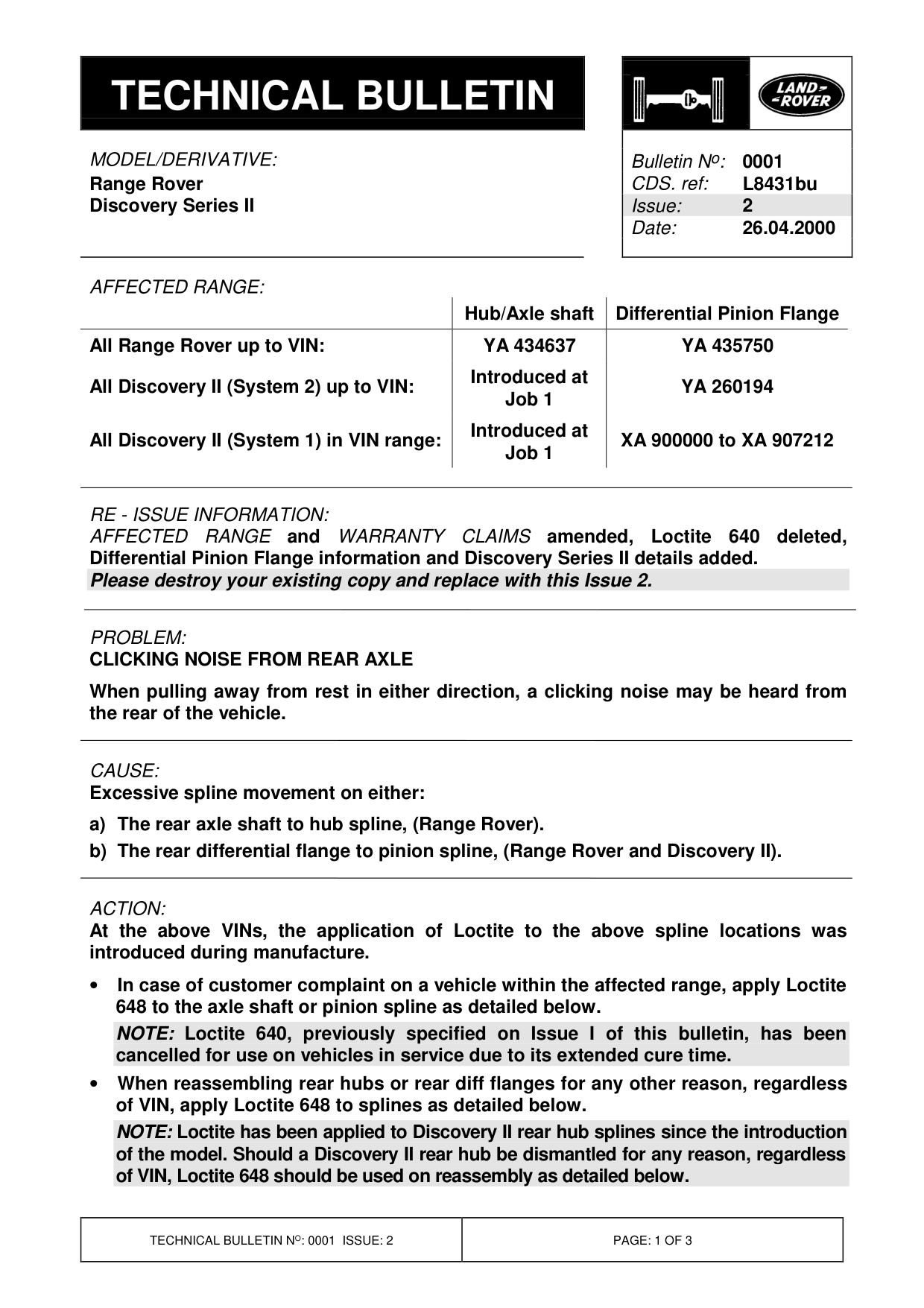
Refer to Workshop Manual repair number 64.15.01 for the repair procedure, noting the following: Carefully remove the hub and shaft assembly from the axle case to avoid damage • to the oil seal. With axle shaft removed from hub, thoroughly clean and degrease the shaft and • flange spline. NOTE: Ensure that from this stage the repair can be completed without delay so that work is completed within Loctite 648 cure time. Apply Loctite 648 to the shaft spline ensuring that only the spline area is coated, • (‘A’ in illustration). Reassemble the hub • and shaft and fit a new stake nut. Tighten the stake nut • to an initial torque of 100 Nm. Carefully refit hub and • shaft assembly to axle case avoiding damage to oil seal. When the vehicle has been lowered onto road wheels, tighten the stake nut to the • full torque of 340 Nm and stake the nut. Allow 2 hours for the Loctite to cure before driving vehicle. •
Clicking noise from rear differential flange to pinion spline:
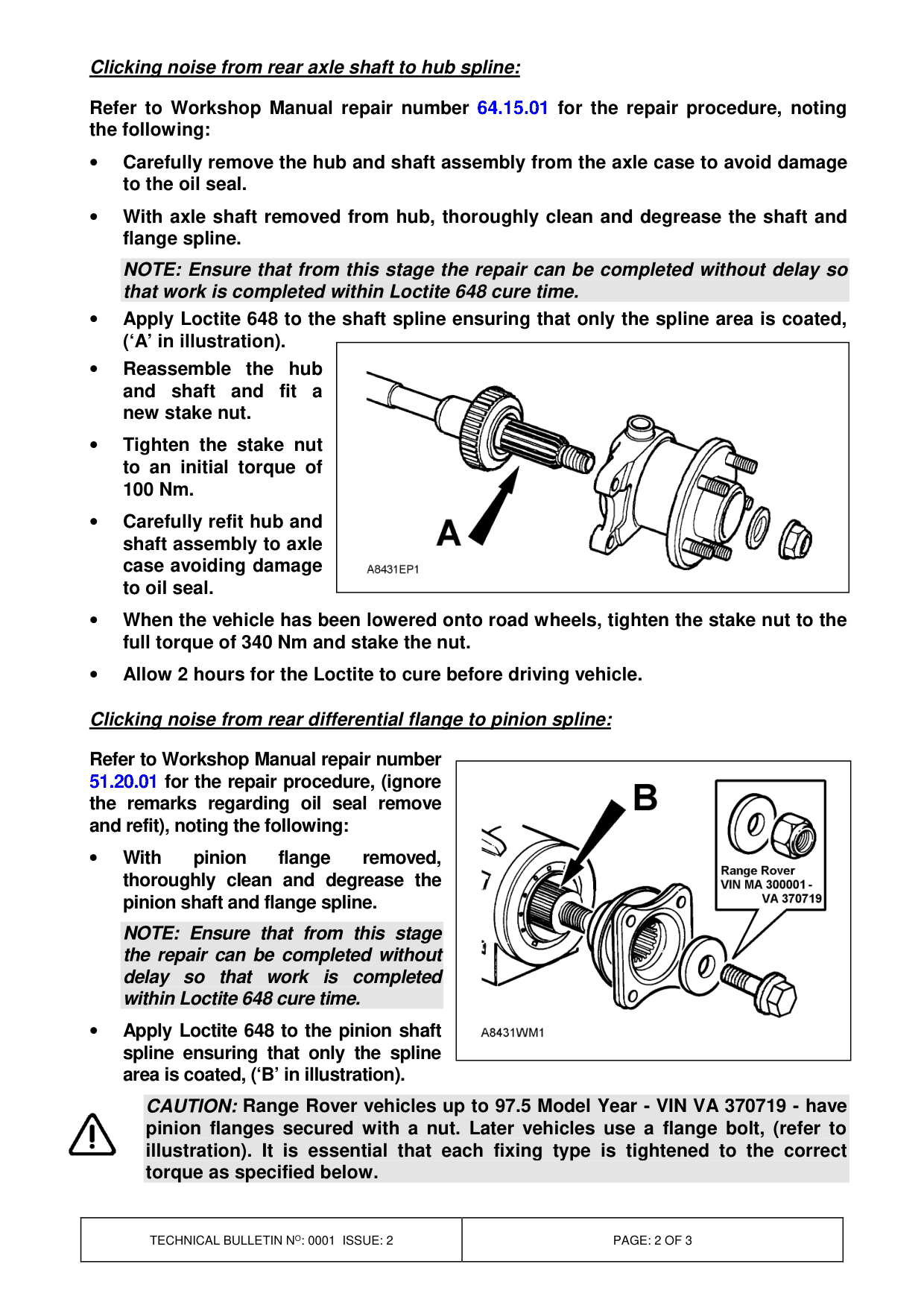
Refer to Workshop Manual repair number 51.20.01 for the repair procedure, (ignore the remarks regarding oil seal remove and refit), noting the following: With pinion flange removed, • thoroughly clean and degrease the pinion shaft and flange spline. NOTE: Ensure that from this stage the repair can be completed without delay so that work is completed within Loctite 648 cure time. Apply Loctite 648 to the pinion shaft • spline ensuring that only the spline area is coated, (‘B’ in illustration). CAUTION: Range Rover vehicles up to 97.5 Model Year - VIN VA 370719 - have pinion flanges secured with a nut. Later vehicles use a flange bolt, (refer to illustration). It is essential that each fixing type is tightened to the correct torque as specified below.
Refit pinion flange and tighten bolt to 100Nm. • If flange is secured with a nut, refit flange and tighten nut to 135Nm. Allow 2 hours for the Loctite to cure before driving vehicle. •
PARTS INFORMATION:
CDU1534L - Stake nut - 1 per rear hub NY116041L - Nyloc nut - rear differential flange - if required FS112301P - Bolt - rear differential flange - if required Loctite 648 - Locally sourced
WARRANTY CLAIMS: Apply Loctite 648 to rear axle shaft spline - Range Rover only:
Use Complaint Code: 4L5G Use S.R.O.: 64.15.01 - Rear hub renew - each side
Apply Loctite 648 to rear differential pinion spline:
Use Complaint Code: 4R6G Use S.R.O.: 51.15.36 - Differential flange renew
Refer to the Repair Operation Times Manual for the model in question for individual repair times.
Parts & tools for this job For Land Rover Discovery
- PARTRear wheel bearingSearch: Land Rover Discovery rear wheel bearing
- TOOLBearing puller kitSearch: wheel bearing puller kit
- PARTCV boot kitSearch: Land Rover Discovery cv boot kit
Links open Amazon search results in a new tab. As an Amazon Associate I earn from qualifying purchases.