
Exhaust valve burnt - oil contamination
- Make
- Land Rover
- Model
- Freelander Technical Bulletins
- Section
- Exhaust valve burnt - oil contamination › Exhaust valve burnt - oil contamination
EXHAUST VALVE BURNT - OIL CONTAMINATION
- Model
- Freelander 1.8
- Affected vehicles
- All vehicles with K series petrol engines
- Date
- 1999-02-17
- Reference
- Bulletin 0014, CDS ref L8500bu
Bulletin text
Freelander 1.8
AFFECTED RANGE:
All vehicles with K series petrol engines
PROBLEM:
EXHAUST VALVE BURNT - OIL CONTAMINATION
Any of the following symptoms: • = Continuous misfire (hot or cold engine). • = Erratic idle / poor engine running. • = Lack of power.
CAUSE:
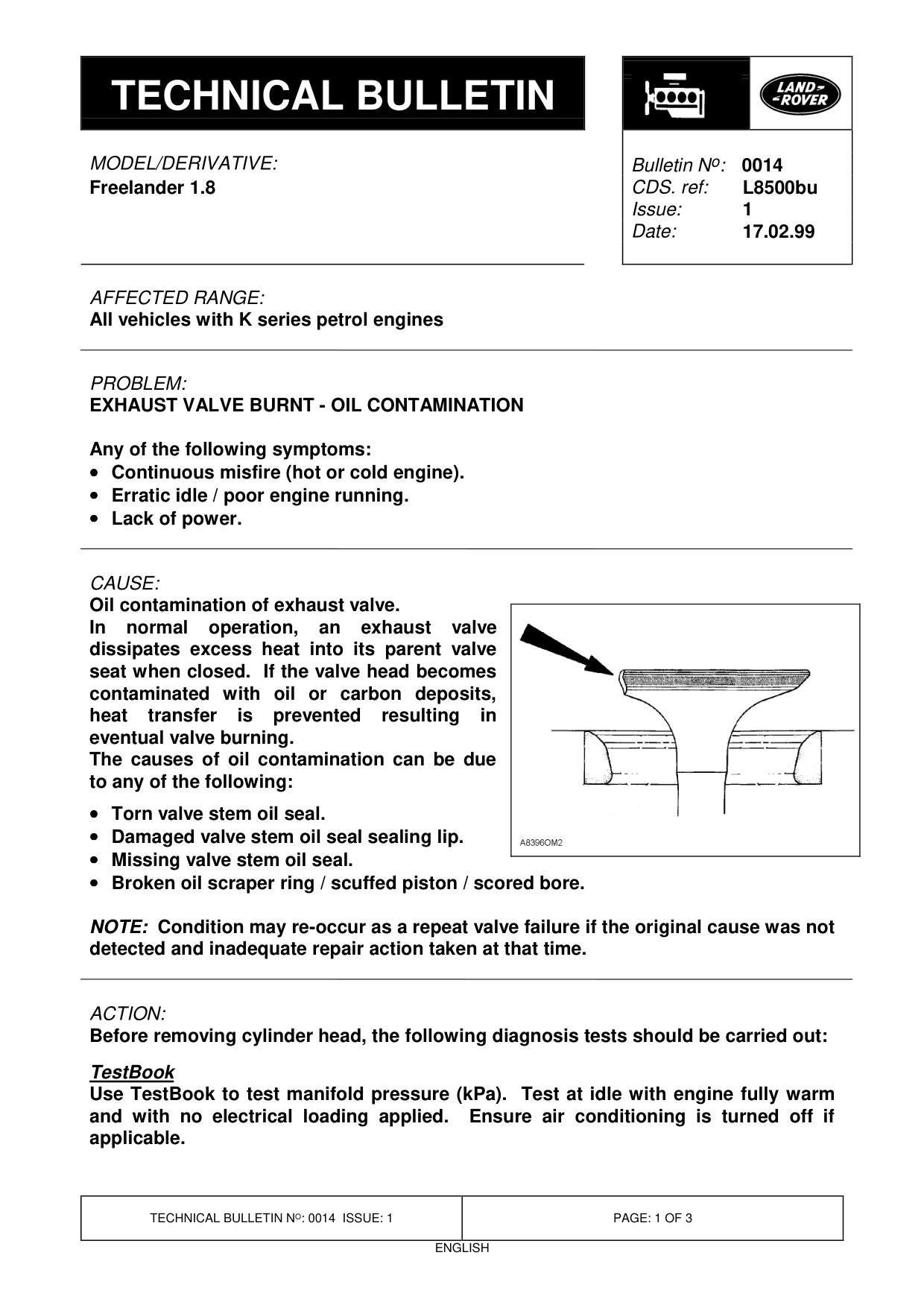
Oil contamination of exhaust valve. In normal operation, an exhaust dissipates excess heat into its parent valve seat when closed. If the valve head becomes contaminated with oil or carbon deposits, heat transfer is prevented resulting eventual valve burning. The causes of oil contamination can be due to any of the following: • = Torn valve stem oil seal. • = Damaged valve stem oil seal sealing lip. • = Missing valve stem oil seal. • = Broken oil scraper ring / scuffed piston / scored bore.
NOTE: Condition may re-occur as a repeat valve failure if the original cause was not detected and inadequate repair action taken at that time.
ACTION:
Before removing cylinder head, the following diagnosis tests should be carried out: TestBook Use TestBook to test manifold pressure (kPa). Test at idle with engine fully warm and with no electrical loading applied. applicable.
Bulletin N o : 0014 L8500bu 1 17.02.99
valve
in
Ensure air conditioning is turned off if
If result of test shows manifold pressure to be in excess of 45 kPa this may indicate poor valve sealing. If manifold pressure is less than 45 kPa, investigate further, i.e. check for ignition, fuel system faults etc.
Cylinder Leakage Test If cylinder leakage equipment is available, a greater degree of diagnostic accuracy can be achieved. Pressure test each cylinder in turn and record % leakage. If leakage is exceptional from any one cylinder, try to determine the source of leakage, i.e. listen for air escaping into inlet manifold, exhaust manifold or crankcase. Leakage into exhaust manifold indicates exhaust valve poor sealing. Preparation: Follow test equipment manufacturers instructions. Leakage results: • = less than 5% leakage indicates good valve / piston sealing. • = 5 to 10% leakage on all cylinders may indicate - general engine wear, multiple bent valves due to over-revving or previous timing belt problems. • = Over 10% leakage on single cylinder only, indicates poor sealing on this cylinder.
Compression Test If cylinder leakage equipment is unavailable check each cylinder compression in turn with a compression tester. Preparation: • = Ensure engine is hot. • = Crank engine for 6 seconds while testing each cylinder compression in turn. Test results: • = If one cylinder pressure is lower than the others by more than 20 psi, this may indicate poor sealing on this cylinder. • = If all pressures are low, i.e. less than 150 psi, this may indicate general engine wear, multiple bent valves due to over-revving or previous timing belt problems.
If above tests confirm leakage problems, remove cylinder head and investigate further.
Cylinder Head Inspection • = Inspect cylinder bores for signs of scuffing or piston and liner assemblies. • = Inspect cylinder head face around combustion chambers. gasket fire rings have made a deep impression on head face, then this may indicate previous overheating. If repair history confirms this, cylinder head replacement should be considered. • = If no obvious cause of oil contamination is apparent from the areas described above, remove all valves (inlet and exhaust) from the affected combustion chamber and inspect valve heads closely for evidence of oil contamination and burning. =
damage. If confirmed, renew
If the cylinder head
NOTE: Affected cylinder should have been determined following cylinder leakage / compression test. • = If when removed, a valve head shows no sign of burning, check that the valve stem is not bent. If it is, this will also result in poor valve sealing with similar symptoms. • = Look for likely causes of oil contamination, i.e. valve stem seals missing or damaged.
Cylinder Head Repair
• = REPLACE ANY EXHAUST VALVES WHICH ARE BURNT ALONG WITH THE ADJOINING VALVE OF THE SAME COMBUSTION CHAMBER.
• = GRIND IN NEW VALVES TO SEATS.
• = RENEW ALL INLET AND EXHAUST COMBUSTION CHAMBER.
Road test vehicle following repair to confirm engine running is acceptable.
PARTS INFORMATION:
LGH101190L - Exhaust valve (2 off required) LUB100350L - Valve stem seal (4 off required)
Refer to parts fiche / electronic parts reader for appropriate gasket sets
WARRANTY CLAIMS: Use Complaint Code: 1G4M Use S.R.O.: 18.90.40/01 Engine management system - diagnosis (TestBook manifold pressure check) Time allowance: 0.40Hrs Use S.R.O.: 12.25.01 Cylinder pressures / leakage - check Time allowance: 0.30Hrs Use S.R.O.: 12.29.59 Valve - one only - cylinder head - renew - includes reface seat & grind in valve Time allowance: 6.90Hrs Use S.R.O.: 12.29.59/01 Valve - extra each - cylinder head - renew - includes reface seat & grind in valve Time allowance: 0.20Hrs
VALVE STEM SEALS IN AFFECTED
Parts & tools for this job For Land Rover Freelander
- PARTExhaust gasketSearch: Land Rover Freelander exhaust gasket
- TOOLPenetrating oilSearch: penetrating oil
- TOOLOBD2 scannerSearch: OBD2 scanner
Links open Amazon search results in a new tab. As an Amazon Associate I earn from qualifying purchases.