
Electronic air suspension-re-calibration
- Make
- Land Rover
- Model
- Range Rover Classic Technical Bulletins
- Section
- Electronic air suspension-re-calibration › Electronic air suspension-re-calibration
ELECTRONIC AIR SUSPENSION-RE-CALIBRATION
- Model
- Range Rover
- Affected vehicles
- All Electronic Air Suspension Derivatives
- Date
- 1994-01-07
- Reference
- 07/01/94
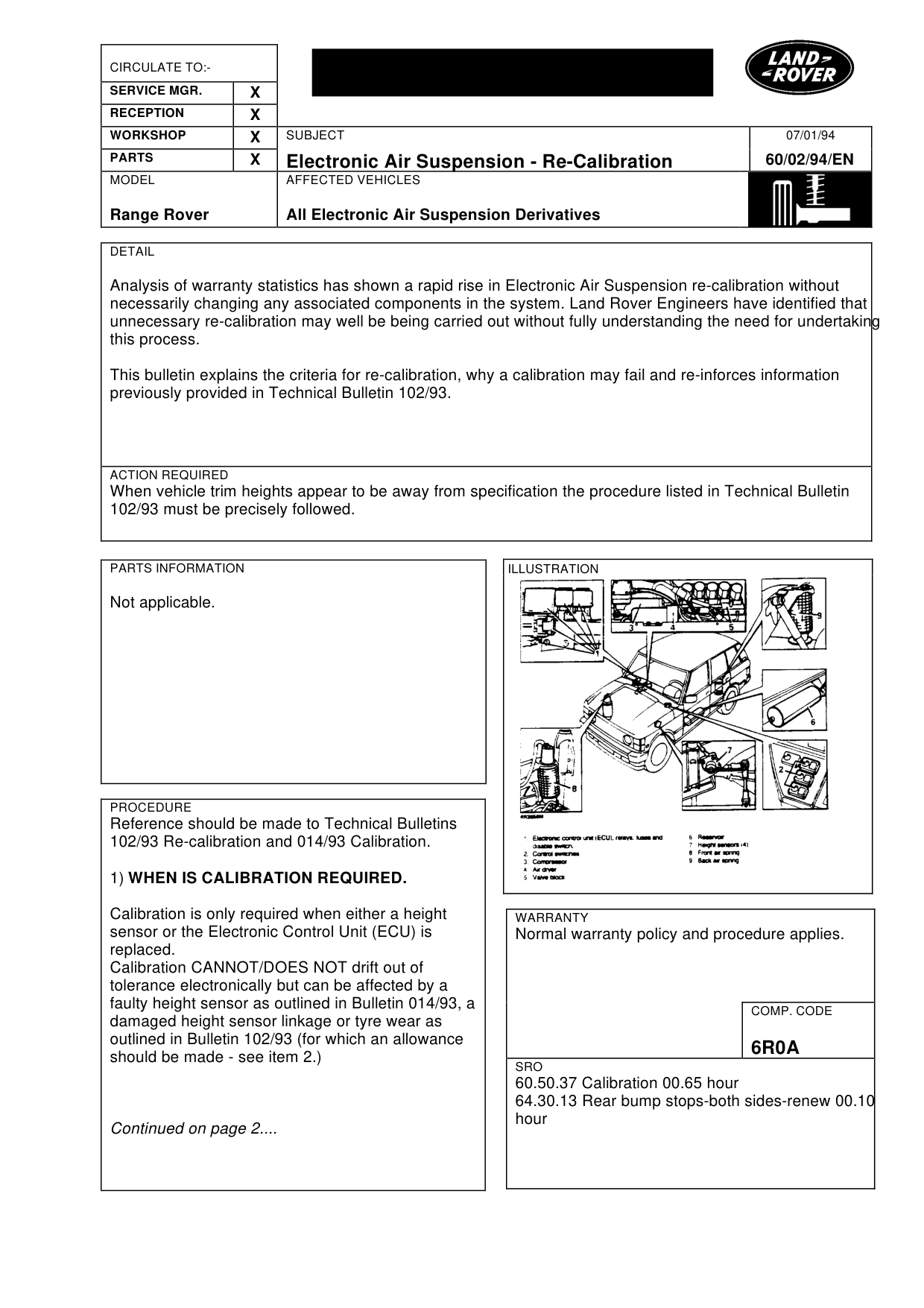
Bulletin text
Electronic Air Suspension - Re-Calibration
MODEL AFFECTED VEHICLES
Range Rover All Electronic Air Suspension Derivatives
DETAIL
Analysis of warranty statistics has shown a rapid rise in Electronic Air Suspension re-calibration without necessarily changing any associated components in the system. Land Rover Engineers have identified that unnecessary re-calibration may well be being carried out without fully understanding the need for undertaking this process.
This bulletin explains the criteria for re-calibration, why a calibration may fail and re-inforces information previously provided in Technical Bulletin 102/93.
ACTION REQUIRED
When vehicle trim heights appear to be away from specification the procedure listed in Technical Bulletin 102/93 must be precisely followed.
PARTS INFORMATION
Not applicable.
PROCEDURE
Reference should be made to Technical Bulletins 102/93 Re-calibration and 014/93 Calibration.
1) WHEN IS CALIBRATION REQUIRED.
Calibration is only required when either a height sensor or the Electronic Control Unit (ECU) is replaced. Calibration CANNOT/DOES NOT drift out of tolerance electronically but can be affected by a faulty height sensor as outlined in Bulletin 014/93, a damaged height sensor linkage or tyre wear as outlined in Bulletin 102/93 (for which an allowance should be made - see item 2.)
Continued on page 2....
07/01/94
60/02/94/EN
WARRANTY
Normal warranty policy and procedure applies.
COMP. CODE
6R0A
SRO
60.50.37 Calibration 00.65 hour 64.30.13 Rear bump stops-both sides-renew 00.10 hour
Electronic Air Suspension - Re-Calibration
MODEL AFFECTED VEHICLES
Range Rover All Electronic Air Suspension Derivatives
2) WHY THE CALIBRATION PROCEDURE LISTED IN BULLETIN 102/93 MUST BE USED.
a) The vehicle must be parked on a smooth level surface with wheels straight ahead to ensure that the vehicle can achieve as level an attitude as possible.
b) Tyre pressures should be correct and the vehicle unladen as these two items will affect tyre profile height.
c) Items 5 to 11 in Bulletin 102/93 are essential to establish if a vehicle requires calibration.
Important note: The wheel arch heights MUST NOT be measured with the engine off as in this condition the Air Suspension system does not level to the same accuracy and will be outside the target height of 790 +/- 7 mm specification.
Additionally all doors must be shut to allow the system to level the vehicle to the target heights.
d) Item 11 in Bulletin 102/93 refers to the effect of tyre wear. Tread depth on new tyres is 11mm if a vehicle has tyres that have worn ie: 4mm of remaining tread depth, an allowance of 7mm should be made. For example:
Measured height to wheel arch = 780 mm Tread depth allowance 11 - 4 = 7 mm Effective trim height 780 + 7 = 787 mm
THE VEHICLE SHOULD NOT BE CALIBRATED IN THIS CASE.
e) When a calibration is carried out care must be taken to ensure that Millimetres and NOT Centimetres are used. If centimetres are used the vehicle will adopt a 'Rear Up', 'Front Down' attitude and fail calibration.
07/01/94 60/02/94/EN
3) WHY A CALIBRATION MAY FAIL
a) Centimetres used instead of Millimetres. Trim heights should always be in the region of 700 - 900 mm.
b) The system is not upto pressure when calibration is commenced.
c) If a calibration procedure is aborted half way through, default heights will remain in the ECU, which may be out of specification. It is therefore important that the whole calibration procedure is completed.
d) If a calibration has been completed, and when 'access' height is selected the down warning light continues to flash, the following procedure must be carried out:
i) Remove both rear bump stops. ii) Calibrate using the procedure identified in Bulletin 102/93. iii) Refit the rear bump stops.
The vehicle should now achieve ' access' height with the down warning light permanently illuminated. The cause of a vehicle not acheiving the default 'access' height at the rear is attributable to a build up of tolerances resulting in bump stop intrusion. With the bump stops removed it allows the vehicle to reach the ECU default demand height which ultimately allows correct calibration to be acheived.
Parts & tools for this job For Land Rover Range Rover
- TOOLCoil spring compressorSearch: coil spring compressor
- TOOLBall joint separatorSearch: ball joint separator
- PARTShock absorbersSearch: Land Rover Range Rover shock absorbers
Links open Amazon search results in a new tab. As an Amazon Associate I earn from qualifying purchases.