
Town Car V8-4.6L VIN V Flex Fuel (2006)
Thermostat: Testing and Inspection
Thermostat - Coolant
A new coolant thermostat should be installed only after these electrical and mechanical tests have been carried out.
Thermostat - Electrical Test
NOTE: The electrical thermostat test is most accurate if carried out indoors at less than 37.8°C (100°F) ambient air. This test may be carried out
with or without the hood open and with the engine warm or cold.
1. Check the engine coolant level. Fill as needed.
2. With the ignition OFF, voltage values (0 - 5 V) may now be monitored while the sensor retains its connection to the wiring harness.
A diagnostic tool may be used to monitor the ECT on vehicles equipped with data link connector (DLC). The SBDS sequence to use for the screen
is: Toolbox-Electronic Engine Control and DCL-Item.
3. Place the transmission in PARK (P) or NEUTRAL(N).
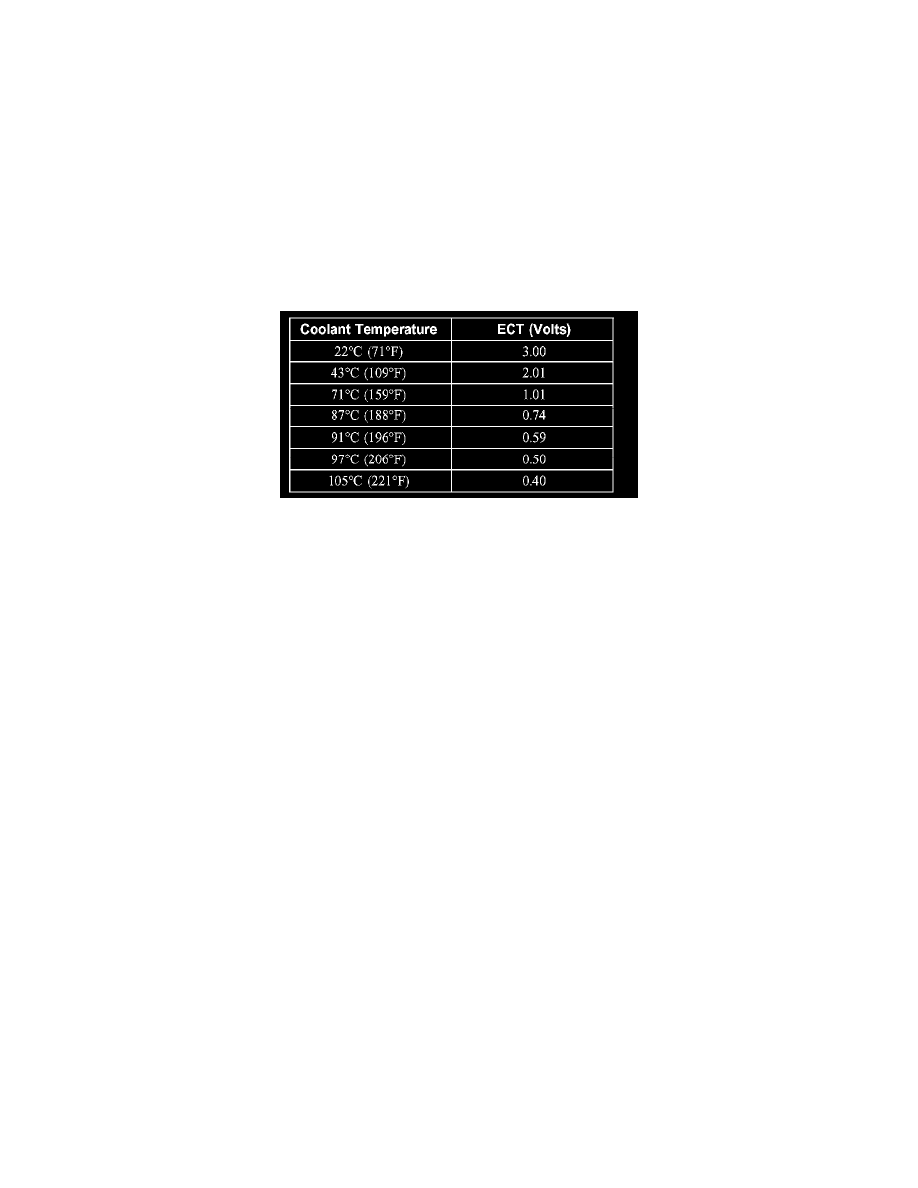
4. Start the engine and allow the engine to idle throughout this test. Allow the engine to run for 2 minutes, then record the ECT voltage. Record the
ECT voltage every 60 seconds. When the ECT voltage trend changes direction or only changes slightly (0.03 volt or less) from the previous
reading, record this as the thermostat opening voltage. Use the voltage and corresponding coolant temperature chart.
5. If the thermostat opening voltage is greater than 0.74 volt and less than 87°C (188°F), install a new water thermostat.
6. If the thermostat opening voltage is less than 0.74 volt and greater than 87°C (188°F), the thermostat is good and a new thermostat should not
be installed. GO to Symptom Chart for further instructions.
Thermostat - Mechanical Test
1. Remove the coolant thermostat.
2. Check the coolant thermostat for seating. Hold the coolant thermostat up to a lighted background. Leakage of light around the thermostat valve at
room temperature indicates that a new coolant thermostat should be installed. Some coolant thermostats have a small leakage notch at one location
on the perimeter of the thermostat valve, which is considered normal.
3. Immerse the coolant thermostat in a boiling antifreeze and water mixture.
4. Refer to Specifications for coolant thermostat opening temperatures.