
Alignment: Specifications (page 2 of 3)
- Make
- Plymouth
- Model
- Grand Voyager
- Engine
- V6-3.8L VIN L
- Year
- 1999
- Section
- Alignment
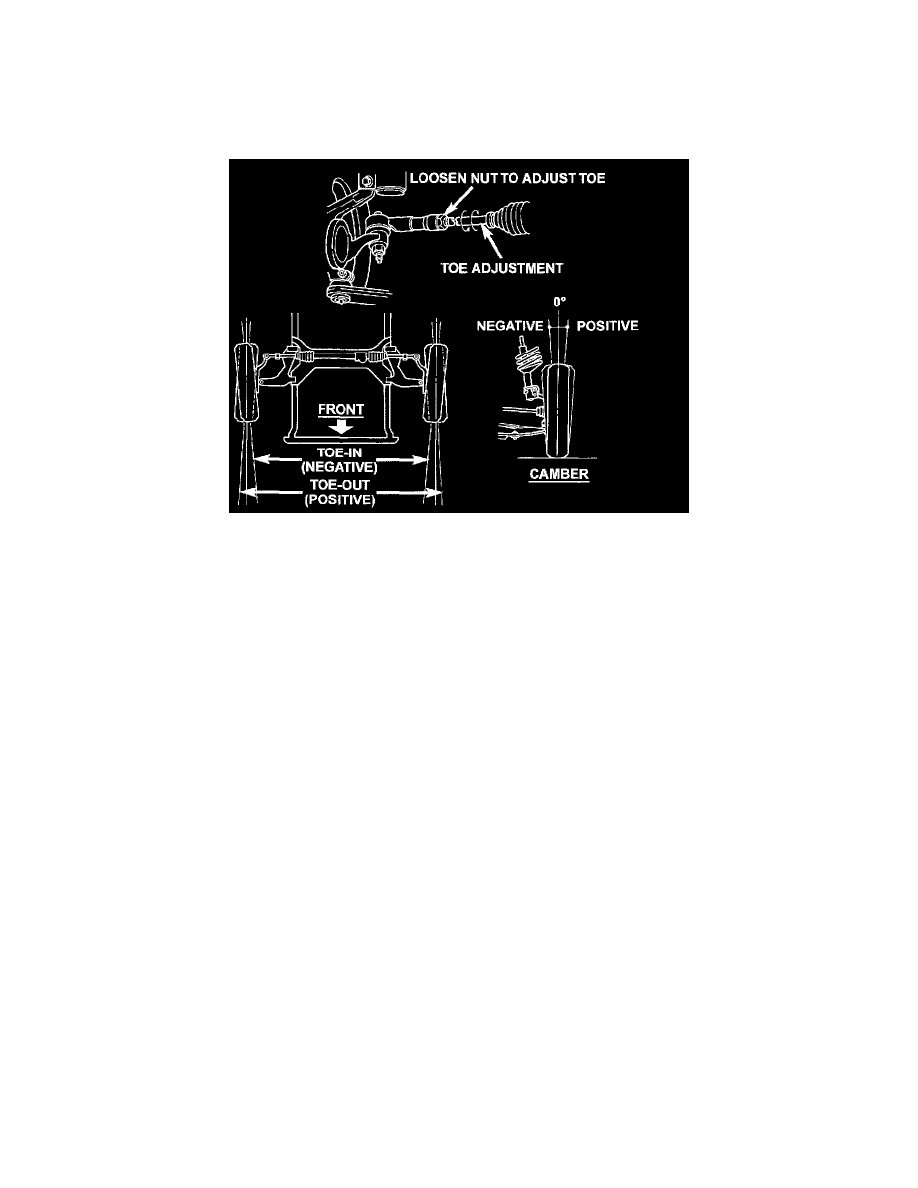
Alignment: Description and Operation
Vehicle wheel alignment is the proper adjustment of all interrelated front and rear suspension angles. These angles are what effects the handling and
steering of the vehicle when it is in motion. The method of checking a vehicle's front and rear wheel alignment will vary depending on the type and
manufacturer of the equipment being used. Instructions furnished by the manufacturer of the equipment being used should always be followed to
ensure accuracy of the alignment, except when alignment specifications recommended by Chrysler Corporation differ.
Typical wheel alignment angles and measurements are camber, caster, toe, and thrust angle.
Alignment Camber And Toe
-
Camber is the number of degrees the top of the tire and wheel are tilted either inward or outward. Camber is a tire wearing angle. Excessive
negative camber will cause tread wear at the inside of the tire, while excessive positive camber will cause outside tire wear.
-
Caster is the number of degrees of forward or rearward tilt of the steering knuckle. Forward tilt provides a negative caster angle, while rearward tilt
provides a positive caster angle. Caster is not adjustable on this vehicle.
-
Cross camber is the difference between left and right camber. The right side camber is to be subtracted from the left, resulting in the cross camber
reading. For example, if the left camber is +0.3° and the right camber is 0.0°, the cross camber would be +0.3°.
-
Toe is measured in degrees or inches and is the difference in width between the centered leading and trailing edges of the tires on the same axle.
Toe-in means that the front width is more narrow than the rear. Toe-out means that the front width is wider than the rear.
-
Thrust angle is defined as the average of the toe settings on each rear wheel. If this measurement is out of specification, readjust the rear wheel toe
so that each wheel has 1/2 of the total toe measurement. When readjusting, do not exceed the total toe specification.
Wheel alignment on this vehicle is to be checked and all alignment adjustments made with the vehicle at its curb height specification. Curb height is
the riding height of the vehicle measured from a certain point on the vehicle to the ground while the vehicle is setting on a flat, level surface.
Pinch or Ctrl + scroll to zoom. Double-tap to reset.
Parts & tools for this job For 1999 Plymouth Grand Voyager 3.8L
- TOOLTie rod end toolSearch: tie rod end puller
- TOOLBall joint separatorSearch: ball joint separator
- FLUIDPower steering fluidSearch: Plymouth power steering fluid
Links open Amazon search results in a new tab. As an Amazon Associate I earn from qualifying purchases.