
Alignment: Specifications (page 4 of 10)
- Make
- Saturn
- Model
- RELAY AWD
- Engine
- V6-3.5L VIN 8
- Year
- 2005
- Section
- Alignment
Lead/Pull Description
At a constant highway speed on a typical straight road, lead/pull is the amount of effort required at the steering wheel to maintain the vehicle's straight
path.
Lead/pull is usually caused by the following factors:
^
Tire construction
^
Wheel alignment
^
Unbalanced steering gear
The way in which a tire is built may produce lead/pull. The rear tires will not cause lead.
Torque Steer Description
A vehicle pulls or leads in one direction during hard acceleration. A vehicle pulls or leads in the other direction during deceleration.
The following factors may cause torque steer to be more apparent on a particular vehicle:
^
A slightly smaller diameter tire on the right front increases a right torque lead. Inspect the front tires for differences in the brand, the construction,
or the size. If the tires appear to be similar, change the front tires from side-to-side and retest the vehicle. Tire and wheel assemblies have the most
significant effect on torque steer correction.
^
A large difference in the right and left front tire pressure
^
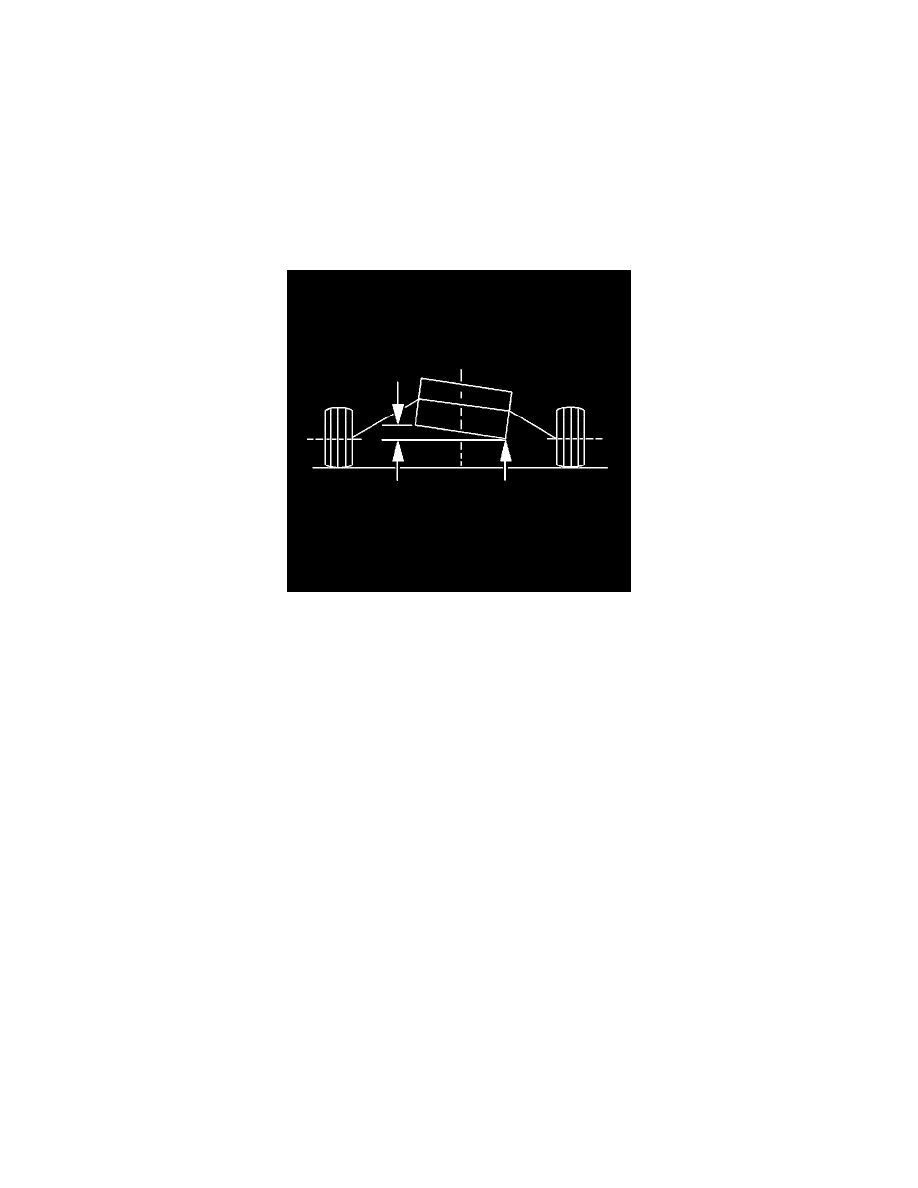
Left-to-right differences in the front view axle angle may cause significant steering pull in a vehicle. The pull will be to the side with the most
downward sloping axle from the differential to the wheels. Axles typically slope downward from the differential. The slope of the transaxle pan to
level ground may be used as an indication of bias axle angles. The side with the higher transaxle pan, shown on the left side of the illustration, has
the most downward sloping axle angle.
Memory Steer Description
Memory steer is when the vehicle wants to lead or pull in the direction the driver previously turned the vehicle. Additionally, after turning in the
opposite direction, the vehicle will want to lead or pull in that direction.
Wander Description
Wander is the undesired drifting or deviation of a vehicle to either side from a straight path with hand pressure on the steering wheel. Wander is a
symptom of the vehicle's sensitivity to external disturbances, such as road crown and crosswind, and accentuated by poor on-center steering feel.
Scrub Radius Description
Ideally, the scrub radius is as small as possible. Normally, the SAI angle and the centerline of the tire and the wheel intersect below the road surface,
causing a positive scrub radius. With struts, the SAI angle is much larger than the long arm/short arm type of suspension. This allows the SAI angle to
intersect the camber angle above the road surface, forming a negative scrub radius. The smaller the scrub radius, the better the directional stability.
Pinch or Ctrl + scroll to zoom. Double-tap to reset.
Parts & tools for this job For 2005 Saturn RELAY 3.5L
- TOOLTie rod end toolSearch: tie rod end puller
- TOOLBall joint separatorSearch: ball joint separator
- FLUIDPower steering fluidSearch: Saturn power steering fluid
Links open Amazon search results in a new tab. As an Amazon Associate I earn from qualifying purchases.