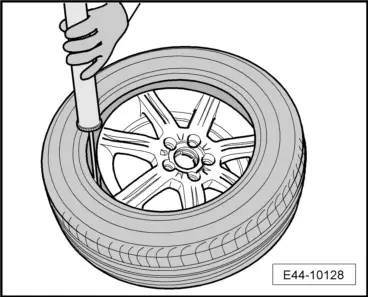
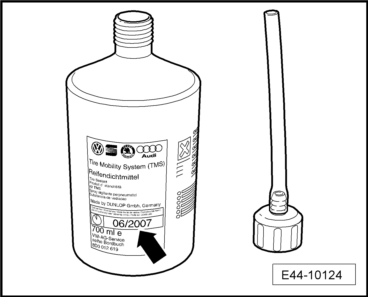
Tyres which have been filled with sealant or which are sealed should be emptied during removal.
DANGER!
t
Do not get tyre sealant near eyes and skin!
t
It is dangerous for health and may cause irritation to eyes and allergies.
t
Gloves and protective glasses should be worn while working.
–
Release the air from the tyres by unscrewing the valve.
–
Release the tyre bead in several places.
Caution
Do not use hydrocarbon based lubricants; these will damage the rubber of the tyre.
–
Lubricate the edge of the bead and the rim.
–
Rotate the entire unit and release the bead on the opposite side.
Note
t
If you are using tyre levers, first release the tyre on the side opposite the valves.
t
Use tyre levers with plastic protection for aluminium rims.
t
Do not use tyre levers in the zone -a-.
–
Set the taper head as near to the valve as possible so that the positioning of the lever about 30° -b- next to the valve is possible.
–
Begin rotating the wheel until the bead has been completely released on the opposite side of the valve.
–
Recover the remains of the sealant from the interior of the tyre using, for example, a syringe.
Note
The remains of the sealant liquid cannot be reused; they should be collected and given to centres specialised in the disposal of workshop waste material.
–
Lift the tyre and repeat the operation on the opposite bead.
–
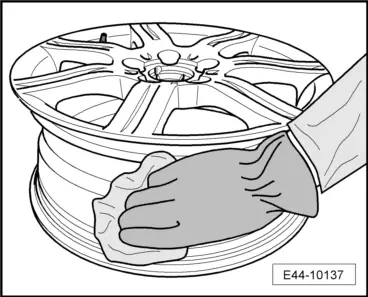
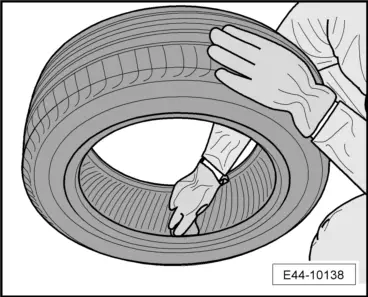
Clear the remains of liquid sealant from the rim and interior of the tyre with a lint-free cloth
–
Replace the air filling valve of the tyre → Chapter
The repair of a punctured tyre that has been repaired with liquid sealant is carried out the same way as for a conventional tyre.
 DANGER!
 Caution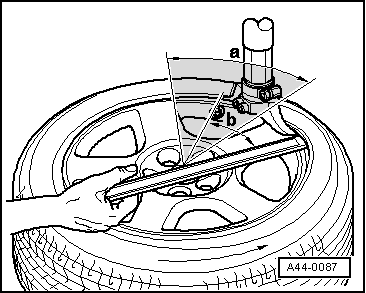
 Note
Note