Running gearRepairing rear brakes (disc brakes)
| Repairing rear brakes (disc brakes) |

Note | t
| Every time after changing pads, depress brake pedal firmly several times with vehicle stationary, so that brake pads are properly seated in their normal operating position. |
| t
| After work for which the brake system had to be opened, bleed the brake system with brake charge and bleed system -VAS 5234- or extraction unit -V.A.G 1869/4-. |
| t
| Before removing a brake caliper or disconnecting a brake hose, fit brake pedal depressor -V.A.G 1869/2- (when doing this, release pressure in system). |
|
|
|
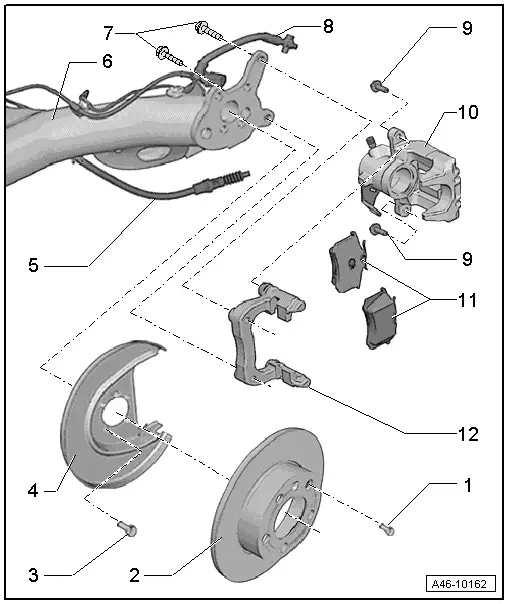
|
q
| Always renew on both sides of an axle. |
|
q
| Unscrew brake caliper prior to removing. |
|
q
| Never remove brake discs from wheel hub by force. If necessary use penetrating fluid, because otherwise brake discs can be damaged. |
| 7 - | Hexagon socket head bolt, 30 Nm and turn 30° further |
|
q
| With banjo bolt and seals |
|
q
| Specified torque of banjo bolt to brake caliper: 38 Nm |
|
q
| Do not disconnect brake hose when changing pads. |
| 9 - | Self-locking hexagon bolt, 35 Nm |
|
q
| Always renew after removing. |
|
q
| Wear limit: 2 mm not including backplate. |
|
q
| Always renew on both sides of an axle. |
| 12 - | Brake carrier with guide pins and protective cap |
|
q
| Supplied as genuine part, assembled with sufficient grease on guide pins. |
|
q
| If protective cap or guide pins are damaged, install set of repair components. Use lubricant sachet supplied to lubricate guide pins. |
01 Steering & suspension