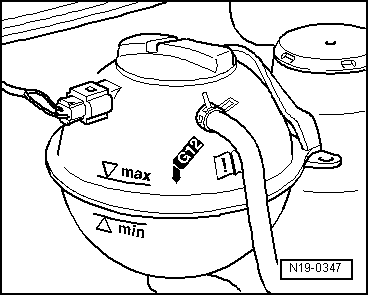
| –
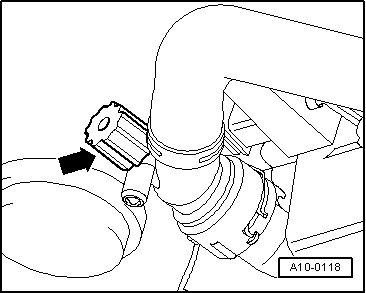
| To drain coolant from radiator, open drain plug -arrow-. |

Note | Observe environmental regulations for disposal. |

Caution | For mixing only tap water must be used. Well water does not have the required quality to ensure the coolant's function. |
|
Note | t
| In vehicles as of model year 2008, only G 12 plus-plus according to TL VW 774 G may be used as coolant additive. |
| t
| For vehicles up to and including model year 2007 coolant additive G 12 plus according to TL VW 774 F and G 12 plus-plus according to TL VW 774 G can be used. |
| t
| The coolant additive G 12 plus-plus can be mixed with the previous coolant additive G 12 plus. Identification: both are coloured purple. |
| t
| Coolant additives marked conforming to „TL VW 774 G“ or conforming to „TL VW 774 F“ prevent frost and corrosion damage, scaling and also raise boiling point of coolant. Therefore, the cooling system must be filled all year round with coolant additive and corrosion protection additive. |
| t
| Because of its higher boiling point, the coolant improves engine reliability under heavy loads, particularly in countries with tropical climates. |
| t
| Frost protection is required down to about -25 °C (in countries with arctic climates: down to about -35 °C). |
| t
| The coolant concentration must not be reduced by adding water even in warmer seasons and in warmer countries. The coolant additive concentration must be at least 40 %. |
| t
| If for climatic reasons greater frost protection is required, the amount of coolant additive can be increased, but only up to 60 % (frost protection to about -40 °C). Otherwise frost protection and cooling effectiveness are reduced again. |
| t
| If radiator, heat exchanger, cylinder head or cylinder head gasket is renewed, do not reuse old coolant. |
| Recommended mixture ratios: |
|
|
|

 WARNING