Description
- Make
- Alfa Romeo
- Model
- 155 Factory Service Manual
- Year
- 1992–1998
- Section
- Bodywork restoration and painting › Description
DESCRIPTION
The body has for the most part been designed following the finished element method. In this way a high degree of torsional rigidity is obtained which renders the geometry indeformable and ensures precision with regard to assembly tolerances and cancellation of noise and squeaking; the stresses are also reduced to within absolute safety limits.
As a further defense against corrosion the vehicle is almost entirely pre-treated by electrogalvanization. In addition, the following features further contribute to the prevention of corrosion:
- A reduction in the number of component parts forming the body and consequent reduction in the number of joints;
- An appreciable reduction in the number of welding points and, at the same time an increase in the ammount of spot welding carried out automatically;
- A reduction in the joints treated by seam welding to an overall length of only one metre. Seam welding is the form of welding which is most subject to imperfections;
- The integral sealing of the bodywork;
- Box-type components, located in covered areas have been fitted with ventilation holes to prevent the formation of condensation;
- Treatment of the underbody with PVC which protects, soundproofs and offers resistance to abrasion, is included in the painting cycle;
- The final body protection cycle involves the injection of wax- oil into most of the boxed parts.
The painting processes follow a particularly distinct cycle which include the following phases:
- Deoxidation;
- Degreasing;
- Phosphatization and passivation (bonderizing) with full body immersion;
- Cataphoresis;
- Oven drying;
- Application of sealants, PVC coating on underbody and wheelhousing etc.;
- Application of primer coating on external parts;
- Oven drying;
Application of primer paints and transparent enamel (which gives further protection and particular luster), in an automatic booth using the rotating cup system that ensures an even thickness of the coating.
BODYWORK RESTORATION AND PAINTING
The word "painting" means the operation of restoration carried out on a painted surface. When a surface is only partially affected, the operation is called "repainting". Depending on the type of repair work to be carried out the following repainting cycles have been defined:
- Painting of replaced fixed metal sheet;
- Painting of replaced mobile metal sheet;
- Repainting of flawed metal sheet;
- Repainting of metal sheet with surface defect;
- Restoration of metal sheet without painting: dent removal.
For repainting purposes it is important to define the term "panel". To clarify this concept the door depicted in the diagram has been taken as an example. The entire door is a panel but for reasons of convenience it can be subdivided into two areas: the upper area and the lower area. Area then, means a surface included between two delimitations.
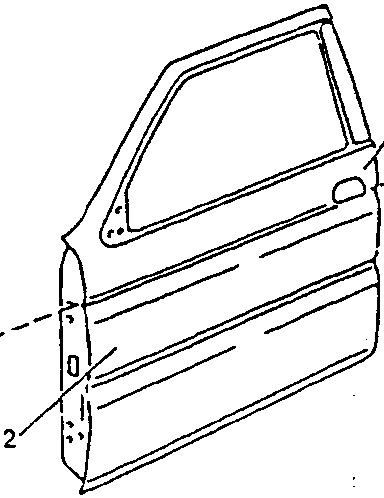
2. Lower area
Parts & tools for this job For 1992 Alfa Romeo 155
- TOOLTorque wrenchSearch: 3/8 inch torque wrench
- TOOLSocket setSearch: socket set metric
- BOOKHaynes manualSearch: Haynes manual Alfa Romeo 155
Links open Amazon search results in a new tab. As an Amazon Associate I earn from qualifying purchases.