
Battery
- Make
- Alfa Romeo
- Model
- GTV / Spider GTV and Spider (916) Factory Service Manual
- Year
- 1995–2000
- Section
- Charging › Battery
BATTERY
The battery has been designed to ensure that the engine starts in the shortest time possible. For this reason a high torque and a predefined engine rpm are required. This is ensured by the optimal sizing of the 6 elements contained inside the battery, each of which delivers a voltage of ~ 2 V (12 V in all). It maintains the charge much longer and also contains diluted sulphuric acid; for this reason it is necessary to keep it in the upright position even when it is not installed in the car. The battery body also has small ventilation holes to minimise the formation of gas during charging. Due to the reduction of the of gas produced, there is no corrosion and good contact at the terminals is ensured.
The advantages of this battery are:
- highly reduced water consumption due to the new type of alloy used in the manufacture of the grills and plates, for which reason topping up is no longer necessary;
- excellent starting capacity, as a result of very low self- discharging of up to seven months thus enabling long term storage (at temperatures below 28°C). When the vehicle is travelling the alternator recharges the battery; whenever the charge is insufficient or the connection between the alternator and the battery is cut off, a warning light on the instrument cluster turns on to indicate a circuit failure.
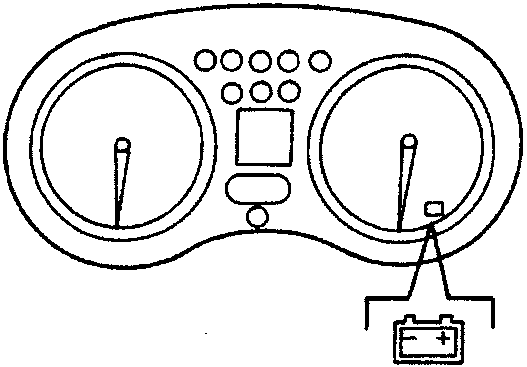
If the battery appears to be flat, check the charge measuring the loadless voltage on the terminals using a Voltmeter. If the voltage is below 12.30 V it is 50% charged; if it reaches 12.48 V it is 75% charged; and at 12.66 V it is 100% charged.
If the electrolyte level in one or more cells of the battery has fallen below the minimum mark on the plastic container, carefully open the cap cover and add distilled de-ionized water, as with ordinary batteries.
NOTE: It is highly unadvisable to recharge the battery quickly at voltages above 15.5 V. When recharging use a normal 12 V battery charger, connecting the positive cable (red) to the battery (+) terminal and the negative cable (black to the battery (-) terminal. If the battery of the vehicle is connected temporarily to an external battery, connect the positive terminal to the positive terminal and the negative terminal to the negative terminal.
- Do not connect or disconnect the battery to or from the electrical system of the car when the engine is running.
- Do not invert the terminal connections (even for a moment) as this would damage the alternator rectifier.
- When connecting the battery charger to the battery, firstly connect the cables and then start the battery charger.
- If it becomes necessary to start the engine with temporary cables and with an auxiliary battery, the voltage of the latter must not exceed 12 V.
- Before recharging the battery the clamp should be removed from the negative terminal.
- When charging make sure that the temperature of the electrolyte does not exceed 45°C.
- Do not touch the positive and negative terminals at the same time with the hands.
- Keep all naked flames away from the battery when recharging.
When replacing the battery follow the directions for use. If the charge of the replacement battery is potentially higher than that of the old one, the higher voltage might cause melting of the starter motor induction coil, or damage to the pinion or ring gear.
MAINTENANCE
The capacity of the battery to start the engine depends on the charge within it; it is therefore necessary to check it regularly and carry out any maintenance, especially in winter due to the greater load exerted on the starter motor and the reduced battery capacity at low temperatures.
Clean the surface of the battery, the terminals and clamps with a solution of water and sodium bicarbonate. Before reconnecting the terminals, coat them with a layer of grease.
Do not let any of the fluid used for cleaning get into the battery as it will react with the electrolyte. The electrolyte fluid is an acid, therefore dangerous for the eyes, hands and clothes.
Parts & tools for this job For 1995 Alfa Romeo GTV / Spider
- TOOLBattery testerSearch: car battery tester
- TOOLDigital multimeterSearch: automotive digital multimeter
- TOOLBattery terminal cleanerSearch: battery terminal cleaner
Links open Amazon search results in a new tab. As an Amazon Associate I earn from qualifying purchases.