
Catalytic converter
- Make
- Alfa Romeo
- Model
- GTV / Spider GTV and Spider (916) Factory Service Manual
- Year
- 1995–2000
- Section
- Exhaust system › Catalytic converter
WARNING: When the engine is running all the exhaust pipes and the catalytic converter in particular get considerably hot. Therefore, before doing any work it is necessary to leave the engine off for an adequate length of time. Never touch the catalytic converter without suitable protection, such as gloves, etc. Never place inflammable materials near the catalytic converter.
CATALYTIC CONVERTER
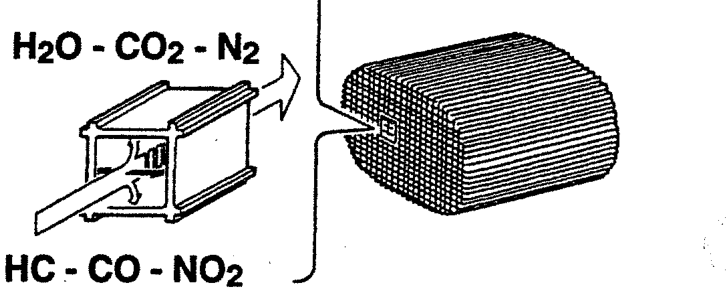
Closed loop mixture titration is activated by the lambda sensor which detects the amount of oxygen contained in the exhaust gas upstream of the catalytic converter. The measurements of the lambda sensor allow the electronic control unit to continuously correct the mixture titration keeping the air-fuel ratio constant. This way harmful emissions at the exhaust are controlled and this is completed by the three-way catalytic converter. The effectiveness of the catalytic converter, thus the amount of harmful gas at the exhaust depends on the air-fuel ratio with which the engine is supplied. The trivalent catalytic converter removes the three polluting substances contained in the exhaust gas: - unburnt hydrocarbons (HC); - carbon monoxide (CO); - nitric oxide (NOx). Two types of chemical reactions take place inside the converter: - oxidation of CO and HC, turned into carbon dioxide (CO2) and water (H2O); - reduction of NOx turned into Nitrogen (N2). The converter comprises a monolith, a metal mesh support to dampen shocks and vibrations and an outer stainless steel casing resistant to high temperatures and the weather. The monolith is made with a honeycomb structure composed of ceramic material coated with a fine layer of catalytically acive substances (platinum or rhodium) which quicken the chemical decomposition of the harmful substances contained in the exhaust gas which cross the cells of the heart at temperatures above 300 ÷ 350°C, activating the catalysts and starting the chemical reduction and oxidation processes. In order to optimise the efficiency and life of the catalyst, a perforated sheet metal cone improves the diffusion of the exhaust gas in the cells of the ceramic heart.
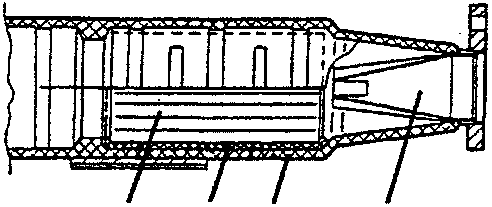
- Ceramic monolith
- Metal support
- Outer casing
- Perforated sheet metal cone
The causes which quickly and irreparably put the catalytic converter out of order are the following: - the presence of lead in the fuel, which lowers the degree of conversion to levels that make the presence of the system useless; - presence of unburnt fuel in the converter: indeed a flow of petrol for 10 seconds in an environment at a temperature of 800°C (inside temperature of the catalyst) is sufficient to melt and break the catalyst. The ignition system must absolutely be in perfect operating conditions and for no reason whatsoever may the spark plugs be disconnected with the engine running, therefore in the event of tests, the catalytic converter must be replaced by an equivalent length of piping. If used correctly the catalytic converter works effectively for at least 80,000 km or five years.
WARNING: The precious metals contained in the catalytic converter are chemically attacked by the presence of lead because of the high temperature. Because of this leaded fuels must be avoided as they quickly and irreversibly ruin the converter. Never use petrol containing lead, not even for a very short time in an emergency.
Parts & tools for this job For 1995 Alfa Romeo GTV / Spider
- PARTExhaust gasketSearch: Alfa Romeo GTV / Spider 1995 exhaust gasket
- TOOLPenetrating oilSearch: penetrating oil
- TOOLOBD2 scannerSearch: OBD2 scanner
Links open Amazon search results in a new tab. As an Amazon Associate I earn from qualifying purchases.