
Checking for leaks
- Make
- Audi
- Model
- A3 Mk3
- Year
- 2012–2020
- Section
- Vacuum system › Checking for leaks
Checking for leaks
Note
- The mean atmospheric pressure at sea level is 1013 mbar and decreases rapidly with increasing altitude (approx. 100 mbar per 1,000 m of altitude). Fluctuations at different locations and times also influence vacuum generation.
- A cold engine, an active air-conditioning system as well as engine idling have an adverse influence on vacuum generation.
Before starting work, check all vacuum hoses for damage (e.g. cracks or animal bites) and make sure they are correctly and securely attached.
Connect brake servo tester VAS 6721Chapter.
Open shut-off valve (A).
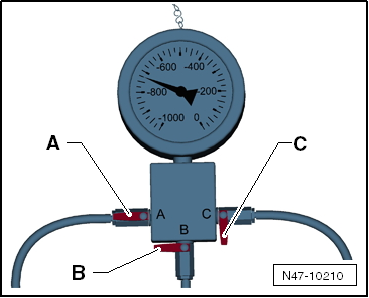
Close shut-off valves (B and C).
Start warm engine (>60° C), press accelerator briefly (engine speed greater than 2000/min).
Under normal conditions (see notes), the generated vacuum should be between 600 and 950 mbar (depending on engine version).
Open shut-off valve (C) to evacuate brake servo.
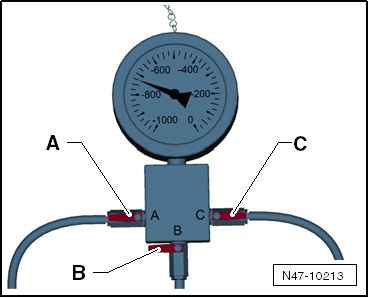
Switch off engine.
Read and make a note of measured value shown.
A vacuum decrease of 400 mbar in 12 hours is permissible.Note
- If there are major leaks, the vacuum will decrease rapidly within a few seconds.
If there is a large drop in vacuum, trace the leak as follows:
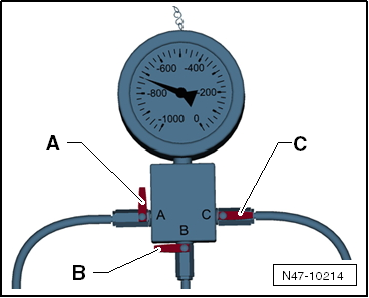
After building up vacuum, close shut-off valve (A) in order to check brake servo vacuum system.
After building up vacuum, close shut-off valve (C) in order to check vacuum system from brake servo tester VAS 6721 to intake manifold or vacuum pump.
Open shut-off valve (B) to facilitate removal of hose connections and adapter.
Parts & tools for this job For 2012 Audi A3
- PARTBrake padsSearch: Audi A3 2012 brake pads
- TOOLBrake bleeder kitSearch: one man brake bleeder kit
- FLUIDBrake fluidSearch: brake fluid
As an Amazon Associate we earn from qualifying purchases.