
Bonded joints
- Make
- Audi
- Model
- A4 Mk4
- Year
- 2015–2023
- Section
- Centre differential › Bonded joints
Bonded joints
The body of the Audi A6 features bonded joints and spot-welded/bonded joints for increased rigidity and strength.
In the case of adhesive-bonded joints, the joint between the sheet metal parts is formed only by the adhesive.
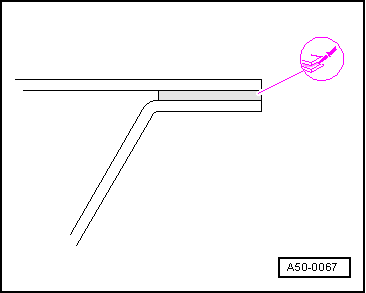
Particular attention should be given to these joints when diagnosing accident damage and performing body repairs.
Note the following points: Do not use a chisel to test the strength of a joint or relieve stresses by hammering as this will damage or destroy the bonded joint.
These joints should be inspected particularly closely when diagnosing accident damage and after performing straightening work on the body.
If the joint is not accessible with pop rivets, it must be repaired with an arc-welded seam (SG). In this case the entire area of the joint must be re-welded, as the heat produced by welding destroys the adhesive in the bonded joint. The SG seams should be welded working from the thin to the thick panel. Always use a fume extractor.
When making repairs, welded joints can be used in place of all spot-welded bonded joints and certain bonded joints if no suitable body adhesive is available.
Do not make the repair with only the same spot welds or seams as originally used in production. These alone are not adequate for a proper joint.
The repair methods are shown in detail on the following pages.
Note
- If the instructions call for additional spot welds, these should be applied in a single operation.
- Do not place new spot welds in-between the original spot welds.
- SG plug welding should only be performed after spot welding.
- This avoids any increased shunt current when spot welding.
Ensure good root penetration at all joints.
Seal off repaired joint flanges and apply cavity sealing.
Parts & tools for this job For 2015 Audi A4
- PARTClutch kitSearch: Audi A4 2015 clutch kit
- TOOLClutch alignment toolSearch: clutch alignment tool
- FLUIDGear oilSearch: Audi A4 manual gearbox oil
As an Amazon Associate we earn from qualifying purchases.