
Operation of heated windscreen
- Make
- Audi
- Model
- A6 C6
- Year
- 2004–2011
- Section
- Heated windscreen › Operation of heated windscreen
Operation of heated windscreen
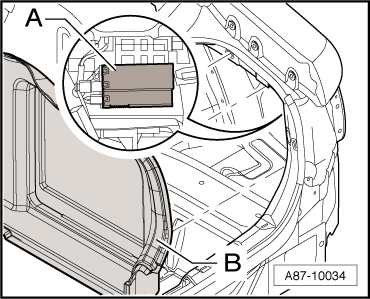
- Heated windscreen control unit J505(A) is installed in luggage compartment on right behind lining (B).
- If fitted, the heated windscreen control unit J505(A) is actuated by the operating and display unit, Climatronic control unit J255 by way of the air conditioner data bus system “Lin bus” (reading measured value block) "Guided fault-finding" function of vehicle diagnostic, testing and information system VAS 5051.
After starting cold engine if ambient temperature is less than + 5° C and operating and display unit, Climatronic control unit J255 is set to “Auto” mode; temperature setting on operating and display unit, Climatronic control unit J255 must be such that air conditioner is in heating mode and temperature measured by senders (left vent temperature sender G150, right vent temperature sender G151, centre vent temperature sender G191) must not be in excess of + 35° C; heating period is governed by ambient temperature (max. 6 minutes at -40°).
On selecting “Defrost” mode on operating and display unit, Climatronic control unit J255 if ambient temperature is less than + 5° C; heating period is between 2 and 6 minutes depending on ambient temperature; lamp in Defrost button flashes as long as heated windscreen is switched on; actuation only takes place with engine running.
- Heated windscreen control unit J505(A) switches on heated windscreen Z2 if the following conditions are fulfilled:
Operating and display unit, Climatronic control unit J255 actuating heated windscreen control unit J505
Voltage at heated windscreen control unit J505 greater than 12.70 V
Heated windscreen control unit J505 not overheated
- The heated windscreen control unit J505 is actuated by the operating and display unit, Climatronic control unit J255 by way of the air conditioner data bus system “Lin bus”. If a condition exists in the heated windscreen control unit J505 which does not permit activation of the heated windscreen, the operating and display unit, Climatronic control unit J255 is informed by way of this signal wire that the heated windscreen is not to be activated "Guided fault-finding" function of vehicle diagnostic, testing and information system VAS 5051.
- Resistance of metal foil in heated windscreen Z2 is approx. 1.9 ohms. A voltage greater than electrical system voltage is required to attain maximum possible heat output of approx. 1000 W (watts) at windscreen. The heated windscreen control unit J505 converts the electrical system voltage for the heated windscreen Z2 into a variable voltage of between 25 and 48 V depending on the electrical system voltage. With an electrical system voltage of 13.1 V at the heated windscreen control unit J505, the control unit supplies the heated windscreen Z2 with a voltage of 41 V "Guided fault-finding" function of vehicle diagnostic, testing and information system VAS 5051. .
- To prevent electrical system overload, heated windscreen control unit J505 regulates heat output for heated windscreen Z2. With an electrical system voltage of 12.70 V this is approx. 200 W and is infinitely regulated to 1000 W at 13.10 V. Heated windscreen control unit J505 permits an increase in power output of max. 200 W per second to guard against voltage dips in the electrical system on switching on heated windscreen.
- To prevent actuation of heated windscreen Z2 in the event of short circuit or open circuit in wiring, heated windscreen control unit J505 interrogates resistance of heated windscreen Z2. If the resistance measured is less than approx. 1.5 ohms (short circuit) or greater than approx. 2.5 ohms (open circuit or contact resistance), the heated windscreen control unit J505 does not switch on the windscreen heating or switches it off "Guided fault-finding" function of vehicle diagnostic, testing and information system VAS 5051.
Parts & tools for this job For 2004 Audi A6
- TOOLA/C manifold gauge setSearch: AC manifold gauge set
- TOOLUV leak detection kitSearch: AC UV leak detection kit
- PARTCabin filterSearch: Audi A6 2004 cabin filter
As an Amazon Associate we earn from qualifying purchases.