
Disconnecting and connecting battery - vehicles without high-voltage system
- Make
- Audi
- Model
- A6 C7
- Year
- 2011–2018
- Section
- Battery › Disconnecting and connecting battery - vehicles without high-voltage system
‹ Prev Disconnecting and connecting batteryNext › Disconnecting and connecting battery A and second battery A1 - vehicles with high-voltage system
Electrical systemDisconnecting and connecting battery - vehicles without high-voltage system
Disconnecting and connecting battery - vehicles without high-voltage system
Warning Risk of accident.
- Contrary to the following description, the battery must be disconnected with the ignition SWITCHED ON when working on pyrotechnic components (e.g. airbags, belt tensioners).
- After the ignition is switched off, the reducing agent is automatically drawn back into the active tank for reducing agent from the metering line going to the injector for reducing agent N474.
- Before working in this area, you must therefore wait until the reducing agent has been completely drawn out of the metering line; this can take up to 10 minutes after the ignition has been switched off.
- For the same reason, it is important to wait until the reducing agent has been drawn back (i.e. 10 minutes) before disconnecting the battery.
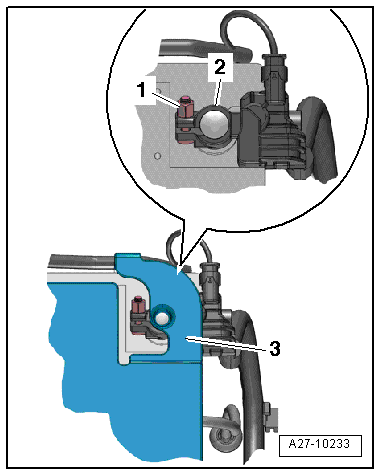
Switch off ignition.
Lift luggage compartment floor using handle and fold forward.
Open cover (3) over negative battery terminal.
Slacken off nut (1) several turns and disconnect battery clamp (2) of earth cable from battery terminal.
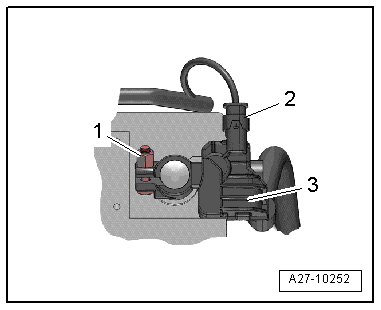
Unplug electrical connector (2) at battery monitor control unit J367(item 3).
When connecting battery, attach battery clamp of earth cable to negative battery terminal “–” by hand and tighten nut (1).
Reconnect connector at battery monitor control unit J367.
The following measures are required after re-connecting the battery:
- Activate automatic open/close function of electric window regulators Owner's Manual for the vehicle.
- Interrogate event memories of all control units and erase “Low voltage” entry Vehicle diagnostic tester.
Note
- After reconnecting the voltage supply, it is possible that the ESP warning lamp will not go out until the vehicle has been driven several metres.
- Chapter“Exploded view - battery, vehicles without high-voltage system”
‹ Prev Disconnecting and connecting batteryNext › Disconnecting and connecting battery A and second battery A1 - vehicles with high-voltage system
Parts & tools for this job For 2011 Audi A6
- TOOLBattery testerSearch: car battery tester
- TOOLDigital multimeterSearch: automotive digital multimeter
- TOOLBattery terminal cleanerSearch: battery terminal cleaner
As an Amazon Associate we earn from qualifying purchases.