
Workshop Manuals Factory service & repair Audi
01 Servicing 6-cylinder TDI engine, common rail (EA 897 Gen. I)02 4-cylinder TDI engine (2.0 ltr. 4-valve common rail - generation II)03 Direct petrol injection and ignition system (4-cyl. 2.0 ltr. 4-valve turbo with timing chain)04 8-cylinder direct injection engine (4.0 ltr. 4-valve TFSI)05 4-cylinder TDI engine, 2.0 ltr. 4-valve common rail (EA 288 Gen. I)06 6-cylinder direct injection engine (evo) with supercharger (3.0 ltr. 4-valve TFSI)07 4-cylinder direct injection engine (1.8, 2.0 ltr. 4-valve TFSI - generation III)08 Technical data for engines09 Technical data for diesel engines10 6-cylinder direct injection engine with supercharger (3.0 ltr. 4-valve TFSI)11 Fuel supply system, petrol engines12 6-cylinder direct injection engine (2.5 ltr., 2.8 ltr. 4-valve)13 6-cylinder TDI engine (3.0 ltr. 4-valve common rail)14 Fuel supply system, diesel engines15 4-cylinder direct injection engine (1.8, 2.0 ltr. 4-valve TFSI - generation II)16 6-cylinder TDI engine, 3.0 ltr. 4-valve common rail (EA 897 Gen. I)17 Rear final drive 0BC, 0BD, 0BE, 0BF18 Servicing 6-speed manual gearbox 0B1, front-wheel drive19 Gearbox: Servicing multitronic 0AW20 Servicing 7-speed dual clutch gearbox 0B5 (S tronic)21 Servicing 7-speed dual clutch gearbox 0CJ, 0CL, 0CK22 Servicing 6-speed manual gearbox 0CS, 0DJ, 0CX23 7-speed dual clutch gearbox 0CK24 6-speed manual gearbox 0B1, front-wheel drive25 6-speed manual gearbox 0CS, 0DJ26 7-speed dual clutch gearbox 0B5 (S tronic)27 Gearbox: multitronic 0AW, front-wheel drive28 8-speed automatic gearbox 0BK, four-wheel drive29 8-speed automatic gearbox 0BW hybrid, front-wheel drive30 Running gear: Specifications for testing the braking force (according to German legislation)31 Running gear: Trailer Operation Guide32 Running gear: Wheel/Tyre Guide33 Running gear, front-wheel drive and four-wheel drive34 Brake system35 Heating, air conditioning36 Heating and air conditioning: Auxiliary/supplementary heater37 Electrical system38 Electrical: Communication39 Electrical: Basic information on high-voltage vehicles40 Electrical system, hybrid41 General body repairs, interior42 General body repairs, exterior
Audi A6 C7 (2011-2018)21 · Servicing 7-speed dual clutch gearbox 0CJ, 0CL, 0CK
21 · Transmission

Bonded joints

Make
Audi
Model
A6 C7
Year
2011–2018
Section
Centre differential › Bonded joints
Servicing 7-speed dual clutch gearbox 0CJ, 0CL, 0CKBonded joints

Bonded joints

AudiBinderPassenger carsAudi A62011Audi A6 Avant2011Audi A6 China2012Edition01.2015

The body of the Audi A6 features bonded joints and spot-welded/bonded joints for increased rigidity and strength.

Bonded joints

In the case of adhesive-bonded joints, the joint between the sheet metal parts is formed only by the adhesive.
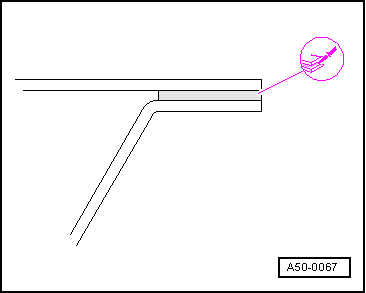
A50-0067

Inspecting and repairing bonded joints

Particular attention should be given to these joints when diagnosing accident damage and performing body repairs.

Note the following points: Do not use a chisel to test the strength of a joint or relieve stresses by hammering as this will damage or destroy the bonded joint.

These joints should be inspected particularly closely when diagnosing accident damage and after performing straightening work on the body.

If the joint is not accessible with pop rivets, it must be repaired with an arc-welded seam (SG). In this case the entire area of the joint must be re-welded, as the heat produced by welding destroys the adhesive in the bonded joint. The SG seams should be welded working from the thin to the thick panel. Always use a fume extractor.

Repair methods for replacing body parts

When making repairs, welded joints can be used in place of all spot-welded bonded joints and certain bonded joints if no suitable body adhesive is available.

Do not make the repair with only the same spot welds or seams as originally used in production. These alone are not adequate for a proper joint.

The repair methods are shown in detail on the following pages.

Note

  • If the instructions call for additional spot welds, these should be applied in a single operation.
  • Do not place new spot welds in-between the original spot welds.
  • SG plug welding should only be performed after spot welding.
  • This avoids any increased shunt current when spot welding.

Ensure good root penetration at all joints.

Seal off repaired joint flanges and apply cavity sealing.

Parts & tools for this job For 2011 Audi A6

As an Amazon Associate we earn from qualifying purchases.