
Checking front seat heating
- Make
- Audi
- Model
- A7 Sportback
- Year
- 2010–2018
- Section
- General notes › Checking front seat heating
Heating, air conditioningChecking front seat heating
Checking front seat heating
The operating unit (Climatronic control unit J255) transmits the request for activation of the seat heating by way of the data bus to the appropriate control unit (the control unit depends on the vehicle model and equipment) Vehicle diagnostic tester in “Guided Fault Finding” mode and Current flow diagrams, Electrical fault finding and Fitting locations.
- On vehicles with no seat and steering column adjustment control unit with memory J136 and no front passenger seat adjustment with memory control unit J521, the onboard supply control unit J519 actuates the driver's and passenger side seat heating. The request for seat heating activation is first transmitted by the operating unit, Climatronic control unit J255 via the data bus to the data bus diagnostic interface J533 and then relayed to J519Vehicle diagnostic testerin “Guided Fault Finding” mode and Current flow diagrams, Electrical fault finding and Fitting locations (for the corresponding vehicle system).
- On vehicles with a seat and steering column adjustment control unit with memory J136 and a front passenger seat adjustment with memory control unit J521, J136 actuates the driver's side seat heating and J521 the passenger side seat heating. The request for seat heating activation is first transmitted by the operating unit, Climatronic control unit J255 via the data bus to the data bus diagnostic interface J533 and then relayed to J136 and J521. If a vehicle is fitted with J136 but not J521, J136 actuates the driver side seat heating and the passenger side seat heating is actuated by J519Vehicle diagnostic tester in “Guided Fault Finding” mode and Current flow diagrams, Electrical fault finding and Fitting locations (for the corresponding vehicle system).
- A start/stop system is offered for this vehicle in combination with certain engines. On vehicles with a start/stop system, the seat heating is deactivated while the stop function is active (to protect the battery A). The setting for actuation of the seat heating does however remain stored in the operating unit (Climatronic control unit J255). The seat heating is switched on again after the engine has been re-started via the start function Vehicle diagnostic tester in “Guided Fault Finding” mode.
- The heating setting for the driver's seat can be stored for a specific key. The settings made before switching off the ignition are then adopted for the next driving cycle Owner's Manual.
- On vehicles with no seat occupied sensor for the front passenger's seat and the rear seats, the seat heating is currently not deactivated automatically if a seat is not occupied while the vehicle is being driven. If the ignition is switched off and not switched on again within approx. 10 minutes, the setting for actuation of the seat heating is deleted Owner's Manual.
- Depending on the vehicle, the setting made for the seat heating may be reduced automatically by one stage after a certain time (e.g. after 10 minutes) Owner's Manual.
Note
- The seat heating may be activated differently depending on the vehicle model Current flow diagrams, Electrical fault finding and Fitting locations.
- Depending on the model and vehicle equipment, the various pieces of information on the activation of the seat heating (setting transmitted by the operating unit (Climatronic control unit J255), specified and actual seat temperature, etc.) are displayed differently in the various measured value blocks in the different control units Vehicle diagnostic tester in “Guided Fault Finding” mode.
- If a condition prevails in which the heating of the driver's seat or front passenger's seat cannot be activated (e.g. short circuit in connection to seat heating element, open circuit in power supply to corresponding control unit), this is stored as a fault in the onboard supply control unit J519 , the seat and steering column adjustment control unit with memory J136 or the front passenger seat adjustment with memory control unit J521 (depending on model and vehicle equipment). On such vehicles, the information that the event memory in the corresponding control unit has to be read out may not be transmitted via the data bus to the operating unit (Climatronic control unit J255) Vehicle diagnostic tester in “Guided Fault Finding” mode. In the event of problems with seat heating, the first step should therefore always be to read out the event memories of the control units which activate the seat heating.
- The procedure for checking the activation of the seat heating is described in the Guided Fault Finding routine for the corresponding control unit (onboard supply control unit J519, seat and steering column adjustment control unit with memory J136 or front passenger seat adjustment with memory control unit J521, depending on vehicle model and equipment) Vehicle diagnostic tester in “Guided Fault Finding” mode.
- If, for example, the voltage measured at the onboard supply control unit J519 at terminal “30” drops below a value stored in J519, the seat heating power is reduced or the function is completely deactivated to relieve the load on the alternator CVehicle diagnostic tester“Guided Fault Finding” function.
- The “Read measured values” function of the Guided Fault Finding routine for the operating unit (Climatronic control unit J255) indicates which seat heating setting has been selected. Depending on the vehicle version and equipment, the activation of the seat heating, the actual and specified temperatures in the seat and the actual current flowing via the seat heating etc. are displayed in the “Read measured values” function for the corresponding control unit Vehicle diagnostic tester in (“Guided Fault Finding” mode.
- Depending on the vehicle model, the seat heating of the front passenger's seat may be deactivated after a certain period if the system detects that the seat is not occupied (at the start of production, no provision was made for deactivation via the seat occupied sensor; introduction not yet finalised) Owner's Manual.
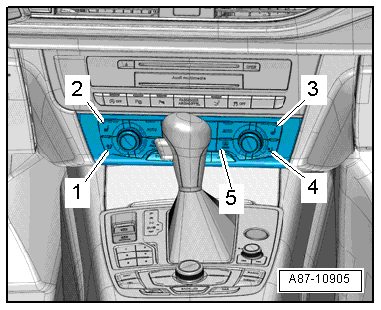
- There are different versions of the operating unit (Climatronic control unit J255) Electronic parts catalogue. The different versions can be recognised for example from the symbols on the buttons (2, 3) (for vehicles with “Seat heating” optional extra) and (1, 4) (for vehicles with “Seat heating/seat ventilation” optional extra).
- The function indicator lamps in the buttons light when seat heating is switched on Owner's Manual.
- The seat heating settings are made on the operating unit (Climatronic control unit J255). These settings are transmitted via the data bus to the corresponding control unit. The specified temperatures for the different seat heating settings are stored in the corresponding control units. Depending on the control unit version and the vehicle production period, the specified temperature for the seat heating may therefore differ in spite of identical settings on J255Vehicle diagnostic tester in “Guided Fault Finding” mode.
Parts & tools for this job For 2010 Audi A7
- TOOLA/C manifold gauge setSearch: AC manifold gauge set
- TOOLUV leak detection kitSearch: AC UV leak detection kit
- PARTCabin filterSearch: Audi A7 2010 cabin filter
As an Amazon Associate we earn from qualifying purchases.