
Description of Auto Hold function
- Make
- Audi
- Model
- Q5 Mk1
- Year
- 2008–2017
- Section
- Auto Hold › Description of Auto Hold function
Description of Auto Hold function
Certain models are equipped with Audi hold assist.
This function assists the driver when the vehicle has to be held stationary, either frequently or for long periods, with the engine running.
When the Audi hold assist is activated after the vehicle comes to a standstill, it will hold the vehicle in a stationary position.
The driver can then release the brake pedal.
Initially the vehicle is held at a standstill by maintaining the brake pressure at all four wheels in the ESP system.
To prevent the ESP solenoid valves from overheating if the vehicle has to be held for long periods, the braking function is taken over automatically by the rear electromechanical parking brake if the temperature at the solenoid valves exceeds 200 °C.
The brakes are released automatically at a point determined according to the following factors:
- Engine torque
- Angle of gradient
- Gear engaged
- Manual gearbox: travel at clutch pedal detected by clutch sensor
- Automatic gearbox: torque converter slip
To prevent the vehicle from rolling back, the brakes are only released when sufficient engine torque is available.
The following requirements must be met in order to switch on the “stand-by” mode:
- Driver's seat belt fastened
- Engine running
- Driver's door closed
- ESP and electromechanical parking brake functioning properly
The function can then be activated by pressing the switch (2) in the centre console.
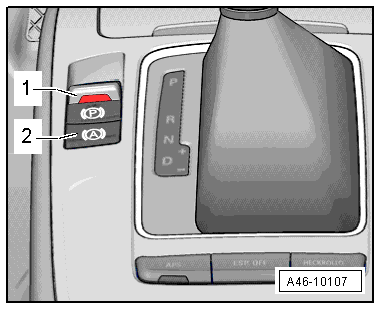
The switch indicates the status of the system:
- System deactivated: LED in switch OFF
- Stand-by: LED in switch lights up
- System active: LED in switch lights up and a green “P” appears in the instrument cluster display
The electromechanical parking brake only takes over the braking function from the ESP when the green “P” appears in the instrument cluster display and when:
- The ESP solenoid valves reach a temperature of 200 °C,
- The driver's door is opened,
- The driver's seat belt is unfastened,
- The engine is switched off,
- The ignition is switched off,
- The switch is operated,
- The brake pedal or accelerator pedal is pressed,
- The switch for the Audi hold assist function is operated without pressing the footbrake.
Note
- The green “P” in the instrument cluster changes to a “red P” when the electromechanical parking brake takes over the braking function from the ESP.
Parts & tools for this job For 2008 Audi Q5
- PARTBrake padsSearch: Audi Q5 2008 brake pads
- TOOLBrake bleeder kitSearch: one man brake bleeder kit
- FLUIDBrake fluidSearch: brake fluid
As an Amazon Associate we earn from qualifying purchases.