
General repair instructions (Automatic gearbox 09G)
- Make
- Audi
- Model
- TT Mk1
- Year
- 1998–2006
- Section
- Repair instructions › General repair instructions
Automatic gearbox 09GGeneral repair instructions
General repair instructions
Proper tools and the maximum possible care and cleanliness are essential for satisfactory gearbox repairs. The usual basic safety precautions also naturally apply when carrying out repair work.
To avoid repetition, a number of generally applicable instructions for the various repair procedures are summarised here. They apply to the work described in this Manual.
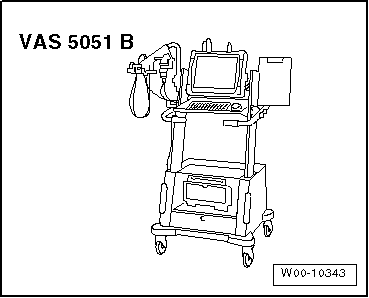
- Before servicing the automatic gearbox, the exact cause of the malfunction must be determined as precisely as possible via the vehicle diagnostic, testing and information system VAS 5051B in the modes “Guided Fault Finding”, “Vehicle Self-Diagnosis” and “Test Instruments”.
- ATF, gear oil and any other type of oil must be handled with care.
- Dispose of drained oil properly.
- Always adhere to statutory environmental and waste disposal regulations.
- Observe the information shown on the packaging of the oil.
For a complete list of special tools used in this Workshop Manual "Workshop equipment and special tools".
- Rules for cleanliness when working on the automatic gearbox → Chapter.
- Do not run engine or tow vehicle with ATF oil pan removed or when there is no ATF in the gearbox.
- If gearbox has been removed from vehicle, secure torque converter to prevent it from falling out.
- Check position of torque converter before installing gearbox Anchor.
- When installing gearbox ensure dowel sleeves are correctly seated.
- After installing, check ATF level and top up if necessary: planetary gearbox and final drive → Chapter. Capacities and specifications → Chapter
- Always renew O-rings, oil seals and gaskets.
- After removing gaskets and seals, always inspect the contact surface on the housing or shaft for burrs resulting from removal or for other signs of damage.
- Thoroughly clean housing joint surfaces before assembling.
- The open side of the oil seal should face the side containing the fluid.
- Before installing, lightly lubricate outer circumference and sealing lips of oil seals with ATF or gear oil, depending on fitting location.
- Lightly lubricate O-rings with ATF before installation to prevent them getting crushed during assembly.
- Use only ATF for parts running in ATF. Other lubricants will cause malfunction of the gearbox hydraulics.
- When installing a new oil seal, position the seal such that the sealing lip does not contact the shaft in the same place as the old seal (make use of installation depth tolerances).
- After installing, check ATF level and top up if necessary: planetary gearbox and final drive → Chapter. Capacities and specifications → Chapter
- Loosen bolts in reverse sequence to the specified tightening sequence.
- Nuts and bolts which secure covers and housings should be loosened and tightened in diagonal sequence and in stages if no tightening sequence is specified.
- Parts which are particularly sensitive to distortion (e.g. valve body) must be kept straight when removing and installing; loosen or tighten diagonally in stages.
- The tightening torques stated apply to non-oiled nuts and bolts.
- Renew self-locking nuts and bolts.
- Use a wire brush to clean the threads of bolts which are secured with locking fluid. Then apply locking fluid AMV 185 101 A1 to bolts again before fitting.
- Threaded holes which take self-locking bolts or bolts coated with locking fluid must be cleaned (using a tap or similar). Otherwise there is a danger of the bolts shearing off the next time they are removed.
- Renew bolts which are tightened by turning through a specified angle.
- Do not over-stretch circlips.
- Renew circlips which have been damaged or over-tensioned.
- Circlips must be properly seated in the base of the groove.
Parts & tools for this job For 1998 Audi TT
- PARTTransmission filter kitSearch: Audi TT 1998 transmission filter kit
- FLUIDAutomatic transmission fluidSearch: Audi automatic transmission fluid
- TOOLFluid transfer pumpSearch: fluid transfer pump
As an Amazon Associate we earn from qualifying purchases.