
ESP - Electronic Stabilisation Program
- Make
- Audi
- Model
- TT Mk1
- Year
- 1998–2006
- Section
- Self-diagnosis › ESP - Electronic Stabilisation Program
ESP - Electronic Stabilisation Program
The ESP is based on the existing on-board safety systems ABS/EDL and ABS/EDL/TCS, with a number of additional capabilities. ESP enhances the degree of control in critical dynamic conditions. In addition to the existing safety systems, ESP further reduces the risk of skidding and improves steerability.
Warning However, ESP is not able to overcome the physical limits of the available road adhesion.
- The ESP is designed to stabilise the dynamic handling response of the vehicle by counteracting any tendency towards oversteer or understeer. The functions of EBPD, ABS, EDL and TCS are incorporated in the control system. However, the characteristic function of the ESP is controlled brake application at individual wheels.
- The ESP function relies on an exchange of signals between ABS with EDL control unit J104 and the engine control unit, the steering angle sender G85 and the four-wheel drive control unit J492 (if fitted). The data is transmitted via CAN bus → Chapter.
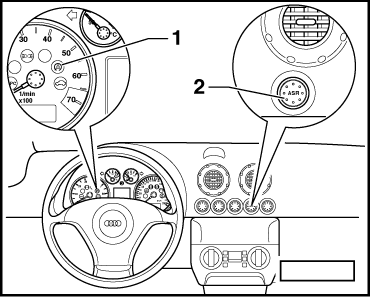
- If required, the TCS function and the ESP function can be switched off (and on again) by means of the button (2) (marked ASR) in the dash panel. The control unit ignores the position of the ESP switch when the driver presses the brake pedal. ESP will remain active at all times during braking. Both functions, TCS and ESP, will be activated again automatically the next time the ignition is switched on.
- When the TCS and ESP function are deactivated, the ESP and TCS warning lamp K155(item 1) in the instrument cluster lights up. The warning lamp flashes at a rate of three times per second when the control function is actually working.
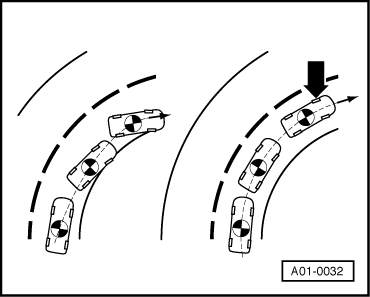
In an oversteer condition, the rear of the vehicle tends to break away. The vehicle rotates further about its vertical axis than is required to maintain course through the corner. The system counteracts this moment of vehicle oversteer by applying a controlled braking force at the outside front wheel (arrow).
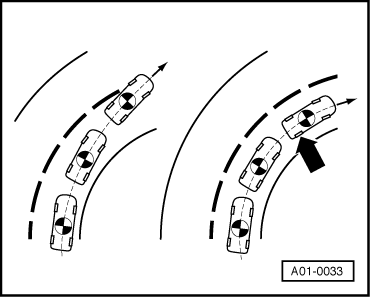
In an understeer condition the front end of the vehicle does not follow the required corner radius. The vehicle breaks away towards the outside of the bend. The vehicle does not rotate far enough about its vertical axis to maintain course through the corner. The system increases the amount of rotation by applying a controlled braking force at the inside rear wheel (arrow).
Parts & tools for this job For 1998 Audi TT
- TOOLOBD2 scannerSearch: OBD2 scanner
- TOOLDigital multimeterSearch: automotive digital multimeter
- TOOLBack-probe test leadsSearch: back probe test leads
As an Amazon Associate we earn from qualifying purchases.