
Data - identification: Nickel-cadmium battery
- Make
- Citroën
- Model
- AX Factory Workshop Manual
- Year
- 1986–1998
- Section
- Air and fuel supply › Data - identification: Nickel-cadmium battery
Data - identification: Nickel-cadmium battery
1. Data
make: SAFT.
Battery type and capacity: Ni/Cd. 100 amps/hour.
Electrolyte: Liquid potash.
Cooling using a fluid: Yes.
Battery maintenance: Topping up of the battery electrolyte level Every 10 000 km.
Nominal voltage: 120V.
Earth: 255 kg.
2. Ni/Cd battery charge data
2.1. Normal charges
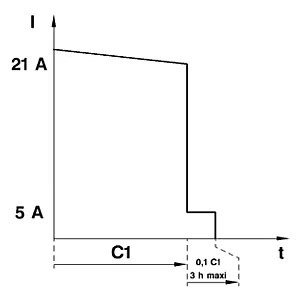
These battery charges are carried out by the on-board charger, controlled by the computer.
The duration of the charge C1 period depends on the charging state of the battery when it is being charged Maximum charging duration C1 = 5 hours.
2.2. Equalisation charge
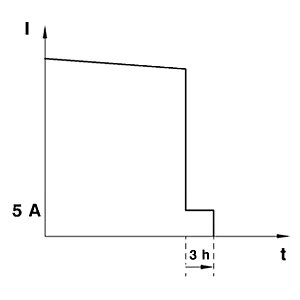
This battery charge is automatically controlled by the ECU, every 10 charges approximately.
2.3. Maintenance charge
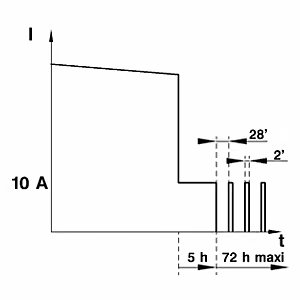
CAUTION: The battery electrolyte can be topped up after a maintenance or an initialisation charge only.
This battery charge is controlled by the tester.
The maintenance charge comprises:
- Normal charge Maximum charging duration C1 = 5 hours
- Charge with a current of 10 amps for 5 hours
- Pulse phase with a current of 10 amps for 2 minutes every 28 minutes (72 hours maximum)
2.4. Initialisation charge
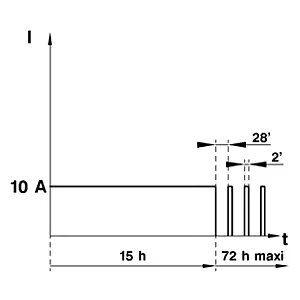
This battery charge is controlled by the tester.
This battery charge must be carried out when replacing a battery pack or a computer.
This battery charge enables:
- Setting the Ah speedometers of the computer to zero
- Setting of the 3 battery packs to the same charge level
The ECU controls:
- Battery charges
- The energy gauge
- The maintenance intervals
2.5. Preliminary charge
This battery charge can be used in two ways, under certain conditions and before normal charge.
Battery discharged: 10V < battery U 120V < 80V.
Battery charge with low current depending on the voltage.
Pre-charging: 105V > battery U 120V > 80V.
Charge with a current of 10 amps for 12 minutes.
N.B.: The duration of the battery charges is subject to the temperature conditions. The cooling fan unit can operate during the battery charge phases.
2.6. Rapid charge
This battery charge is carried out by the rapid charge terminals having a power of 23 kW.
The rapid charge enables the battery to reach 80 % of its capacity within 30 minutes.
A dialogue is established between the rapid charge terminal and the vehicle computer via the "ISO" line integrated in the charging socket.
If a fault appears during the charging phase, the computer will memorise it as well as the rapid charge terminal No. (the computer can memorise 2 charge terminal numbers).
3. Identification
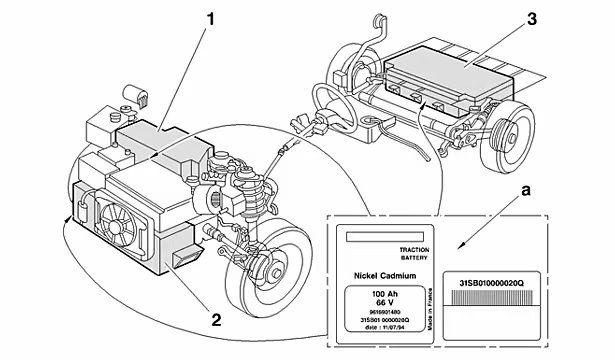
The battery consists of 20 6 volt one-piece units.
The 20 one-piece units are distributed into 3 packs:
- (1) Upper battery pack: 3 units
- (2) Lower battery pack: 6 units
- (3) Rear battery pack: 11 units
Each battery pack is identified by a label "a".
Information written on the label:
- Supplier’s identification No.
- Battery type and capacity
- Nominal voltage
- Supplier’s Part No.
- Identification of the battery pack (14 characters)
- Date of manufacture
3.1. Electrical circuit
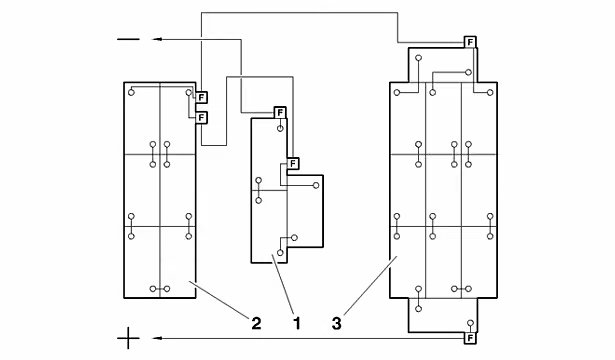
(1) Upper battery pack.
(2) Lower battery pack.
(3) Rear battery pack.
The battery packs are connected in series by means of an electric circuit and they make up a 120 volt battery.
The "high voltage" electric circuit contains 3 fuses and 3 circuit breakers placed on the battery packs.
3.2. Distilled water topping up system
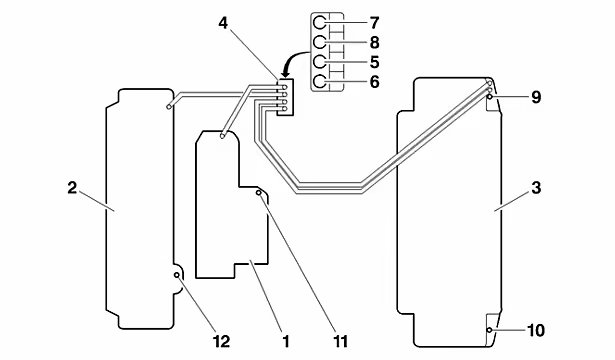
The Ni/Cd battery requires a periodic topping up with distilled water.
The 4 distilled water filler connections are grouped on a support (4) located on the RH side of the engine compartment.
Filler connections to battery packs couplings:
- (5) Rear battery pack (right)
- (6) Rear battery pack (L.H. side)
- (7) Upper battery pack (front)
- (8) Lower battery pack (front)
Overflow pipe:
- (9) Rear battery pack (right)
- (10) Rear battery pack (L.H. side)
- (11) Upper battery pack (front)
- (12) Lower battery pack (front)
N.B.: The distilled water topping up system is also used for draining the hydrogen that may escape from the battery at the end of its charging phase.
Parts & tools for this job For 1986 Citroën AX
- TOOLBattery testerSearch: car battery tester
- TOOLDigital multimeterSearch: automotive digital multimeter
- TOOLBattery terminal cleanerSearch: battery terminal cleaner
As an Amazon Associate we earn from qualifying purchases.