
Presentation: Door management
- Make
- Citroën
- Model
- Berlingo (M59) Multispace Factory Workshop Manual
- Year
- 2002–2008
- Section
- Lock › Presentation: Door management
Presentation: Door management
1. Foreword
Management of doors and tailgate consists of the locking / unlocking of the front and rear doors and of the tailgate.
1.1. Control devices
The doors and tailgate locking/unlocking devices are the following:
- Two declutchable exterior locks on the driver’s and passsenger’s doors
- One remote control for vehicles without deadlocking
- One central locking button for locking/unlocking of doors and tailgate
- A tailgate exterior opening control
- An interior opening control on all four doors (COI)
- An interior locking control (CCI) on the rear doors or a locking button on the front doors
- Mechanical controls, one on each rear door, for deactivating opening of the rear doors using the interior door handles (according to model)
1.2. Display devices
The display devices for locking / unlocking are the following:
- The direction indicators flash
- Lighting/extinction of a diode on the hazard warning lamps button
- Lighting of the interior lamps (vehicle location, locking, opening of doors)
- Doors and tailgate status message on multifunction screen type A
- Flashing of the interior lamp to indicate doors and tailgate status (only when vehicle is in motion)
- Message on the multifunction screen when the remote control battery is spent
2. Defining the doors and tailgate status
| Condition | Definitions |
|---|---|
| Unlocked | The opening of doors and tailgate is possible from the outside and from the inside of the vehicle |
| Locked | The opening of doors and tailgate is impossible from the outside of the vehicle |
| Deadlocked | Opening of the front passenger’s and driver’s doors is impossible from the outside and the inside of the vehicle |
| Door closed | Door closed to the second catch of the lock |
| Rebound | Immediate unlocking after a locking or deadlocking command |
| Child lock | The rear doors cannot be opened using controls that can be accessed by the rear passengers |
3. Flow chart
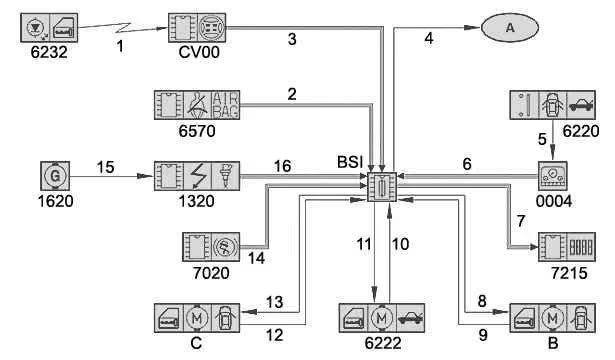
Key:
- Single arrow: Wire connection
- Triple arrow: Multiplexed connection
| Components | |
|---|---|
| A | Direction indicators |
| B | Lock assembly for rear doors |
| C | Lock assembly for front doors |
| BSI | Built-in systems interface |
| CV00 | Switch module at the steering wheel |
| 0004 | Instrument panel |
| 1320 | Engine ECU |
| 1620 | Vehicle speed sensor (*) |
| 6220 | Door locking central switch |
| 6222 | Boot lock assembly |
| 6232 | High frequency transmitter |
| 6570 | Air bag and pretensioners control unit |
| 7020 | ABS ECU (or ESP according to version) |
| 7215 | multifunction screen |
(*) Depending on the equipment on the vehicle, the vehicle speed information comes either from the vehicle sensor or from the ESP or ABS ECU.
| Connections | ||
|---|---|---|
| N° | signal | Nature of signal |
| 1 | Doors and tailgate unlocking request. Doors and tailgate locking request. Deadlocking request | High frequency signal |
| 2 | Information for triggering of a pyrotechnic component for unlocking of openers in the event of collision | VAN CAR1 |
| 3 | Unlocking request. Locking request. Deadlocking request (according to model) | VAN CAR1 |
| 4 | Lighting of the direction indicators | All or nothing |
| 5 | Central unlocking request. Central locking request | filament |
| 6 | Doors central locking switch status (locked/unlocked) | Comfort VAN |
| 7 | Display of doors and tailgate status | Comfort VAN |
| 8 | Information on status of door open switches (CPO) on the rear doors | All or nothing |
| 9 | Control of locking/unlocking motors on the rear doors | All or nothing |
| 10 | Information on status of the door open switch (CPO) on the boot | All or nothing |
| 11 | Control of opening or release of the boot | All or nothing |
| 12 | Information on door open switches (CPO) on the front doors. Information on locking button switches (CTF) on the front doors | All or nothing |
| 13 | Control of locking/unlocking motors on the front doors | All or nothing |
| 14 | Vehicle speed information (*) | CAN |
| 15 | Vehicle speed information (*) | filament |
| 16 | Vehicle speed information (*) | CAN |
(*) Depending on the equipment on the vehicle, the vehicle speed information comes either from the vehicle sensor or from the ESP or ABS ECU.
4. High frequency remote control
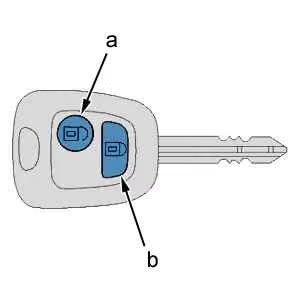
| Reference | Description |
|---|---|
| "a" | Unlock doors |
| "b" | Locking / deadlocking of doors and tailgate. Vehicle location |
4.1. Remote control functioning conditions
The remote control functions are activated.
| Condition |
|---|
| If the key is not inserted in the ignition |
| Or if the key is in the ignition in the stop position, 1 minute after the opening of the driver’s door Or if the key is in the ignition in the stop position, 1 minute after the return of the key from the +ACC position to the stop position |
4.2. Operations performed
| The remote control activates the following functions | |
|---|---|
| Function | Designation |
| Unlocking | A first press unlocks the doors and tailgate |
| Locking | Opening of doors and tailgate is impossible from outside the vehicle |
| Deadlocking | Opening of doors and tailgate is impossible from outside and from inside the vehicle (only on the front passenger’s and driver’s doors) |
| Location | Flashing of the direction indicators and lighting of the interior lamps for 10 seconds |
N.B.: A message on the instrument panel informs the user that the battery is becoming spent when its performance diminishes.
4.3. Matching with the vehicle
Use of the remote control necessitates matching with the vehicle.
The coded message sent to the receiver by each remote control is composed of the following codes:
- A fixed code linked to the key
- A rolling code matched with the vehicle’s receiver
- A code corresponding to the action to be performed
- A code corresponding to the condition of charge of the batteries
4.4. Resynchronisation of the remote control
The rolling code of the remote control is modified each time the remote control is used.
A small offset between the rolling code expected by the receiver and that transmitted by the remote control is tolerated (case of use of the remote control outside the range of the receiver).
In the event of this tolerance being exceeded it is necessary to resynchronise the remote control.
The tolerance is of 255 offsets.
| To resynchronise the remote control, this procedure has to be followed | |
|---|---|
| Stage | Action |
| 1 | Switch on the ignition using the key whose remote control is to be resynchronised |
| 2 | Press one of the transmitter buttons within 10 seconds of the appearance of ignition+ |
Parts & tools for this job For 2002 Citroën Berlingo
- TOOLTrim removal tool kitSearch: trim removal tool kit
- PARTTouch-up paintSearch: Citroën touch up paint
- PARTPanel clip assortmentSearch: Citroën panel clips assortment
As an Amazon Associate we earn from qualifying purchases.