
Draining - Refilling - Draining: Brake circuit
- Make
- Citroën
- Model
- Berlingo (M59) Van Factory Workshop Manual
- Year
- 2002–2011
- Section
- Front brakes › Draining - Refilling - Draining: Brake circuit
Draining - Refilling - Draining: Brake circuit
ESSENTIAL: Ensure that the precautions relating to safety and cleanliness are adhered to.
1. Tooling
A bleed unit approved by the manufacturer.
A diagnostic tool.
2. Draining
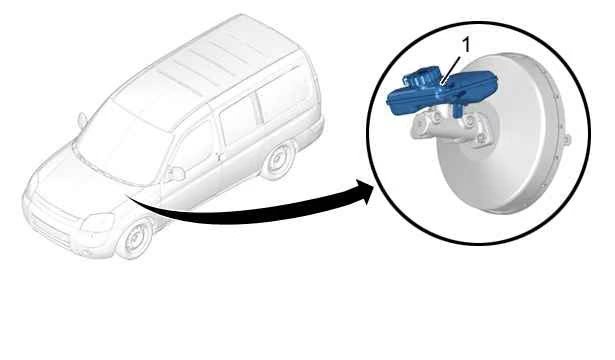
Remove the brake fluid reservoir filter 1.
Drain the brake fluid reservoir (1) as much as possible; Using a clean syringe.
Refit the brake fluid reservoir filter (1).
3. Refilling
N.B.: Use only new brake fluid which has not emulsified. Avoid the introduction of any impurities into the hydraulic circuit.
Use only approved and recommended hydraulic fluid(s): DOT4.
Fill the brake fluid reservoir (1) to its maximum capacity.
4. Precautions to be taken
CAUTION: During the bleed operations, take care to maintain the level of brake fluid in the brake fluid reservoir (1), topping it up.
Vehicles fitted with ABS or ESP have a system with 2 brake circuits:
- The primary brake circuit which is the main circuit pressurised directly by the brake pedal
- The secondary brake circuit inside the hydraulic block
Bleed each brake cylinder in the following order:
- The rear RH wheel
- The rear LH wheel
- The RH front road wheel
- The L.H. front wheel
N.B.: If the master cylinder is removed-refitted, it is advisable to complete the automatic bleed with a manual bleed.
5. Bleeding the primary braking circuit
CAUTION: Respect the order of opening of the bleed screws.
CAUTION: Do not switch on the ignition at any time during the operation.
N.B.: Bleed the primary circuit until clean, non-foaming brake fluid is obtained.
5.1. Bleeding the primary braking circuit (With the bleeding device)
Connect the bleed equipment to the brake fluid reservoir.
Bleed the circuit, following the instructions given in the instrument’s user manual.
5.2. Bleeding the primary braking circuit (without brake bleeding equipment)
N.B.: Two operators are necessary.
Place a transparent pipe on the bleed screw.
Press the brake pedal slowly.
Open the bleed screw.
Hold the pedal fully down.
Close the bleed screw.
Allow the brake pedal to come back up by itself.
Repeat the operation until the brake fluid runs out clean and free from bubbles.
Proceed in the same way for the other wheels.
N.B.: Check that the wheels rotate freely, with the handbrake released.
5.3. Check: Bleeding the primary braking circuit
N.B.: At the end of the bleed programme, check and top up, if necessary, the brake fluid level.
Check the brake pedal travel (no creep).
N.B.: If the travel is long and spongy, repeat the bleed procedure.
Start the engine.
Check the brake pedal travel (no creep); Carry out a road test (if necessary).
N.B.: If brake pedal travel is not correct; Bleed the secondary brake circuit.
6. Bleeding the secondary braking circuit
N.B.: Bleeding of the secondary braking circuit is done with a diagnostic tool This procedure is only carried out if the primary brake circuit has been bled The bleed is carried out with the engine off and requires two operators (Ignition on).
Connect the bleed equipment to the brake fluid reservoir.
Bleed the secondary brake circuit (Refer to the procedure of the diagnostic tool).
N.B.: At the end of the bleed programme, check and top up, if necessary, the brake fluid level.
Check the brake pedal travel (no extension), otherwise repeat the bleeding procedure.
Parts & tools for this job For 2002 Citroën Berlingo
- TOOLDigital multimeterSearch: automotive digital multimeter
- PARTAssorted fuse kitSearch: car fuse assortment kit
- TOOLWire crimper and connector kitSearch: wire crimper connector kit
As an Amazon Associate we earn from qualifying purchases.