
Main functions: MA piloted manual gearbox
- Make
- Citroën
- Model
- C2 Factory Workshop Manual
- Year
- 2003–2009
- Section
- Gearbox › Main functions: MA piloted manual gearbox
Main functions: MA piloted manual gearbox
1. General
1.1. Foreword
The MA piloted manual gearbox is a manual gearbox with electro-mechanical control of:
- Selection and engagement of gears
- Clutch operation
The MA piloted manual gearbox uses a special ECU and two electric actuators to operate the gearbox mechanically (dependent on the MA gearbox).
The driver changes gear without effort, there is no clutch pedal.
The changing of gears is possible without releasing the accelerator pedal.
The MA piloted manual gearbox allows the use of 2 operating programmes:
- "One-touch" programme: The driver decides to change gear
- "Automatic" programme: The gearbox ECU decides to change gear
1.2. Description
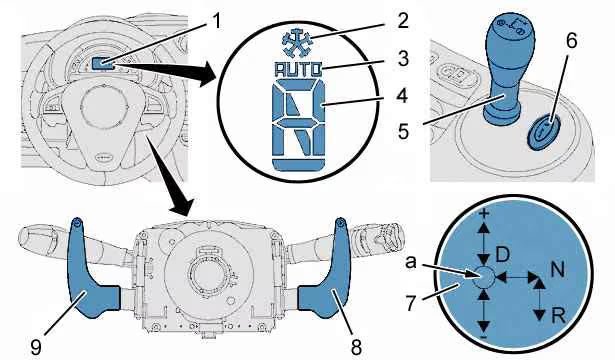
(1) Display in the instrument panel (liquid crystal display).
(2) Snow warning lamp.
(3) Auto warning lamp.
(4) Alphanumeric display.
(5) Gear selector.
(6) Programme selector connection.
(7) Gear selector grille.
(8) RH gear control at the steering wheel (+).
(9) LH gear control at the steering wheel (-).
Starting of the engine is authorised by a press on the brake pedal.
1.3. Identification of the vehicles
Vehicles can be identified by:
- Liquid crystal display, In the instrument panel
- Programme selector (6)
- The gear selector (5) (simplified selection grille (7))
- The gear controls at the steering wheel (8) (9)
1.4. Driver commands
Features of the gear controls at the steering wheel:
- Pull the control to change gear
- The LH gear control at the steering wheel (-) permits changing down
- The RH gear control at the steering wheel (+) permits changing up
- The gear controls at the steering wheel are integrated into the switch module under the steering wheel
- The gear controls at the steering wheel do not permit you to engage neutral (N) or reverse gear (R)
Features of the gear selector:
- The gear selector is electrically-controlled and has short travel
- The central position (a) of the gear selector is stable
- Position (+) engages a higher gear
- Position (-) engages a lower gear
- Position "N" engages the neutral position (neutral)
- Position "R" engages reverse gear
The programme selector allows you to select the following programmes:
- "Automatic" programme
- "One-touch" programme
- The "snow" programme is selected automatically if wheel spin is detected (ABS/ESP ECU, or gearbox ECU)
1.5. Driver information - Use
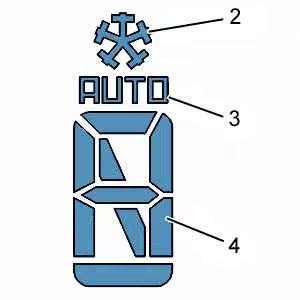
Display in the instrument panel (liquid crystal display).
(2) Snow warning lamp.
(3) Auto warning lamp.
(4) Alphanumeric display.
The display on the instrument panel shows:
- The programme that is active ("automatic" or "one-touch")
- The gear engaged (1, 2, 3, 4, 5, R, N)
The selected program is shown on the control panel by the corresponding lamp illuminating:
- "One-touch" programme active: The warning lamp (3) goes out
- "Automatic" programme active: The warning lamp (3) is illuminated
- "Snow" programme active: The warning lamp (2) is illuminated
If the display on the instrument panel is active, then you can change gear.
The gearbox ECU sends the information on the gear engaged to the BSI via the CAN network.
The BSI forwards the information on the gear engaged to the instrument panel.
2. Function
2.1. Unlock doors - Driver’s door opened
The opening of the driver’s door or the unlocking of doors and tailgate causes:
- A rapid initialisation of the gearbox actuators (clutch actuator, gearbox actuator)
- Activation of the display on the instrument panel
- Display of the gear engaged and the programme active
- The opening of the clutch, if the gear engaged is position "N"
When the ignition is switched on, the gearbox systematically places itself in the "automatic" programme.
The gears 1, 2, N and R can be engaged if the instrument panel is active.
2.2. Initialisation of the actuators
The gearbox ECU has to perform an initialisation of the actuators (clutch actuator, gearbox actuator) in the following cases:
- Disconnection of the battery before extinction of the instrument panel
- Disconnection of the battery before putting the gearbox ECU on shutdown mode (4 minutes after extinction of the instrument panel)
- Failure of initialisation or initialisations not recognised in the gearbox ECU (see the relevant operation)
On switching on the ignition while pressing the brake pedal (*) The gearbox ECU carries out:
- An initialisation of the clutch fork position (movements of the clutch fork)
- An initialisation of the gear lever position (movements of the gear lever)
(*) Starting of the engine is authorised by a press on the brake pedal.
CAUTION: The starting of the engine is prohibited during the operations to initialise the actuator positions.
N.B.: The waiting time for the initialisations of the actuator positions varies between 10 seconds and 1 minute.
N.B.: Initialisations not performed: The initialisation operations are performed at each attempt to start the vehicle.
2.3. Starting the engine - Starting safety
Starting of the engine is authorised by a press on the brake pedal.
This function allows:
- The presence of the driver to be confirmed (by operation of the brake pedal) before the vehicle can be driven by the engine
- To prevent sudden movement of the vehicle on selecting a gear
Gear engaged (1, 2 or R):
- The press on the brake pedal causes the clutch to open (declutching)
- The starting of the engine is authorised
- Release of the brake pedal before the engine has started causes the clutch to close, therefore a prohibition on starting
- With the engine running, gear engaged, a press on the accelerator pedal causes the vehicle to move
The progressiveness of the speed of the vehicle’s movement is regulated by the level and speed of the action on the accelerator pedal.
Gear "N" engaged:
- The clutch opens as soon as the instrument panel lights up
- Starting of the engine is authorised by a press on the brake pedal
2.4. Choosing a gearbox operating mode
When the ignition is switched on, the gearbox systematically places itself in the "automatic" programme.
The driver can select the programme he wants by pressing the programme selector.
The instrument panel displays the programme selected by the driver.
2.5. Engaging a gear
First gear is engaged by means of an action on one of the controls (+) (gear selector, gear controls at the steering wheel).
Engine speed has to be close to idling speed.
N.B.: Reverse gear can only be engaged when pressing the brake pedal, vehicle stationary.
N.B.: The controls at the steering wheel do not permit the neutral "N" and reverse "R" positions to be selected.
According to the position of the programme selector (see corresponding chapter).
3. Operation in automatic mode
3.1. General
Gear changes between 1st and 4th take place automatically (without any action by the driver).
Allows gears to be changed without the accelerator pedal being released.
Gear changes take place automatically according to the following parameters:
- Position of the accelerator pedal
- Vehicle engine load and speed
- Road profile (vehicle travelling downhill, ...)
- Driving style
The ECU adapts the gearbox operation to the road, engine load and driving style.
The gearbox performance is linked to the driver’s driving style From the most sedate to the most sporting driving styles.
If the accelerator pedal is fully depressed, the ECU automatically goes to the KD point (kickdown) (changedown).
The "kick-down" function makes it possible to:
- Increase the time it remains in a certain gear before changing up (occcurs at a high engine speed)
- Change down a gear if certain conditions relating to the vehicle speed are met
3.2. Methods of changing gear
Methods of changing up.
| Dependent on the driver’s actions | Without driver action |
|---|---|
| Action on the accelerator pedal and acceleration of the vehicle | Reduced engine load |
| (vehicle on flat surface, ...) | |
| Accelerator pedal released after "kick-down" | Gear changes progressively adapted to the driving style |
| Action on the following components (*): | Freed from locking function preventing the changing up of gears (gearbox ECU) |
| Gear selector (+) or (++) | |
| Gear controls at the steering wheel (+) or (++) |
(+) or (-) A single action is performed.
(++) or (--) Two successive actions are performed.
(*) The gearbox ECU automatically selects the "one-touch" programme.
Methods of staying in gear.
| Dependent on the driver’s actions | Without driver action |
|---|---|
| Rapid release of the accelerator pedal | - |
| Accelerator pedal released (foot raised) | - |
Methods of changing down.
| Dependent on the driver’s actions | Without driver action |
|---|---|
| Pressing down the accelerator pedal | Vehicle speed decreases |
| (vehicle on a slope) | |
| Foot fully down on the accelerator pedal | Engine load increases |
| (kickdown) (*) | (vehicle on a slope) |
| Action on the brake pedal | - |
| Action on the following components (**): | - |
| Gear selector (-) or (--) | |
| Gear controls at the steering wheel (-) or (--) |
(+) or (-) A single action is performed.
(++) or (--) Two successive actions are performed.
(*) Change-down if the vehicle speed conditions permit.
(**) The gearbox ECU automatically selects the "one-touch" programme.
Selecting the "one-touch" programme.
The "one-touch" programme is selected after the following actions are taken:
- Press button "(6)" of the program selector
- Action one of the controls: (+) or (-) (gear selector, gear controls at the steering wheel)
An action on a control (+) changes up a gear.
An action on a control (-) changes down a gear.
N.B.: A command that is incompatible with the vehicle speed or the engine speed is ignored.
"snow" program.
The "snow" programme is selected automatically if wheel spin is detected (ABS/ESP ECU, or gearbox ECU).
Special features:
- Selection of the 1st gear is prevented
- Gear changes are less frequent than for the other programmes
- Allows a smooth performance (no sudden variation in torque to the wheels)
- Forced downshifting when braking
- With the gear selector in the central position, starting is performed in 2nd gear
The "snow" programme is deselected as soon as the wheels cease to spin.
4. Operating in "one-touch" mode
4.1. General
The driver initiates the change of gear using either the gear selector or the gear controls at the steering wheel.
4.2. Engaging a gear
First gear is engaged by means of an action on one of the controls (+) (gear selector, gear controls at the steering wheel).
Engine speed has to be close to idling speed.
N.B.: Reverse gear can only be engaged when pressing the brake pedal, vehicle stationary.
N.B.: The controls at the steering wheel do not permit the neutral "N" and reverse "R" positions to be selected.
4.3. Methods of changing gear
The driver can engage the gear he wants using the following components:
- Gear selector
- Gear controls at the steering wheel
Double change of gear.
The driver can perform a double change of gear with 2 consecutive actions on the controls: (+) or (-) (gear selector, gear controls at the steering wheel).
Between 2 actions: (+) or (-); It is essential for the gear selector to pass through the central position.
Between 2 actions: (+) or (-); The gear controls at the steering wheel must be released.
N.B.: A command that is incompatible with the vehicle speed or the engine speed is ignored.
Methods of changing up.
| Dependent on the driver’s actions | Without driver action |
|---|---|
| Action on the following components: | Maximum engine speed reached, The higher gear is engaged (*) |
| Gear selector (+) or (++) | |
| Gear controls at the steering wheel (+) or (++) |
(+) or (-) A single action is performed.
(++) or (--) Two successive actions are performed.
(*) The "one-touch" programme remains active.
Methods of changing down.
| Dependent on the driver’s actions | Without driver action |
|---|---|
| Action on the following components: | Engine speed too low (under-revving) (*) |
| Gear selector (-) or (--) | |
| Gear controls at the steering wheel (-) or (--) |
(+) or (-) A single action is performed.
(++) or (--) Two successive actions are performed.
(*) The "one-touch" programme remains active.
N.B.: If the engine speed is too low, the gearbox ECU causes the clutch to open so as to prevent the engine from stalling.
Selecting the "automatic" programme.
The driver can select the "automatic" programme while the vehicle is moving.
Engaging of position "N" with the vehicle moving.
The driver can engage position "N" while the vehicle is moving.
A press on one of the controls: (+) and (-); Causes the engaging of a gear that is compatible with the speed of the vehicle.
5. Engaging a gear - Vehicle parked
The gearbox ECU permits a gear to be engaged while the vehicle is parked, engine switched off:
- Gears 1, 2, N and R can be engaged with the ignition in the on position
- Gears 1, 2 and R can be engaged if the instrument panel is activated (number of changes of gear authorised: 1)
N.B.: It is not possible to disengage a gear when the ignition is switched off.
6. Safety functions
6.1. Starting the engine - Starting safety
Starting of the engine is authorised by a press on the brake pedal.
6.2. Incorrect actions on the driver controls
The driver controls are temporarily deactivated in the following cases:
- Commands that are contradictory between the gear selector and the gear controls at the steering wheel
- Prolonged press on the gear selector
- Prolonged actions on the controls at the steering wheel
- Prolonged actions on the gear selector
6.3. Automatic engaging of position "N"
The gearbox causes the engaging of position "N" after 20 seconds in the following conditions:
- Vehicle stopped
- Engine running
- Gear engaged
With the vehicle stopped, engine running, the opening of the driver’s door systematically causes the engaging of position "N".
An action on the accelerator pedal engages 1st gear if the vehicle is stationary for not more than 2 minutes.
7. Clutch protection functions
The gearbox ECU permanently calculates the clutch friction temperature.
With the vehicle on a slope, gear engaged, the driver is able to hold the vehicle by pressing the accelerator pedal.
The clutch progressively heats up.
If the clutch becomes too hot, the gearbox ECU causes a series of declutches/clutches to rock the vehicle and thus warn the driver.
N.B.: Always use the handbrake to immobilise the vehicle.
8. Faults display
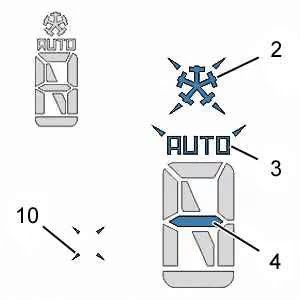
Display in the instrument panel (liquid crystal display).
(2) Snow warning lamp.
(3) Auto warning lamp (automatic).
(4) Alphanumeric display.
(10) Display flashing.
Simultaneous flashing of the "auto" and "snow" warning lamps signals a functioning fault.
In addition, the alphanumeric display shows a dash (4).
9. Summary of the operation of the controls
9.1. "Automatic" programme active
Actions on the gear selector.
| Gear engaged | Actions on the gear selector - "+" | Actions on the gear selector - "-" | Actions on the gear selector - "N" | Actions on the gear selector - "R" | Actions on the gear selector - "++" | Actions on the gear selector - "--" |
|---|---|---|---|---|---|---|
| R | A + 1 (a) | No action | A + N | No action | A + R | A + R |
| N | A + 1 | No action | No action | A + R | M + 2 | M + N |
| 1 | M + 2 | M + 1 | A + N | A + R | M + 3 | M + 1 |
| 2 | M + 3 | M + 1 | A + N | A + R | M + 4 | M + 1 |
| 3 | M + 4 | M + 2 | A + N | A + R | M + 5 | M + 1 |
| 4 | M + 5 | M + 3 | A + N | A + R | M + 5 | M + 2 |
| 5 | M + 5 | M + 4 (b) | A + N | A + R | M + 5 | M + 3 |
M: "one-touch" programme.
A: "automatic" programme.
R: Reverse gear.
N: Neutral.
(+) or (-) A single action is performed.
(++) or (--) Two successive actions are performed.
(a) Example 1:
- The gear engaged is reverse gear (R)
- An action (+) on the gear selector causes first gear to be engaged, you are still in "automatic" programme
(b) Example 2:
- The gear engaged is 5th gear
- An action (-) on the gear selector causes 4th gear to be engaged, you have selected "one-touch" programme
Action on the gear controls at the steering wheel.
| Gear engaged | Action on the gear controls at the steering wheel - "+" | Action on the gear controls at the steering wheel - "-" | Action on the gear controls at the steering wheel - "++" | Action on the gear controls at the steering wheel - "--" |
| R | No action | No action | A + R | A + R |
| N | M + 1 | No action | M + 2 | M + N |
| 1 | M + 2 | No action | M + 3 | M + 1 |
| 2 | M + 3 | M + 1 | M + 4 | M + 1 |
| 3 | M + 4 | M + 2 | M + 5 | M + 1 |
| 4 | M + 5 | M + 3 | M + 5 | M + 2 |
| 5 | No action | M + 4 | M + 5 | M + 3 |
M: "one-touch" programme.
A: "automatic" programme.
R: Reverse gear.
N: Neutral.
(+) or (-) A single action is performed.
(++) or (--) Two successive actions are performed.
Actions on the programme selector.
| Gear engaged | Actions on the programme selector |
|---|---|
| R | M + R |
| N | M + N |
| 1 | M + 1 |
| 2 | M + 2 |
| 3 | M + 3 |
| 4 | M + 4 |
| 5 | M + 5 |
M: "one-touch" programme.
A: "automatic" programme.
R: Reverse gear.
N: Neutral.
9.2. "One-touch" programme active
Actions on the gear selector.
| Gear engaged | Actions on the gear selector - "+" | Actions on the gear selector - "-" | Actions on the gear selector - "N" | Actions on the gear selector - "R" | Actions on the gear selector - "++" | Actions on the gear selector - "--" |
|---|---|---|---|---|---|---|
| R | M + 1 | No action | M + N | No action | M + R | M + R |
| N | M + 1 | No action | No action | M + R | M + 2 | M + N |
| 1 | M + 2 | No action | M + N | M + R | M + 3 | M + 1 |
| 2 | M + 3 | M + 1 | M + N | M + R | M + 4 | M + 1 |
| 3 | M + 4 | M + 2 | M + N | M + R | M + 5 | M + 1 |
| 4 | M + 5 | M + 3 | M + N | M + R | M + 5 | M + 2 |
| 5 | No action | M + 4 | M + N | M + R | M + 5 | M + 3 |
M: "one-touch" programme.
A: "automatic" programme.
R: Reverse gear.
N: Neutral.
(+) or (-) A single action is performed.
(++) or (--) Two successive actions are performed.
Action on the gear controls at the steering wheel.
| Gear engaged | Action on the gear controls at the steering wheel - "+" | Action on the gear controls at the steering wheel - "-" | Action on the gear controls at the steering wheel - "++" | Action on the gear controls at the steering wheel - "--" |
| R | No action | No action | M + R | M + R |
| N | M + 1 | No action | M + 2 | M + N |
| 1 | M + 2 | No action | M + 3 | M + 1 |
| 2 | M + 3 | M + 1 | M + 4 | M + 1 |
| 3 | M + 4 | M + 2 | M + 5 | M + 1 |
| 4 | M + 5 | M + 3 | M + 5 | M + 2 |
| 5 | No action | M + 4 | M + 5 | M + 3 |
M: "one-touch" programme.
A: "automatic" programme.
R: Reverse gear.
N: Neutral.
(+) or (-) A single action is performed.
(++) or (--) Two successive actions are performed.
Actions on the programme selector.
| Gear engaged | Actions on the programme selector |
|---|---|
| R | A + R |
| N | A + N |
| 1 | A + 1 |
| 2 | A + 2 |
| 3 | A + 3 |
| 4 | A + 4 |
| 5 | A + 5 |
M: "one-touch" programme.
A: "automatic" programme.
R: Reverse gear.
N: Neutral.
Parts & tools for this job For 2003 Citroën C2
- PARTClutch kitSearch: Citroën C2 2003 clutch kit
- TOOLClutch alignment toolSearch: clutch alignment tool
- FLUIDGear oilSearch: Citroën C2 manual gearbox oil
As an Amazon Associate we earn from qualifying purchases.