
Presentation: Airbags
- Make
- Citroën
- Model
- C3 Factory Workshop Manual
- Year
- 2002–2009
- Section
- Airbags › Presentation: Airbags
Presentation: Airbags
1. Variation of equipment on vehicles
| equipment | C3 | C3 Pluriel | C2 |
| Front pyrotechnically pretensioned seat belt | Yes | Yes | Yes |
| Rear pyrotechnically pretensioned seat belt | No OK | No OK | No OK |
| Driver’s airbags | Yes (standard) | Yes (standard) | Yes (standard) |
| Passenger’s airbags | Yes (*) | Yes (*) | Yes (*) |
| chest type side airbags | Yes (*) | Yes (*) | Yes (*) |
| curtain type side airbags | Yes (*) | No OK | Yes (*) |
| Key for deactivating passenger’s airbag | Yes | Yes | Yes |
| Lateral sensor | Yes (*) | Yes (*) | Yes (*) |
(*) According to equipment.
2. Airbag ECU
The airbag ECU manages deployment of the pyrotechnically pretensioned seat belts and the airbags.
The airbag ECU is installed between the two front seats, at floor level.
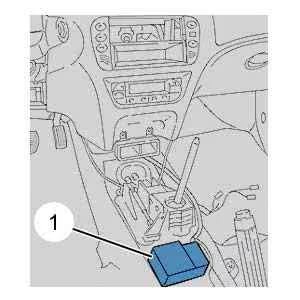
(1): Airbag ECU.
3. Front airbags
The front airbag is a complement to the seat belt, designed to activate in the event of a violent front impact.
Its role is to interpose itself between the front occupant(s) of the vehicle and the dashboard, to absorb their projection forward at the time of a violent frontal impact and thus to limit the risk of serious injury to head and chest.
The airbags are not deployed by only a slight front impact, by a rear impact or by the vehicle overturning, as they would not be of use in these instances.
4. Side airbags
The side airbags are designed to deploy in the event of a substantial lateral impact, but only on the side where the impact occurs.
The side airbags are not designed to deploy when the side collision is only slight, or in the event of a rear or front collision or overturning, as they would not be of use in these instances.
4.1. Chest type side airbags
The role of the chest-type side airbag is to insert itself between the driver or passenger and the door panel at chest level.
The chest-type side airbags are incorporated in the outer side wings of the driver’s and passenger’s seats.
4.2. Curtain type side airbags
The role of the "curtain airbag" is to interpose itself between the front or rear occupant and the windows. It thus limits the risks of serious injury to the head.
The curtain airbags are incorporated under the roof trim, on each side of the vehicle.
N.B.: At the time of a very violent lateral impact, the front airbags may also deploy.
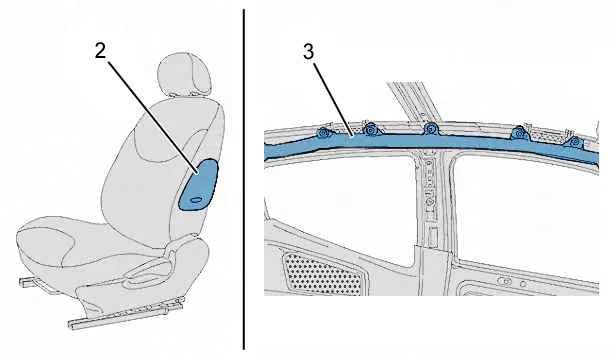
Key:
- "2": Chest type side airbag
- "3": Curtain type side airbag
5. Seat belts with pyrotechnic pretentioners and force limiters
The aim of the pretensioners is to tighten the front seat belts in order to hold the occupants firmly back against the seat, thus to increase their effectiveness.
The traction is obtained by deployment of a pyrotechnic cartridge.
In the case of a minor impact, the seat belts alone may be triggered.
The force limiter comes into play after the pretensioner and reduces the belt pressure exerted on the occupant’s chest.
6. Side sensors
The lateral sensors measure the lateral acceleration and transmit the information on this to the airbag ECU.
There is a lateral sensor on each side of the vehicle.
Coomunication between the sensors and the airbag ECU is assured by 2 wires in twisted cables. These 2 wires also assure the supply of the sensors.
The sensors transmit:
- The data on deceleration to the airbag ECU
- Presence information which detects a connection fault between the sensors and the airbag ECU
From being energised, the lateral sensors are completely operational within 4 seconds.
It performs its own auto-diagnosis in 500 milliseconds and sends presence information and the reference of calibration to the airbag ECU.
7. Deactivation of the passenger’s airbag
The passenger’s airbag can be deactivated by means of the switch (4).
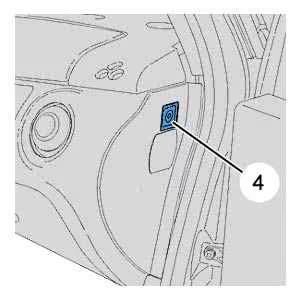
The deactivation of the passenger’s airbag allows the use of a rear facing child seat.
The passenger’s airbag deactivation warning lamp keeps the driver informed of the airbag’s functioning status.
N.B.: The passenger’s pyrotechnically pretensioned seat belt is not deactivated by the key.
8. General over-view
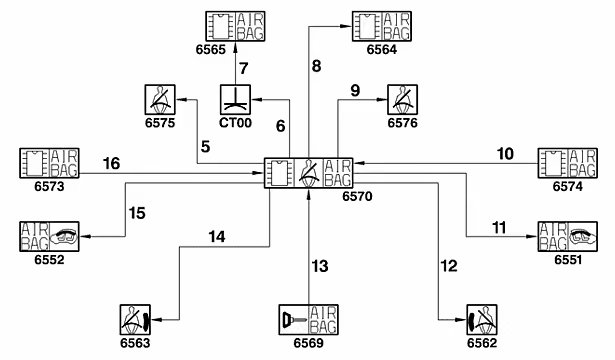
Single arrow: Wire connection.
| Components | |
|---|---|
| CT00 | Rotary connector |
| 6551 | Curtain type right-hand side airbag |
| 6552 | Curtain type left-hand side airbag |
| 6562 | Chest type right-hand side airbag |
| 6563 | Chest type left-hand side airbag |
| 6564 | Passenger airbag |
| 6565 | Driver’s airbag |
| 6569 | Passenger’s airbag deactivation switch |
| 6570 | Airbag ECU |
| 6573 | LH lateral sensor |
| 6574 | RH lateral sensor |
| 6575 | Front left seat belt with pyrotechnic pretensioner |
| 6576 | Front RH pyrotechnically pretensioned seat belt |
| Connections | ||
|---|---|---|
| No. of link | signal | Nature of signal |
| 5 | Triggering | CURRENT LEVELS |
| 6 | Triggering | CURRENT LEVELS |
| 7 | Triggering | CURRENT LEVELS |
| 8 | Triggering | CURRENT LEVELS |
| 9 | Triggering | CURRENT LEVELS |
| 10 | Deceleration information | Analogue |
| 11 | Triggering | CURRENT LEVELS |
| 12 | Triggering | CURRENT LEVELS |
| 13 | Passenger airbag deactivation switch status | All or nothing |
| 14 | Triggering | CURRENT LEVELS |
| 15 | Triggering | CURRENT LEVELS |
| 16 | Deceleration information | Analogue |
Parts & tools for this job For 2002 Citroën C3
- TOOLOBD2 scanner with SRSSearch: OBD2 scanner ABS SRS
- TOOLTrim removal tool kitSearch: trim removal tool kit
As an Amazon Associate we earn from qualifying purchases.