
Operating conditions: Diesel fuel circuit
- Make
- Citroën
- Model
- C4 Factory Workshop Manual
- Year
- 2004–2010
- Section
- Air and fuel supply › Operating conditions: Diesel fuel circuit
Operating conditions: Diesel fuel circuit
1. Recommendations
CAUTION: The addition of additives such as fuel circuit cleaner/remetalliser, is prohibited.
2. Safety recommendations (When carrying out work)
2.1. Foreword
All operations on the injection system must be carried out in conformity with the following instructions and regulations:
- Of the health authorities
- For the prevention of accidents
- For protection of the environment
The operations must be carried out by specialist personnel informed of the safety advice and the precautions to be taken.
2.2. Safety recommendations
Bearing in mind the high pressures (1500 bars) which may exist in the fuel circuit, follow the instructions below:
- Do not smoke in the immediate vicinity of the high pressure circuit when work is being carried out
- Avoid working near flames or sparks
- Do not carry out any operations on the high pressure fuel circuit with the engine running
- When the engine has stopped, use the diagnostic tool to check that the pressure in the rail has dropped, before carrying out any work; this may take several minutes
N.B.: The waiting time is necessary to allow the high pressure fuel circuit to return to normal atmospheric pressure.
engine running:
- Always stay out of range of a possible jet of fuel which may cause serious injuries
- Do not place your hands near the site of a leak on the high pressure fuel circuit
2.3. Work area
The working area (ground etc.) must be clean and free from clutter; parts being repaired must be stored away from dust.
2.4. Preliminary operations
ESSENTIAL: Before carrying out any operations on the system, it may be necessary to clean the circuit concerned.
Sensitive components of the circuit:
- Fuel filter
- High pressure fuel pump
- Fuel high pressure common injection rail
- High pressure fuel pipes
- Low pressure fuel pipes
- Injector holders
ESSENTIAL: The operator must wear clean clothing.
CAUTION: Following removal immediately plug the high pressure circuit unions to prevent entry of impurities into the high pressure circuit.
CAUTION: Safety torques: always observe the high pressure circuit tightening torques (pipes, injector holder clips), using a regularly checked torque wrench.
3. Replacement of parts - Operations to be performed
CAUTION: Before carrying out any operations on the engine, read the injection ECU memories.
3.1. Prohibited operations
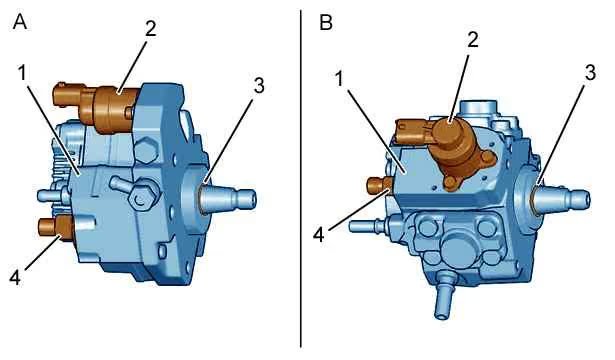
"A" Assembly with CP3.2 diesel high pressure pump.
"B" Assembly with CP1H diesel high pressure pump.
Do not detach the high pressure fuel pump (1) from the following components:
- (2) Flow solenoid (diesel)
- Sealing ring (3)
- High pressure outlet union (4) (Malfunction)
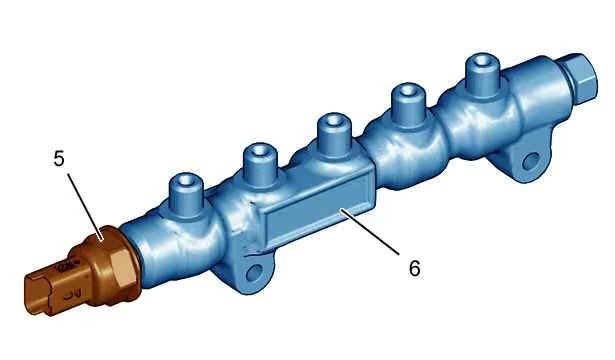
CAUTION: During the period of guarantee: Do not separate the fuel high pressure common injection rail (6) from the fuel high pressure sensor (5) (Malfunction).
N.B.: During the warranty period, for removing-refitting the fuel high pressure sensor, refer to the procedure for removing-refitting the fuel high pressure common injection rail.
N.B.: Outside the warranty period, removing-refitting the fuel high pressure sensor only is authorised.
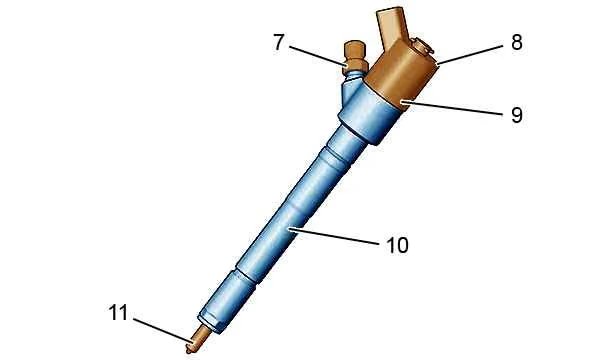
Do not detach the diesel injector holder (10) from the following components:
- Diesel injector (11)
- Electromagnetic element (8) (Non operation)
Do not turn the nut (9) (Malfunction).
Do not separate the union (7) from an injector.
CAUTION: Cleaning of the carbon deposit on the diesel injector nozzle and diesel or ultrasound cleaning is prohibited; All work on the high pressure pipes requires systematic replacement of these pipes.
3.2. Replacement of parts
When an injection ECU is replaced, the engine immobiliser system must be relearned.
To carry out the operation, the following conditions are necessary:
- Possession of the analogue module access code (written on the customer’s confidential card)
- Possession of a new injection ECU and diagnostic equipment
- Carry out a learning process for the engine ECU (Engine ECU Learning)
- Configure the ECU
3.3. Replacement of the injection ECU
CAUTION: Exchanging the injection ECU between two vehicles results in it being impossible to start the vehicle.
4. Packaging for warranty return
Injection system parts return.
Before return to the technical inspection centre, the following components must be plugged, placed in a plastic bag and packed in the original packaging of the replacement parts:
- Injectors ()
- High pressure fuel pump
- Supply rail
- High pressure fuel sensor
Parts & tools for this job For 2004 Citroën C4
- PARTGlow plugsSearch: Citroën C4 2004 glow plugs
- TOOLGlow plug socketSearch: glow plug socket
- TOOLDiesel compression testerSearch: diesel compression tester
As an Amazon Associate we earn from qualifying purchases.