
Check: Turbocharge pressure (DW10CTED4)
- Make
- Citroën
- Model
- C5 (X7) Factory Workshop Manual
- Year
- 2008–2017
- Section
- Turbocharging › Check: Turbocharge pressure (DW10CTED4)
Check: Turbocharge pressure (DW10CTED4)
ESSENTIAL: Observe the safety and cleanliness recommendations.
1. Tooling
Equipment: Diagnostic tool.
| tool | Reference | Designation |
|---|---|---|
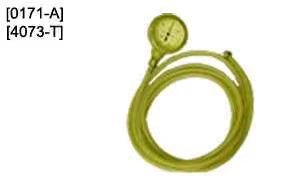
| [0171-A] [4073-T] | Pressure gauge for checking the turbocharging pressure |
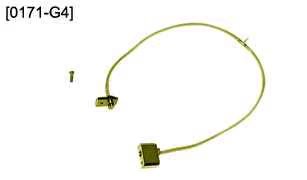
| [0171-G4] | Tool for checking inlet air pressure-vacuum |
2. Removing
CAUTION: Prior to any operation on a sensor or an actuator, read the memory of faults and do the necessary tests, with the aid of the diagnostic tool.
Remove the engine style cover.
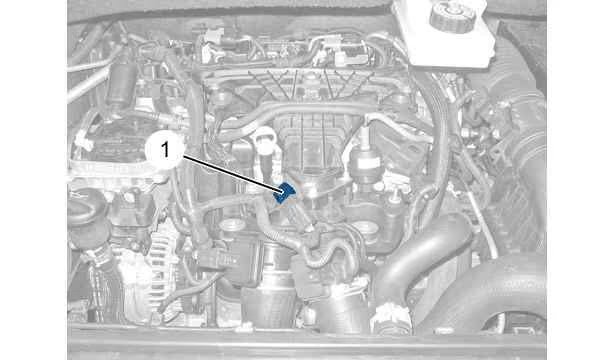
Remove the turbocharging pressure sensor (1).
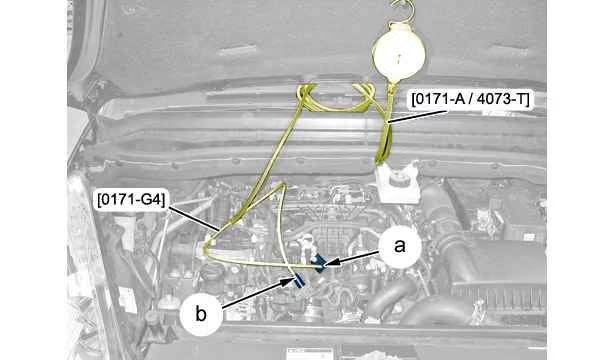
Connect:
- The tool [0171-G4] in place of the turbocharging pressure sensor (as "a")
- The turbocharging pressure sensor on the tool [0171-G4] (as "b")
- The tool [0171-A / 4073-T] on the tool [0171-G4]
Connect the diagnostic equipment to the vehicle’s diagnostic socket.
Place the diagnostic tool in parameter measures.
3. Check
3.1. Check (Vehicle stopped)
CAUTION: Observe the following checking conditions: Engine at operating temperature; Vehicle stopped.
Method of checking: Vehicle stopped:
- Start the engine
- Note the pressures on the tools [0171-A / 4073-T] and the diagnostic tool
- Accelerate the engine to 2500 r.p.m
- Note the pressures on the tools [0171-A / 4073-T] and the diagnostic tool
- Accelerate fully
- Note the pressures on the tools [0171-A / 4073-T] and the diagnostic tool
Compare the values of the pressures read.
3.2. Check (Road test)
CAUTION: Observe the following checking conditions: Engine at operating temperature; Vehicle being driven; Two operators are necessary.
Method of checking: On road test:
- Place the tools [0171-A / 4073-T] and the diagnostic tool inside the vehicle
- Start the engine
- Select 2nd gear
- Accelerate fully
- Note the pressures on the tools [0171-A / 4073-T] and the diagnostic tool
Compare the values of the pressures read.
3.3. Verification of the coherence of the signal
If there is a big difference between the pressures taken by the diagnostic tool and on the pressure gauge, do the tests on the turbo pressure sensor and its supply circuit.
If the pressures taken are identical between the diagnostic tool and the pressure gauge, but different from the reference values; Perform the tests as required by the diagnostic tool.
Table summarising the possible causes of a turbo pressure fault.
| Faults: Turbocharger pressure | ||||
|---|---|---|---|---|
| Lack of pressure | Measured pressure too high | Pressure fluctuations (Hesitation while driving) | Turbo whistles | |
| Possible causes | Break in the turbo circuit (collars - Air ducts - Exchanger) | Variable geometry control fault (Vacuum circuit - Actuator …) | Turbocharger variable geometry actuator fault (Hard spot) | Break in the turbo circuit (collars - Air ducts - Exchanger) |
| Variable geometry control fault (Vacuum circuit - Actuator …) | Information from the turbocharger position copy sensor incorrect | Transient circuit breaks in the variable geometry control (Vacuum pipes - Actuator …) | Increase in the imbalance on the turbocharger shaft | |
| Clogging: Turbocharging circuit (Air cleaner / catalytic converter) | Movements of the flaps in the air loop (Metering unit - Recycling valve) | Information from the turbocharger position copy sensor (Transient circuit breaks) | ||
| Movements of the flaps in the air loop (Metering unit - Recycling valve) | Signal fault: Air temperature (Air flow meter) | Signal fault: (Transient circuit breaks): Air temperature - Air flow meter - Atmospheric pressure | ||
| Information from the turbocharger position copy sensor incorrect | Signal fault: Atmospheric pressure | Signal fault: (Transient circuit breaks): Turbocharging pressure sensor | ||
| Signal fault: Turbocharging pressure sensor | Signal fault: Turbocharging pressure sensor | |||
| Lack of fuel flow (Low pressure - High pressure) | ||||
| Turbocharger fault (Significant play - Fins damaged) | ||||
| Engine temperature: Too high | ||||
N.B.: This table gives the possible causes of problems with the turbo system as a guide, but it is not exhaustive.
4. Refitting
CAUTION: Adhere to the tightening torques.
Remove the tools [0171-A / 4073-T], [0171-G4].
Refit: The turbocharging pressure sensor (1).
Refit the engine style cover.
CAUTION: Perform the operations to be carried out following reconnection of the battery.
Reconnect the battery.
CAUTION: Clear the memory of faults; Using the diagnostic equipment.
Parts & tools for this job For 2008 Citroën C5
- PARTEngine gasket setSearch: Citroën C5 2008 engine gasket set
- TOOLTorque wrenchSearch: 3/8 inch torque wrench
- TOOLFeeler gauge setSearch: feeler gauge set
As an Amazon Associate we earn from qualifying purchases.