
General: Vehicle stability management
- Make
- Citroën
- Model
- C8 Factory Workshop Manual
- Year
- 2002–2014
- Section
- Front brakes › General: Vehicle stability management
General: Vehicle stability management
1. Foreword
Management of vehicle adhesion allows:
- Retention of vehicle manoeuvrability (conserving the lateral guidance of the front wheels) by avoiding locking of the front wheels
- Retention of directional stability (conserving the lateral guidance of the rear wheels) by avoiding locking of the rear wheels
- Control of traction to drive the vehicle forward while avoiding wheel spin
- Retention of vehicle control during critical avoidance manoeuvres (within the laws of physics) by correcting the trajectory of the vehicle
| Adhesion management | Name of function | Description |
|---|---|---|
| When braking | Electronic brake distributor (REF) | The ECU modulates the braking pressure of the rear wheels to prevent them locking |
| When braking | Anti-lock brakes (ABS) | The ECU modulates braking pressure to prevent the wheels locking |
| On acceleration. When braking | Traction control (BASR) | The ECU brakes the wheel to avoid wheelspin. The ECU modulates braking pressure to prevent the wheels locking |
| On acceleration | Traction control (ASR) | The ECU brakes the wheel and adjusts the engine torque to prevent wheelspin |
| When decelerating | Antilocking when using engine braking (MSR) | The ECU manages engine torque during use of the engine brake to prevent the wheels locking |
| When braking. On acceleration. In trajectory | Dynamic stability control (ESP) | The ECU modulates braking pressure to prevent the wheels locking. The ECU brakes the wheel and adjusts the engine torque to prevent wheelspin. The ECU brakes the wheels independently to optimise the vehicle’s trajectory |
2. Summary of functions
| The table below gives the functions included in addition to the basic functions | |
|---|---|
| Name of function | Additional functions included |
| ABS | REF |
| BASR | ABS. REF. Traction control (only by braking) |
| Traction control | ABS. REF. MSR |
| ESP | ABS. REF. MSR. Traction control |
| Abbreviation | Designation |
|---|---|
| ABS | Anti-lock brakes |
| REF | Electronic brake distributor |
| BASR | Traction control by braking only |
| Traction control | Traction control |
| ESP | Stability control |
| MSR | Antilocking when using engine braking |
3. Anti-lock brakes (ABS)
3.1. General
The ABS system avoids locking the front and rear wheels when braking.
The vehicle’s directional stability and manoeuvrability are thus maintained.
Braking distance is optimised.
The system manages the braking pressure applied to the calipers, controlling each wheel independently to avoid locking.
3.2. Flow chart
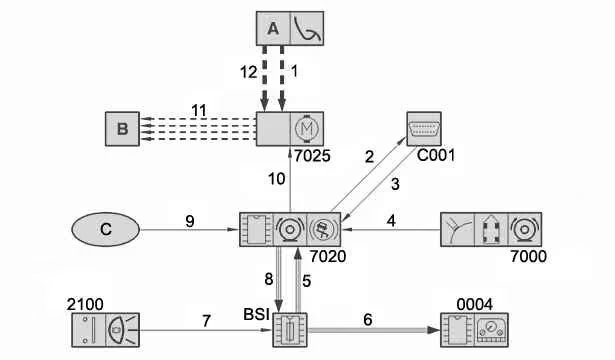
Key:
- Single arrow: Wire connection
- Triple arrow: Multiplexed connection
- Dotted arrow: Hydraulic link
| Components | |
|---|---|
| A | Brake master cylinder |
| B | Brake calipers |
| C | Brake pad wear |
| BSI | Built-in systems interface |
| 0004 | Minimum brake fluid level alert. Brake pad wear warning lamp. ABS fault warning lamp |
| 2100 | Stop switch |
| 7000 | ABS sensor |
| 7020 | ABS ECU |
| 7025 | ABS hydraulic block |
| C001 | Diagnostic connector |
| Connections | ||
|---|---|---|
| No. of link | signal | Nature of signal |
| 1 | Braking request by the driver (front circuit) | Hydraulic |
| 2 | Reading fault codes. Reading of the parameters | Diagnostic line |
| 3 | ACTUATOR TESTS. Configuration | Diagnostic line |
| 4 | Signal from the ABS sensors | Frequency modulated |
| 5 | Status of the brake pedal switch | CAN network |
| 6 | Brake fluid minimum level information. Front brake pad wear information. Operating fault information on ABS and the REF function | BODYWORK VAN network |
| 7 | Status of the brake pedal switch | filament |
| 8 | Request for illumination of the ABS warning lamp. Request to light the REF fault lamp. Status of the brake pedal switch | CAN network |
| 9 | Brake pad wear. Brake fluid level | filament |
| 10 | Control of the hydraulic pump electric motor. Control of the electrovalves | filament |
| 11 | Assisted brake pressure to the brake calipers | Hydraulic |
| 12 | Braking request by the driver (rear circuit) | Hydraulic |
4. Traction control (BASR)
4.1. General
The traction control function avoids wheelspin on the driving wheels.
When a wheel spins, the ABS ECU brakes this wheel. This braking allows the engine torque to be transferred to the other wheel.
The vehicle’s directional stability, traction and manoeuvrability are thus maintained.
4.2. Flow chart
The synopsis of the BASR function is identical to the synopsis of the ABS function, only the ECU program is different.
5. Dynamic stability control (ESP)
5.1. General
The ESP function optimises the vehicle’s trajectory.
The function is divided into three operations:
- Calculating the trajectory desired by the driver
- Calculation of the vehicle’s actual trajectory
- Calculation of the corrections needed for the vehicle to follow the trajectory desired by the driver (within the laws of physics)
5.2. Flow chart
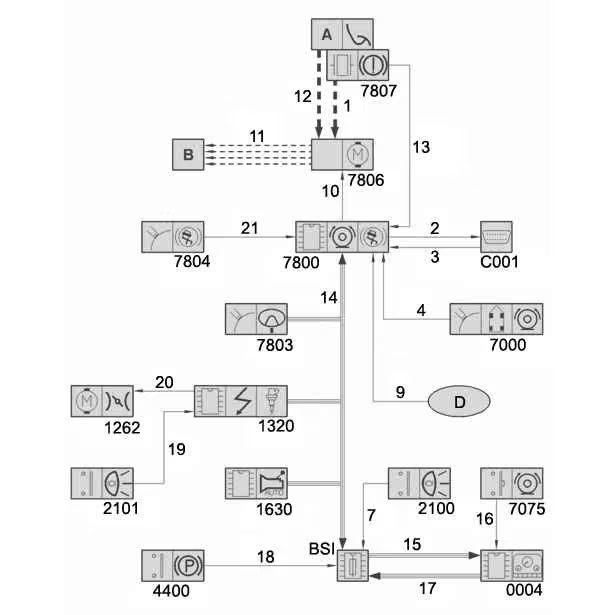
Key:
- Single arrow: Wire connection
- Triple arrow: Multiplexed connection
- Dotted arrow: Hydraulic link
| Components | |
|---|---|
| A | Brake master cylinder |
| B | Brake calipers |
| BSI | Built-in systems interface |
| 0004 | Instrument panel |
| 7807 | Braking circuit pressure sensor |
| 7806 | ESP hydraulic unit |
| 7804 | ESP accelerometer gyroscope |
| 7800 | ESP ECU |
| 7000 | ABS sensor |
| 7803 | Stability control steering wheel angle sensor |
| 1262 | Motorised throttle |
| 1320 | Engine ECU |
| 2101 | Unused stoplamp switch |
| 1630 | automatic gearbox ECU |
| 4400 | Handbrake switch |
| 2100 | Stop switch |
| 7075 | Traction control cut-off switch |
| C001 | Diagnostic connector |
| Connections | ||
|---|---|---|
| No. of link | signal | Nature of signal |
| 1 | Braking request by the driver (braking circuit 1) | Hydraulic |
| 2 | Reading fault codes. Reading of the parameters | Diagnostic line |
| 3 | ACTUATOR TESTS. Configuration | Diagnostic line |
| 4 | Signal from the ABS sensors | Frequency modulated |
| 7 | Status of the stoplamp switch | filament |
| 9 | Brake pad wear. Brake fluid level | filament |
| 10 | Control of the hydraulic pump electric motor Stability control. Hydraulic block electrovalve control Stability control | filament |
| 11 | Assisted brake pressure to the brake calipers | Hydraulic |
| 12 | Braking request by the driver (braking circuit 2) | Hydraulic |
| 13 | Hydraulic pressure information (braking circuit 1) | filament |
| 14 | Steering wheel angle. Status of the stoplamp switch. Status of the handbrake switch. Direction of rotation of the stability control steering wheel angle sensor. Control of engine torque. Control of the suspension. Auto box control | CAN network |
| 15 | Warning for EBD fault, brake fluid level. ABS fault warning light. Brake pad wear warning lamp. Stability control fault warning. Stability regulation fault warning (ASR) | BODYWORK VAN network |
| 16 | Stability control deactivation switch (ASR) | filament |
| 17 | Deactivation of stability control (ASR) | BODYWORK VAN network |
| 18 | Handbrake switch position | filament |
| 19 | Stoplamp switch information unused | filament |
| 20 | Motorised gas butterfly control | filament |
| 21 | Vehicle’s lateral acceleration. Position on vehicle roll axis | filament |
6. Traction control (ASR)
6.1. General
The traction control function avoids wheelspin on the driving wheels.
When a wheel spins, the ABS ECU brakes this wheel. This braking allows the engine torque to be transferred to the other wheel.
If both wheels are spinning, the ABS ECU brakes both wheels and reduces the engine torque.
On petrol engines, the ABS ECU operates on the motorised butterfly and the ignition timing.
On diesel engines the ABS ECU operates on the injection time.
The vehicle’s directional stability, traction and manoeuvrability are thus maintained.
6.2. Flow chart
The synopsis of the traction control function is identical to the synopsis of the stability control function, only the ECU software is different.
Parts & tools for this job For 2002 Citroën C8
- PARTBrake padsSearch: Citroën C8 2002 brake pads
- TOOLBrake bleeder kitSearch: one man brake bleeder kit
- FLUIDBrake fluidSearch: brake fluid
As an Amazon Associate we earn from qualifying purchases.