
Removing - Refitting: Turbocharger (MHI)
- Make
- Citroën
- Model
- C-Elysée Factory Workshop Manual
- Year
- 2012–2020
- Section
- Turbocharging › Removing - Refitting: Turbocharger (MHI)
Removing - Refitting: Turbocharger (MHI)
ESSENTIAL: Observe the safety and cleanliness recommendations.
1. Removing
Place the vehicle on a ramp.
Disconnect the battery.
Remove:
- The engine style cover (according to equipment)
- The protective panel under the engine
- The catalytic converter
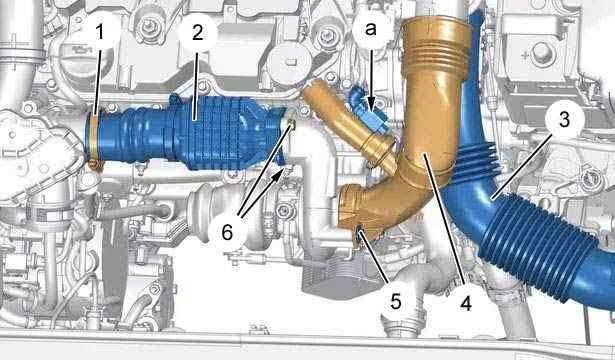
CAUTION: Protect the engine cooling radiator to prevent damage to the fins.
CAUTION: Plug the turbocharger inlet and outlet openings.
Disconnect the connector at "a".
Remove:
- The air inlet neck (3)
- The (5) bolt
- The turbocharger air inlet sleeve (4)
- The bolts (6)
- The clip (1)
- The turbocharger outlet expansion chamber (2); Retrieve the seal
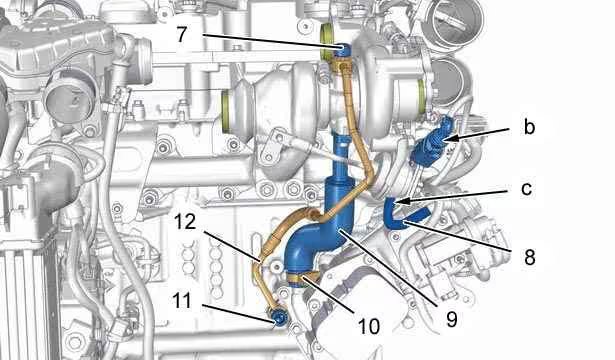
Uncouple the vacuum pipe (8) (at "c").
Disconnect the connector at "b".
CAUTION: Keep the filling cylinder full.
Remove:
- The banjo bolt (7) from the turbocharger lubrication inlet pipe (12)
- The copper seals
- The banjo bolt (11) from the turbocharger lubrication inlet pipe (12)
- The copper seals
- The turbocharger lubrication pipe (12)
Remove the collar (10).
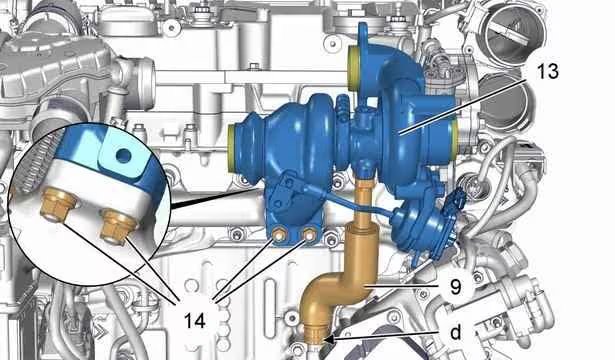
Uncouple the lubrication return pipe (9) (at "d").
Remove:
- The nuts (14)
- The turbocharger (13); Retrieve the seal
CAUTION: Protect: The exhaust manifold; Using the closer.
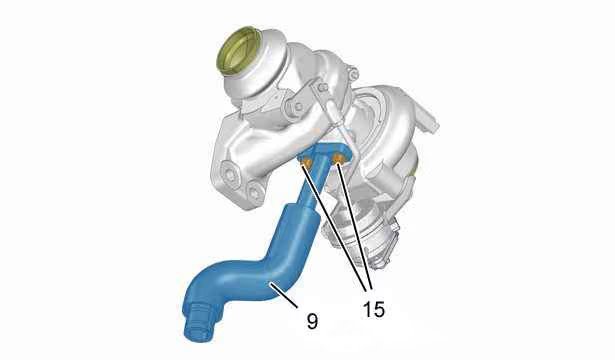
CAUTION: Mark the orientation of the lubrication return pipe (9).
Remove (on the work bench):
- The bolts (15)
- The lubrication return pipe (9)
2. Check
Examine the engine air filtering system.
Check:
- The air hoses ()
- The condition and the correct positioning of the vacuum pipe (8) of the turbocharger
Check the absence of foreign bodies in the following components:
- Induction circuit
- Exhaust gas manifold (Risk of destruction of the turbocharger (13) when operating)
Clean the surface of the turbocharger exhaust manifold (13).
Check that the oil circuit unions are clean.
CAUTION: Use the recommended bolts and nuts (heat resistant).
Replace:
- The turbocharger (13) fixing nuts (14)
- The banjo bolts (7), (11)
- The 4 copper seals of the turbocharger (13) lubrication banjo bolts (7),(11)
- The catalytic converter clips
3. Refitting
CAUTION: Adhere to the tightening torques.
CAUTION: At refitting, all the removed seals must be replaced with new seals.
CAUTION: When refitting: Remove the plugs on the turbocharger (13) at the last moment.
CAUTION: Clean the gasket faces with an approved descaling product. Do not use abrasives or sharp tools on the joint faces. The gasket faces must not have any traces of knocks or scores.
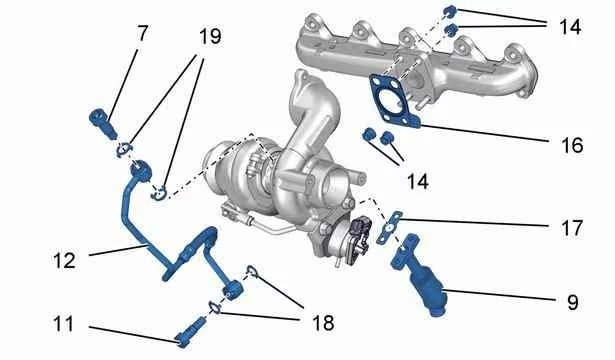
CAUTION: Test fit the components of the turbocharger (13), in order to adjust their position (Before final tightening).
CAUTION: Always replace: The nuts (14).
CAUTION: Always replace: The banjo bolts (7), (11).
Refit: New seals (16), (17), (18), (19).
CAUTION: Mark the orientation of the lubrication return pipe (9).
Refit (on the work bench):
- The lubrication return pipe (9)
- The bolts (15)
Couple up: The turbocharger (13) on the exhaust manifold.
Fit the nuts (14) (without tightening).
Position:
- The lubrication tube assembly (12)
- The banjo bolts (7), (11) (new)
- The copper seals (18), (19) (new)
Tighten the nuts (14) to the specified torque.
CAUTION: When refitting, lubricate the end of the lubrication return pipe (9) using engine oil.
Couple up: The lubrication return pipe (9) (at "d").
Refit the clip (10).
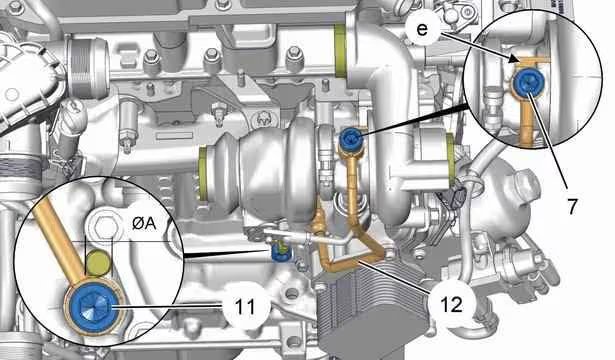
Tightening procedure: Lubrication pipe (12) upper union:
- Position the lug "e" of the lubrication pipe (12) (As indicated above)
- Tighten to the specified torque: The upper bolt (7)
Tightening procedure: Lubrication pipe (12) lower union:
- Put a "A" = 10 mm diameter pin in place horizontally (As indicated above)
- Tighten the lower bolt (11), retaining the union with the pin
Remove the "A" = 10 mm diameter pin.
Connect the connector at "b".
Couple up: The vacuum pipe (8) (at "c").
Remove the turbocharger inlet and outlet plugs.
Refit:
- The turbocharger (13) outlet expansion chamber (2); (new seal)
- The clip (1)
- The bolts (6)
- The turbocharger (13) air inlet sleeve (4)
- The (5) bolt
- The air inlet neck (3)
Connect the connector at "a".
Refit:
- The catalytic converter
- The vehicle to its wheels
CAUTION: Perform the operations to be carried out following reconnection of the battery.
Reconnect the battery.
4. Precautions to be taken before starting the vehicle
Disconnect the connector of the diesel injectors.
Turn the engine over with the starter motor for 15 seconds.
Reconnect: The diesel injector connectors ().
Let the engine run at idle for 30 seconds before increasing the load.
After switching on, check the sealing of the various unions.
Clear the faults in the memory; Using the diagnostic equipment.
5. Additional operations
Check there are no leaks.
Refit:
- The protective panel under the engine
- The engine style cover (according to equipment)
Parts & tools for this job For 2012 Citroën C-Elysée
- PARTEngine gasket setSearch: Citroën C-Elysée 2012 engine gasket set
- TOOLTorque wrenchSearch: 3/8 inch torque wrench
- TOOLFeeler gauge setSearch: feeler gauge set
As an Amazon Associate we earn from qualifying purchases.