
Checks: Boost pressure
- Make
- Citroën
- Model
- DS3 Factory Workshop Manual
- Year
- 2009–2019
- Section
- Turbocharging › Checks: Boost pressure
Checks: Boost pressure
ESSENTIAL: Ensure that the precautions relating to safety and cleanliness are adhered to.
1. Tooling
| Tool | Reference | Description |
|---|---|---|
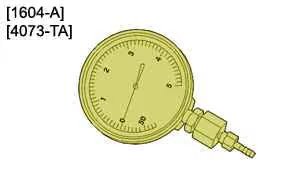
| [1604-A] [4073-TA] | Pressure gauge for checking turbo pressure |
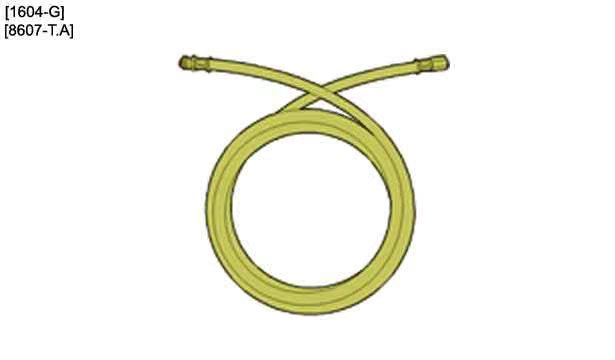
| [1604-G] [8607-T.A] | Pressure take-off extension |
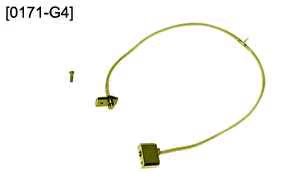
| [0171-G4] | Tool for checking inlet air pressure-vacuum |
2. Removing
CAUTION: Prior to any operation on a sensor or an actuator, read the memory of faults and do the necessary tests, with the aid of the diagnostic tool.
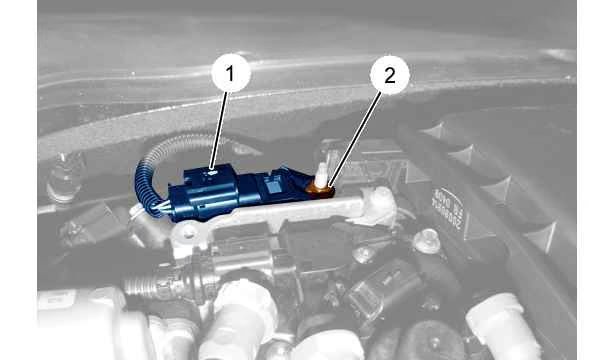
Remove nut (2).
Raise and move aside: The turbocharging pressure sensor (1).
Uncouple the pressure take-off pipe from the turbocharging pressure sensor (1).
3. Prepare the tooling
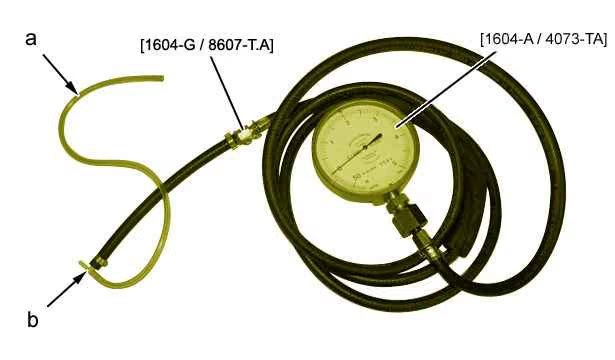
From the tool [0171-G4], take a transparent pipe "a" and a "T" union "b".
Assemble as above.
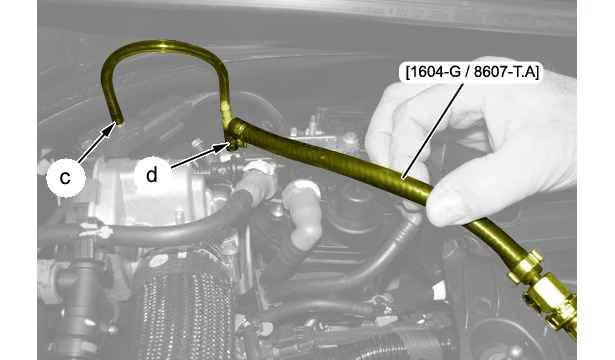
Connect:
- The transparent pipe "a" (at "c") on the pressure sensor (1)
- The "T" union "b" (at "d") on the pressure take-off pipe of the pressure sensor (1)
Connect the diagnostic equipment to the vehicle’s diagnostic socket.
Place the diagnostic tool in parameter measures.
4. Checks
4.1. Checks (Vehicle stopped)
CAUTION: Observe the following checking conditions: Engine at operating temperature; Vehicle stopped.
Start the engine.
| Engine speed | Boost pressure |
|---|---|
| 2500 rpm | 0,2 ± 0,1 bar |
| 4000 rpm | 0,4 ± 0,1 bar |
4.2. Checks (Road test)
CAUTION: Observe the following checking conditions: Engine at operating temperature; Vehicle being driven; Two operators are necessary.
Checking method: On road test:
- Place the tools inside the vehicle
- Start the engine
- Select 2nd gear
- Fully accelerate
- Note down the pressures shown on the tools
- Start the engine
| Engine speed | Boost pressure |
|---|---|
| 2000 rpm | 0,2 ± 0,1 bar |
| 4000 rpm | 0,7 ± 0,1 bar |
4.3. Verification of the coherence of the signal
N.B.: If there is a significant difference in the pressure read on the diagnostic tool and on the pressure gauge, replace the turbocharging pressure sensor.
If the pressure taken in the circuit is lower than the value given, check the following components:
- The turbocharger air inlet and outlet ducts
- The turbocharging air cooler inlet and outlet air ducts
- The turbocharging air cooler ()
- The turbocharger
If the pressure taken in the circuit (maximum 1 bar) is higher than the value given, check the turbocharger regulation system.
Table summarising the possible causes of a turbo pressure fault.
| Faults: Boost pressure | ||||
|---|---|---|---|---|
| Lack of pressure | Measured pressure too high | Pressure fluctuations (Hesitation while driving) | Turbo whistles | |
| Possible causes | Break in the turbo circuit (Collars - Air ducts - Exchanger) | Variable geometry control fault (Vacuum circuit - Actuator …) | Turbocharger variable geometry actuator fault (Tight spot) | Break in the turbo circuit (Collars - Air ducts - Exchanger) |
5. Refitting
CAUTION: Observe the tightening torque values.
Remove the tools [1604-A / 4073-TA], [0171-G4], [1604-G / 8607-T.A].
Connect the pressure take-off pipe on the turbocharging pressure sensor (1).
Refitting:
- The turbocharging pressure sensor (1)
- The nut (2)
CAUTION: Clear the memory of faults; Using the diagnostic tool.
Parts & tools for this job For 2009 Citroën DS3
- PARTEngine gasket setSearch: Citroën DS3 2009 engine gasket set
- TOOLTorque wrenchSearch: 3/8 inch torque wrench
- TOOLFeeler gauge setSearch: feeler gauge set
As an Amazon Associate we earn from qualifying purchases.