
Safety recommendations: Pneumatic suspension
- Make
- Citroën
- Model
- Jumper III Factory Workshop Manual
- Year
- 2006–2017
- Section
- Suspension › Safety recommendations: Pneumatic suspension
Safety recommendations: Pneumatic suspension
ESSENTIAL: Taking into account the special features of the pneumatic suspension system, observe the recommendations below.
1. Before any operations
ESSENTIAL: Depending on the operation to be carried out, observe the instructions for chocking up the vehicle.
ESSENTIAL: Deactivate the pneumatic suspension before lifting the vehicle (2 or 4 post lift, workshop jack or vehicle jack).
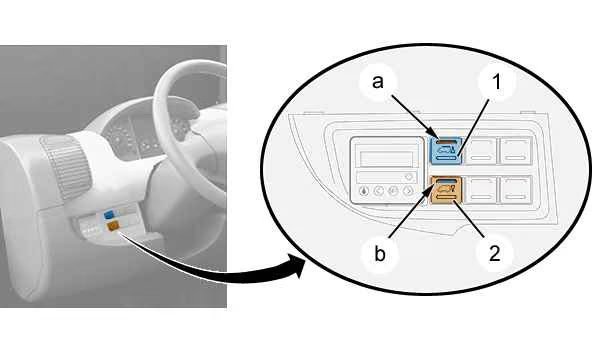
"a": Pneumatic suspension raising indicator lamp.
"b": Pneumatic suspension lowering indicator lamp.
(1) Pneumatic suspension raising switch.
(2) Pneumatic suspension lowering switch.
The pneumatic suspension is deactivated by pressing the 2 switches simultaneously for 5 seconds (the indicator lamps remain on continuously).
The pneumatic suspension is activated by pressing the 2 switches simultaneously for 5 seconds (The indicator lamps switch off).
2. During the operation
ESSENTIAL: Do not work on the pneumatic suspension circuit without releasing the pressure. Observe the procedure for pressurisation of the pneumatic suspension circuit.
CAUTION: Do not place a vehicle back on its wheels while the pneumatic suspension is depressurised.
Wait for the pressure in the pneumatic suspension circuit to drop completely before uncoupling the unions on the following components:
- Air compressor
- Compressed air reservoir
- Pneumatic spring
Do not work on the pneumatic suspension circuit while the engine is running.
ESSENTIAL: After the engine has been switched off, wait 30 seconds before carrying out any work.
3. Air compressor
CAUTION: Plug the pneumatic suspension circuit immediately to prevent destruction of the suspension compressor drying cartridge.
4. Pneumatic spring
CAUTION: Any knocks or impacts on the pneumatic spring are prohibited. Any kinking or bending of the pneumatic spring diaphragm is prohibited (Damage to the fibres of the pneumatic spring diaphragm). Do not fit a pneumatic spring which has a fault on the contact surface.
ESSENTIAL: Do not fit a damaged pneumatic spring (Distortion, blistering, indent, tear...). Risk of bursting of the damaged pneumatic spring when the pneumatic suspension circuit is pressurised.
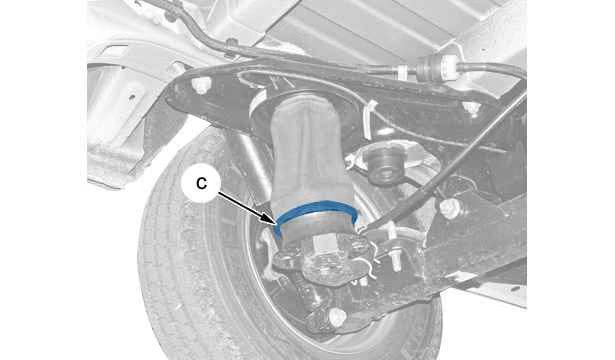
CAUTION: When the spring is removed, always support the diaphragm bearing "c" on the pneumatic spring piston.
ESSENTIAL: Do not pressurise the pneumatic suspension circuit if the diaphragm does not conform (risk of ejection from the pneumatic spring).
5. Compressed air reservoir
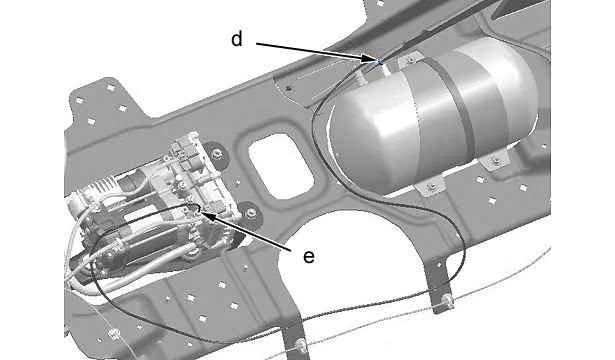
ESSENTIAL: Never uncouple the pipe at "d" or at "e" (Pressure at the air reservoir outlet 17 bars). Depressurise the compressed air reservoir.
Never carry out welding operations near the air reservoir.
Depending on the closeness of these elements, protect them from heat and from sparks by using protective screens, or otherwise by removing them.
CAUTION: No distortion of the air reservoir is permitted. If distortion of the air reservoir is noticed: Replace the air reservoir.
6. Pneumatic suspension circuit pipes
CAUTION: Do not bend or crush the pipes. Do not subject the pneumatic suspension circuit pipes to a flame or heat. Protect the area if necessary (Welding operation...). Couple up the pipes without adding any products to facilitate fitting (grease, lubricant...).
Couple up the pipes in thecentreline of the unions, without any twisting or stress.
7. Air union
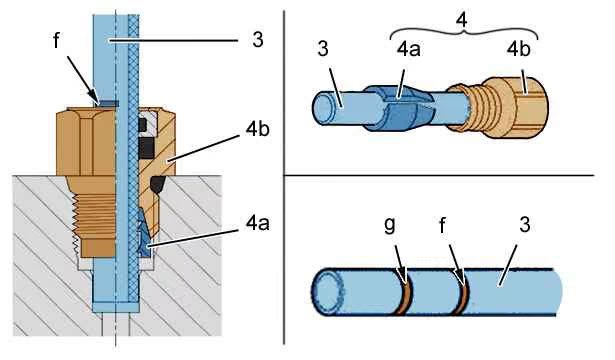
(4) Air union (Type "Voss"):
- (4A) Union screw
- (4B) Oval-shaped handle
ESSENTIAL: The removal operation renders the union useless. Always replace the union each time the pneumatic suspension circuit pipes are uncoupled.
CAUTION: When fitting the pipe, only the mark "f" should remain visible (the mark "g" corresponds to the minimum pressing of the pipe).
Fit the new air union (4):
- Fit the new air union (4) (Without tightening it)
- Press the pipe (3) into the union (4) by approximately 20 mm (only the mark "f" should remain visible)
- Tighten to the recommended torque
8. Body height sensor
ESSENTIAL: Do not remain underneath the vehicle during an adjustment of heights or an actuator test (electrovalves); Do not alter the height of the vehicle by manual action on the body height sensor.
CAUTION: Any deformation of the height sensor supports is prohibited. If deformation is noticed, replace the part.
Parts & tools for this job For 2006 Citroën Jumper
- TOOLCoil spring compressorSearch: coil spring compressor
- TOOLBall joint separatorSearch: ball joint separator
- PARTShock absorbersSearch: Citroën Jumper 2006 shock absorbers
As an Amazon Associate we earn from qualifying purchases.