
Modification: Hydraulic suspension union
- Make
- Citroën
- Model
- Xantia II Factory Workshop Manual
- Year
- 1998–2001
- Section
- Suspension › Modification: Hydraulic suspension union
Modification: Hydraulic suspension union
Vehicle application: XANTIA hydractive (with or without SC.CAR).
Applicable from RPO number: 8057.
The CITROEN hydraulic union replaces the ISO union.
N.B.: SC.CAR: CITROEN active roll-control system.
1. Description
The new CITROEN union is fitted to the end of 10 mm diameter pipes, connecting the following components:
- Front suspension regulator - Suspension strut supports (front)
- Rear suspension regulator - cylindres de suspension (rear)
This modification entails the evolution of the following components:
- Suspension regulators (front and rear)
- Suspension strut supports (front)
- Cylindres de suspension (rear)
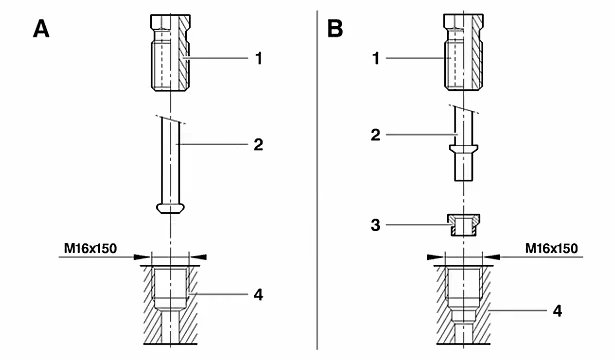
A - Previous assembly: union ISO.
B - New assembly: union CITROEN.
(1) Union screw (dimension across the flats):
- Previous assembly: 17 mm
- New assembly: 16 mm
(2) End of the pipe.
(3) Weatherstrip (steel bush with bonded seal).
(4) Body of the part.
CAUTION: The thread on the old and new unions is the same: M16 x 150. Mixing old and new parts is prohibited.
1.1. Suspension regulators (front and rear)
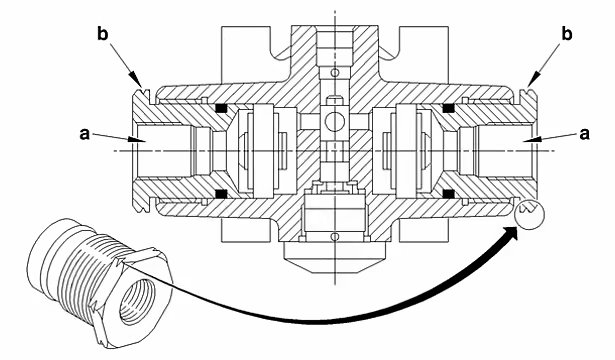
"a" Housing of the CITROEN union.
New assembly: The hexagonal section of the union has a machined part at "b".
1.2. Suspension strut supports (front)
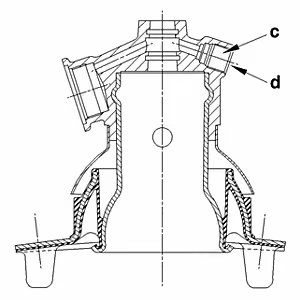
"c" Housing of the CITROEN union.
Identifying the fittings:
- Previous assembly: The side "d" is not machined, and is protected by a coat of black paint
- New assembly: The side "d" is machined
1.3. Cylindres de suspension (rear)
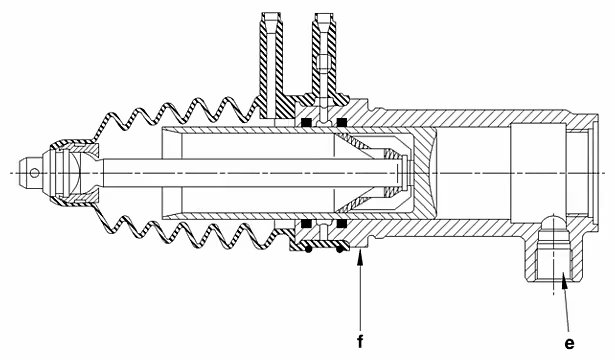
"e" Housing of the CITROEN union.
Identifying the fittings:
- Previous assembly: The diameter "f" is not machined
- New assembly: The diameter "f" is machined
N.B.: To identify the suspension cylinder on the vehicle, it may have to be released and moved backwards.
2. Repair operations
ESSENTIAL: In the event of a problem, please inform the CITROEN After Sales technical assistance team by "Techfile Info".
2.1. Interchangeability
Both old and new parts are available from the Replacement Parts Division.
CAUTION: Mixing old and new parts is prohibited.
N.B.: The thread on the old and new unions is the same. Check that the parts match before assembly.
ESSENTIAL: Check the union is sealed by varying the height of the vehicle, engine running.
2.2. Recommendations/precautions
The LHM mineral hydraulic fluid is the only suitable fluid to be used.
2.3. Recommendations/precautions: Precautions to be taken before carrying out any work
Clean:
- The area in which work is to be done
- The unions
- The component to be removed
Disconnect the cable from the battery negative terminal.
Use either petrol or lead free petrol, but no other product.
2.4. Recommendations/precautions: Precautions to be taken during the dismantling operation
Blank off the metal pipes with plugs.
Close the hydraulic unit openings using caps.
2.5. Recommendations/precautions: Precautions to be taken during assembly
The steel pipes should be blown through with compressed air.
The hydraulic components should be cleaned either with ordinary petrol, or with lead-free petrol, and blown through with compressed air.
ESSENTIAL: Each time work is carried out, it is necessary to replace the hydraulic seals.
The metal pipes are protected with an EPOXY paint.
CAUTION: Make sure, before effecting the assembly, that neither the pipe, nor its location, are carrying EPOXY paint particles.
2.6. Recommendations/precautions: Fitting a new hydraulic union
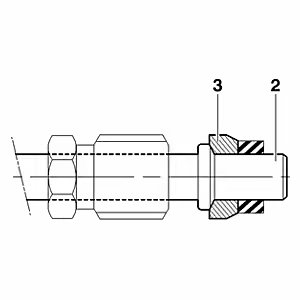
Fit the seal (3) to the pipe (2).
The seal must be up against the shoulder of the pipe.
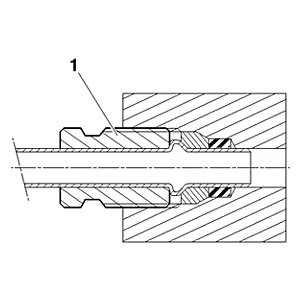
Centre the pipe into the bore, lining it up with the centre line of the hole and avoiding all stress.
CAUTION: Start screwing in the union-nut (1) by hand. If necessary, slacken the component fixing to make this operation easier. Gently tighten the nut. Excessive tightening may cause a leak as a result of the deformation of the pipe.
| Tightening torques | ||
|---|---|---|
| tube | Diameter | Tightening torque |
| New union | 10 mm | 2,5 daNm |
| Old union | 10 mm | 3 daNm |
Should a leak occur, check the tightening torque of the union-nut.
If the leak does not stop, check the condition of the tube and renew the sleeve seal if need be.
2.7. Verifications after repairs
Check the hydraulic pipe connections for leaks.
The hydraulic pipes should neither touch a fixed or movable component or exert a stress upon them.
Clearance:
- 2 Mm at least between a fixed tube and a fixed part
- 10 Mm min. between a fixed tube and a movable part
Parts & tools for this job For 1998 Citroën Xantia
- TOOLCoil spring compressorSearch: coil spring compressor
- TOOLBall joint separatorSearch: ball joint separator
- PARTShock absorbersSearch: Citroën Xantia 1998 shock absorbers
As an Amazon Associate we earn from qualifying purchases.