
Engine starting
- Make
- Fiat
- Model
- 500 Classic Workshop Manual
- Year
- 1957–1975
- Section
- Carburetter operation and adjustment, Weber 26.OC › Engine starting
Engine starting
So that full advantage may be taken of the progressive action starting device the engine should be started as follows:
- Cold starts. The starting device should be moved across to position 'A' as shown in FIG 2:13. Once the engine has fired push the control in partially.
- Warm starts. Only partially move the starting device to position 'B' as shown in FIG 2:13.
- Engine warm-up. As the engine begins to warm up to its normal operating temperature. Gradually push home the starting device lever so as only to supply the engine with the richened charge enabling the cold engine. operation to be smooth and regular. Position 'B'shown in FIG 2:13.
- Normal car driving. Once the engine has reached its normal operating temperature the starting device should be completely brought out of operation by bringing the control lever to the position C shown in FIG 2:13. 14.5 = .57 inch
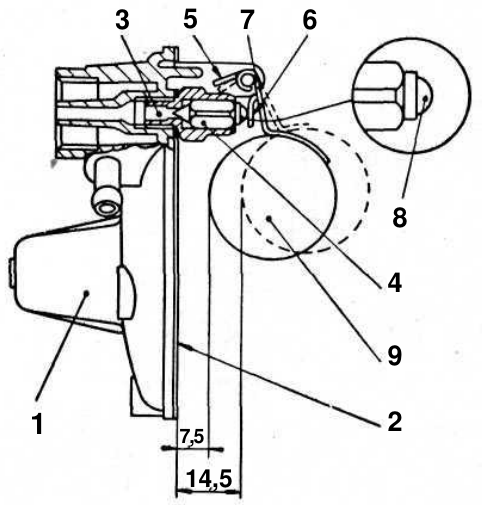
| 1 | Carburetter cover |
| 2 | Cover gasket |
| 3 | Needle valve |
| 4 | Valve needle |
| 5 | Lug 6, 7 Arms |
| 8 | Needle ball |
| 9 | Float |
Idle speed adjustment
The idling speed is adjusted by movement of the throttle setscrew and the mixture setscrew. The throttle screw allows for the adjustment of the throttle opening whereas the conical mixture setscrew has the purpose of metering the amount of charge issuing from the idling speed passage, which will then mix with the air flowing past the throttle which when correctly set for normal idling speed should leave a gap between its edges and the throat walls. This ensures a correct petrol/air ratio best suited to the engine requirements and smooth operation.
The idling speed should always be adjusted with the engine running and at its normal operating temperature by first setting the throttle to its minimum opening by turning the throttle setscrew so enabling an accurate adjustment to be made. Then slowly turn the mixture setscrew either in or out so as to adjust the mixture petrol/air ratio to the most suitable for the throttle opening, this will accomplish a fast and steady idling speed which should be then reduced by closing the throttle opening slightly by easing back the throttle setscrew. This adjustment should continue until the best idling speed is obtained.
Parts & tools for this job For 1957 Fiat 500 Classic
- PARTEngine gasket setSearch: Fiat 500 Classic 1957 engine gasket set
- TOOLTorque wrenchSearch: 3/8 inch torque wrench
- TOOLFeeler gauge setSearch: feeler gauge set
Links open Amazon search results in a new tab. As an Amazon Associate I earn from qualifying purchases.