
Fuel pressure regulator (RPM 36)
- Make
- Fiat
- Model
- Punto (176) Factory Service Manual
- Year
- 1993–1999
- Section
- Fuel system (1242 MPI) › Fuel pressure regulator (RPM 36)
The fuel manifold (1), which distributes fuel to the injectors (2) is pressure die cast and incorporates a pressure regulator (3) and the injectors themselves.
The fuel intake (4) is fastened with tapered sealed screws. Fuel recirculation (5) is via a pipe inside the manifold connected on the outside to a return pipe that leads to the tank.
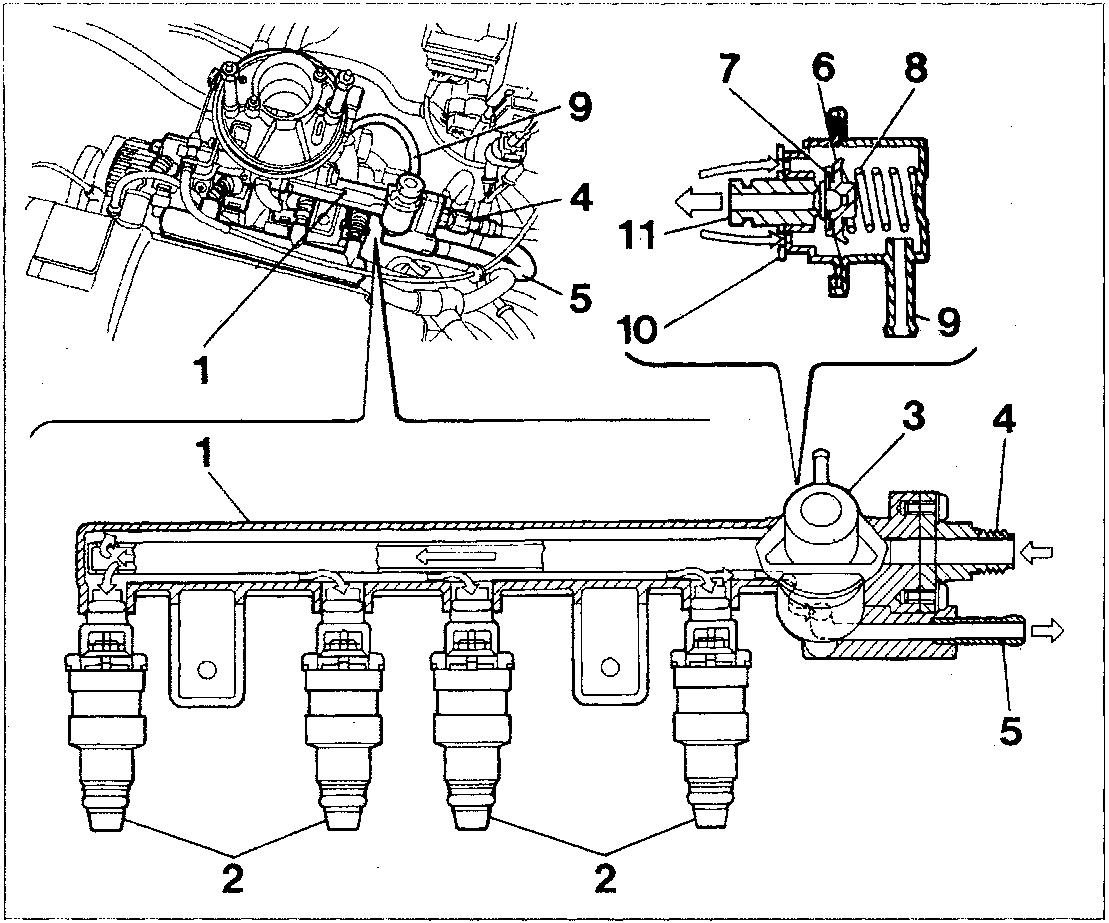
- Fuel manifold
- Injectors
- Pressure regulator
- Fuel inlet fitting
- Fuel return fitting to tank
- Membrane
- Reflux valve
- Regulating spring
- Vacuum socket
- Fuel inlet
- Fuel return
FUEL PRESSURE REGULATOR (RPM 36)
The pressure regulator is essential for maintaining the injector pressure gap constant. It is a differential membrane device, set during manufacture to a pressure of 2.5 ± 0.05 bar.
Fuel under pressure from the pump presses against mobile parts (6 and 7) and is countered by calibrated spring (8).
When the pressure setting is overcome, gate valve (7) moves to allow excess fuel to flow back to the tank. The pressure regulator is also affected by the vacuum in the inlet manifold (where the injectors are housed). As a result, the pressure change occuring at the injector nozzle is also set up at the regulator membrane. This allows the pressure gap across the injector terminals to be maintained under all engine service conditions. Fuel flow is therefore determined by the injector opening time (Tj).
Example: if the vacuum at the injector nozzle increases by 0.5 bar, fuel pressure drops by 0.5 bar.
Fuel pressure is therefore a fixed parameter that cannot be controlled by the ECU, but is essential for calculating fuel quantity. It should therefore never be altered - otherwise engine/catalytic converter efficiency may be jeopardized.
Parts & tools for this job For 1993 Fiat Punto
- PARTFuel filterSearch: Fiat Punto 1993 fuel filter
- TOOLFuel pressure test kitSearch: fuel pressure test kit
- TOOLFuel line disconnect toolSearch: fuel line disconnect tool
Links open Amazon search results in a new tab. As an Amazon Associate I earn from qualifying purchases.