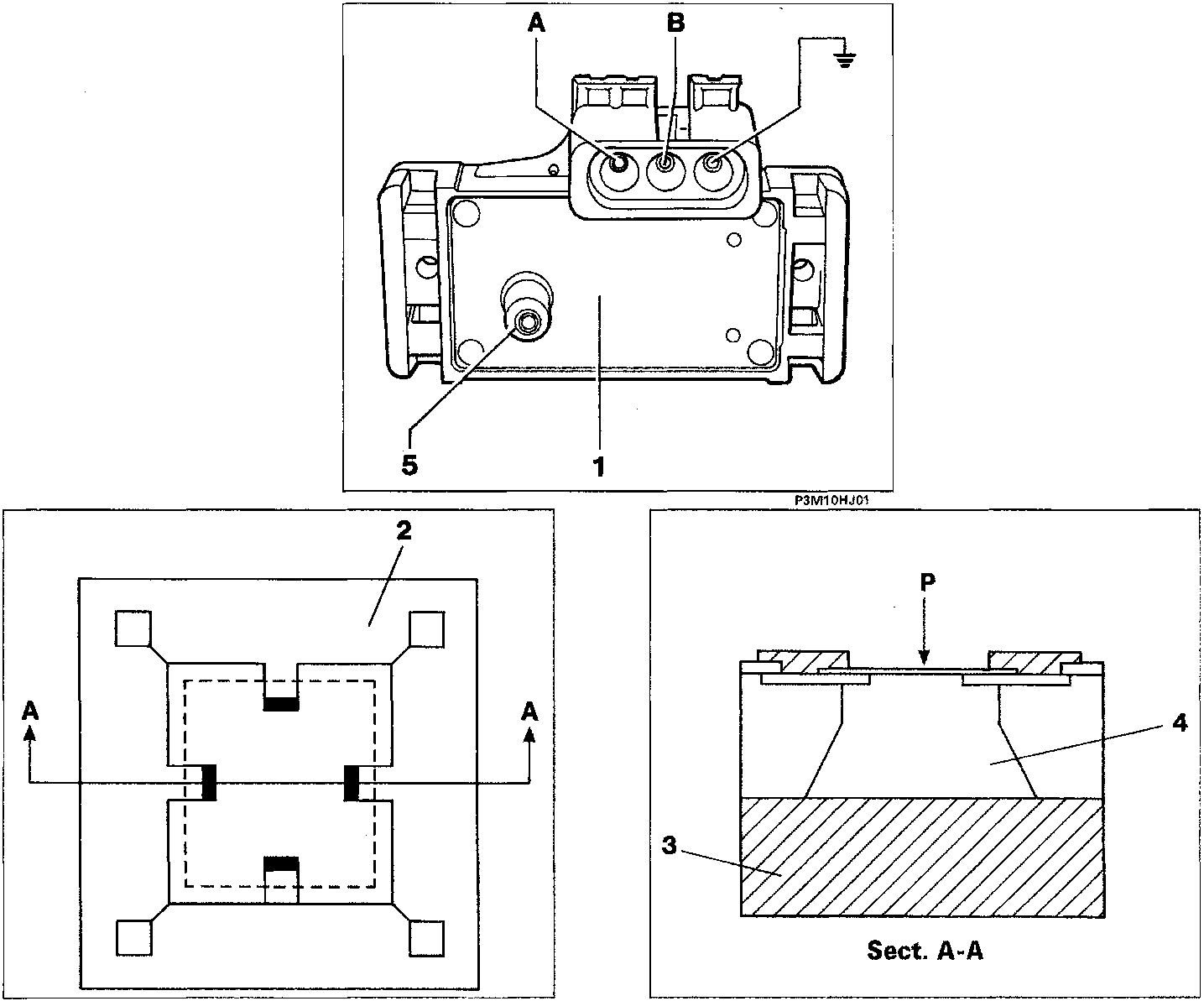
Absolute pressure sensor (1) measures changes inside the inlet manifold due to changes in engine load and rpm through vacuum point (5).
It consists of a diaphragm made out of insulating material in which are embedded resistances connected to form a bridge mesh (2).
The edge of the diaphragm is sealed to pyrex plate (3). A vacuum is set up in this in order to obtain reference cavity (4).
As soon as pressure P is applied to the part of the diaphragm that communicates with the inlet manifold, the diaphragm bends to bring about a change in the bridge resistance proportional to the applied pressure.
The ECU supplies pressure sensor (1) with a reference voltage of 5 Volts through terminal A and is able to record voltage changes brought about by pressure changes: the resistance change brings about a voltage change that the ECU uses to calculate absolute pressure in the intake manifold on a parametric basis. If pressure recorded in the intake manifold is 0.60 bar, therefore, voltage measured by the ECU is 2.75 Volt.
The ECU also uses the pressure value measured before the engine starts: this value measured with no vacuum in the inlet manifold represents the atmospheric pressure level.
Links open Amazon search results in a new tab. As an Amazon Associate I earn from qualifying purchases.
Help keep workshop manuals free
workshop-manuals.com provides free online workshop manuals.
If they helped you fix your car, please consider sharing or
making a small donation to keep the servers running.