
Operation of the electric front windows
- Make
- Fiat
- Model
- Punto (176) Factory Service Manual
- Year
- 1993–1999
- Section
- Electric front windows › Operation of the electric front windows
OPERATION OF THE ELECTRIC FRONT WINDOWS
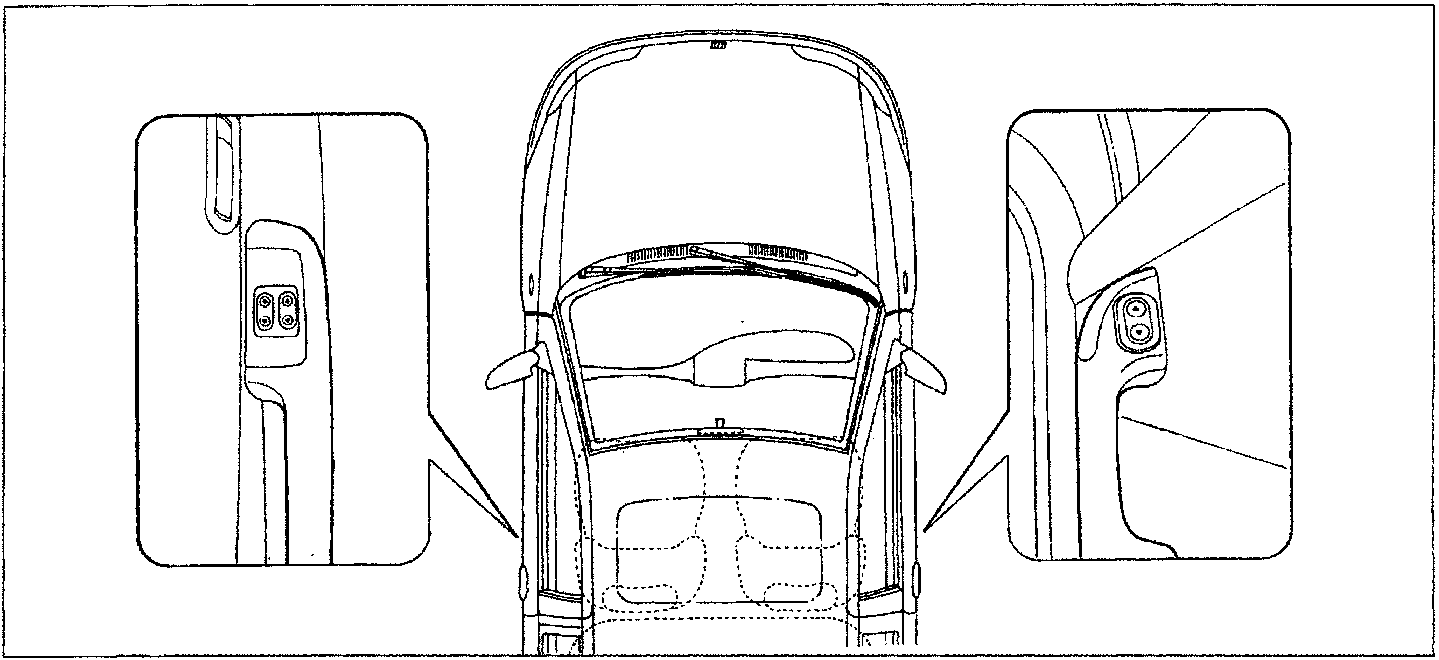
Location on car of front electric window pushbutton assemblies
On request, the car may have electric front windows.
The electrical system relating to the electrically-operated front windows consists of an electronic control unit (E2) installed on the optional devices control unit (8), which allows the window on the driver’s side to be operated both automatically and in the conventional manner.
With the ignition switch at the ON position, if one of the two buttons (72) controlling the electric window on the driver’s side is pressed, the window functions AUTOMATICALLY, i.e. it ascends or descends completely even if the button is not held pressed down.
During automatic operation, the window can be stopped by pressing one of the two control buttons.
The window on the passenger’s side can only be controlled in the conventional manner, by pressing the control buttons on the pushbutton assembly on the driver’s side (73) or on the pushbutton assembly on the passenger side (74).
"Noise detector" (frequency detector) safety systems
If the control button is pressed when the window has reached the end-of-travel position, the electronic control unit automatically cuts off the supply to the motor. This condition is recognized through an electronic circuit called "NOISE DETECTOR" (frequency detector) which acts by analysing the frequency of the interference caused by the motor brushes during its rotation.
When the motor is rotating, it generates, by means of the commutation which occurs between the brushes and commutator, an interference signal which is transmitted to the control unit through the supply line, whose frequency is proportional to the engine rpm.
If the frequency of this signal exceeds 15 ± 5 Hz, the control unit recognizes that the motor is turning freely.
When the window reaches the end-of-travel position or tends to jam for mechanical reasons, such as to drastically reduce the normal speed of rotation, the frequency of the interference signal is reduced proportionally. When this frequency falls below the established threshold (15 ± 5 Hz), the "NOISE DETECTOR" (frequency detector) cuts off the supply.
Parts & tools for this job For 1993 Fiat Punto
- TOOLTrim removal tool kitSearch: trim removal tool kit
- PARTTouch-up paintSearch: Fiat touch up paint
- PARTPanel clip assortmentSearch: Fiat panel clips assortment
Links open Amazon search results in a new tab. As an Amazon Associate I earn from qualifying purchases.