
Exhaust gas recirculation system (e.g.r.)
- Make
- Fiat
- Model
- Ulysse Factory Service Manual
- Year
- 2002–2010
- Section
- Emission control system › Exhaust gas recirculation system (e.g.r.)
EXHAUST GAS RECIRCULATION SYSTEM (E.G.R.)
INTRODUCTION
The EGR device makes it possible to introduce a certain amount of exhaust gases, with very little oxygen, into the intake manifold. The metering is controlled by the NCM according to the engine temperature, speed and load.
The diagram below illustrates the exhaust gas recirculation circuit EGR.
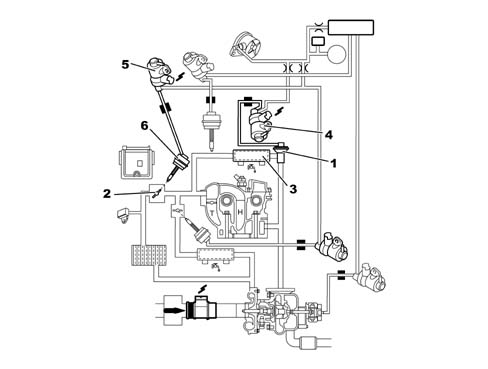
| 1, exhaust gas recirculation valve EGR | 4, Exhaust gas recirculation regulation solenoid EGR |
| 2, EGR metering throttle | 5, throttle adjustment solenoid valve EGR |
| 3, water/exhaust gas heat exchanger EGR | 6, EGR metering actuator |
COMPOSITION
The EGR device includes:
- a water/exhaust gas heat exchanger EGR (3): this has the function of decreasing the temperature of the recirculation gases to increase their density and thereby increase the quantity of gas introduced into the engine.
- an EGR metering throttle (2): this is designed to increase the difference in pressure qat the EGR valve (1) inlet when it is in the fully open position with an insufficient gas flow rate. Its gradual closure is ensured by an actuator (6) pneumatically controlled by a solenoid valve (5) operated by the NCM.
OPERATION
Management of the EGR device
The following conditions allow the recirculation of the exhaust gases:
- engine speed greater than 725 rpm,
- engine and air temperature: in accordance with the NCM strategy,
- engine load: in accordance with the NCM strategy,
- regeneration assistance: inactive.
The recirculation of the exhaust gases is not permitted in the following conditions:
- engine speed greater than 2650 rpm,
- altitude above 1500 m,
- heavy engine load,
- regeneration assistance: activated,
- engine temperature > 105°C.
The EGR device is managed according to the intake air flow rate.
The intake air flow rate depends on:
- the engine speed,
- the engine load,
- the engine temperature.
Depending on the flow rate, the NCM:
- controls the EGR recycling solenoid valve,
- determines the exhaust gas recirculation rate and corrects the opening of the EGR valve so that the actual recirculation rate corresponds with the rate determined.
During the regeneration assistance stage:
- the EGR recycling is excluded,
- the management of the turbocharger takes priority.
VACUUM RESERVE TANK
The circuit is pneumatically supplied by means of the vacuum pump. A vacuum reservoir tank allows the correct, simultaneous operation of:
- brake servo,
- SWIRL throttle actuator.
- heater throttle actuator.
- turbine variable geometry piston actuator,
- EGR throttle actuator.
The vacuum tank is located under the left front wheel arch.
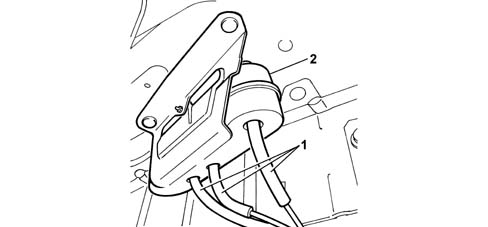
1, connecting pipes
2, reservoir
EGR SOLENOID VALVE
The solenoid valve places the vacuum pump and the pneumatic actuators in contact.
When the solenoid valve is operated, the operating pressure is between atmospheric pressure the vacuum produced by the vacuum pump.
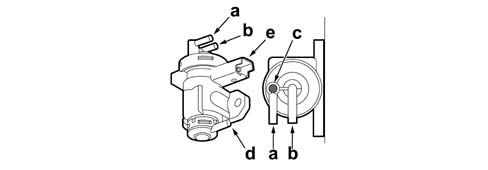
| a, outlet to the consumer | d, atmospheric pressure input |
| b, vacuum inlet | e, electrical connector |
| e, white marking |
Parts & tools for this job For 2002 Fiat Ulysse
- PARTExhaust gasketSearch: Fiat Ulysse 2002 exhaust gasket
- TOOLPenetrating oilSearch: penetrating oil
- TOOLOBD2 scannerSearch: OBD2 scanner
Links open Amazon search results in a new tab. As an Amazon Associate I earn from qualifying purchases.