
Vehicle Lifting: Description and Operation
- Make
- Ford
- Model
- E 150
- Engine
- V8-4.6L
- Year
- 2007
- Section
- Vehicle Lifting › Description and Operation
Vehicle Lifting: Description and Operation
JACKING
Jacking Points
Refer to the Owner Guide.
LIFTING
Lifting Instructions
CAUTION:
-
Damage to the suspension or steering linkage system components can occur when positioning the hoist adapters. The front adapter pads
should be positioned carefully to ensure maximum contact under the center of the lower suspension arms or spring supports as near the
wheels as practical. The rear suspension hoist adapters (forks) should be placed under the spring mounting pads or the rear axle housing
tubes, but the adapters must not interfere with the shock absorber mounting brackets or the stabilizer bar mounting brackets.
-
When raising a vehicle on a twin post hoist, care should be taken to position the vehicle so that the hoisting adapters (forks) do not
damage the axle housing cover or contact the rear stabilizer bar or brackets.
-
For correct wrecker towing procedures, refer to the vehicle Owner Guide. Incorrect towing of a vehicle can result in transmission
damage. Always follow the outlined towing procedures.
Refer to the hoist manufacturer's operating manual for correct lifting instructions.
Hoist, Drive-On
To prevent possible damage to the underbody, do not drive the vehicle onto the drive-on hoist without first checking for possible interference between
the upright flanges of the hoist rails and the underbody. Should there be interference, the hoist flanges should be modified as necessary and the
approach ramps built up to provide the necessary clearance.
Hoist, Frame Contact
Adapters may be necessary to clear any vehicle components (front and rear) to lift the vehicle safely. This will provide enough clearance to prevent
damaging the lower body.
Hoist, Single-Post
Adapters may be necessary to clear any vehicle components (front and rear) to lift the vehicle safely. This will provide enough clearance to prevent
damaging the lower body.
Hoist, Twin-Post
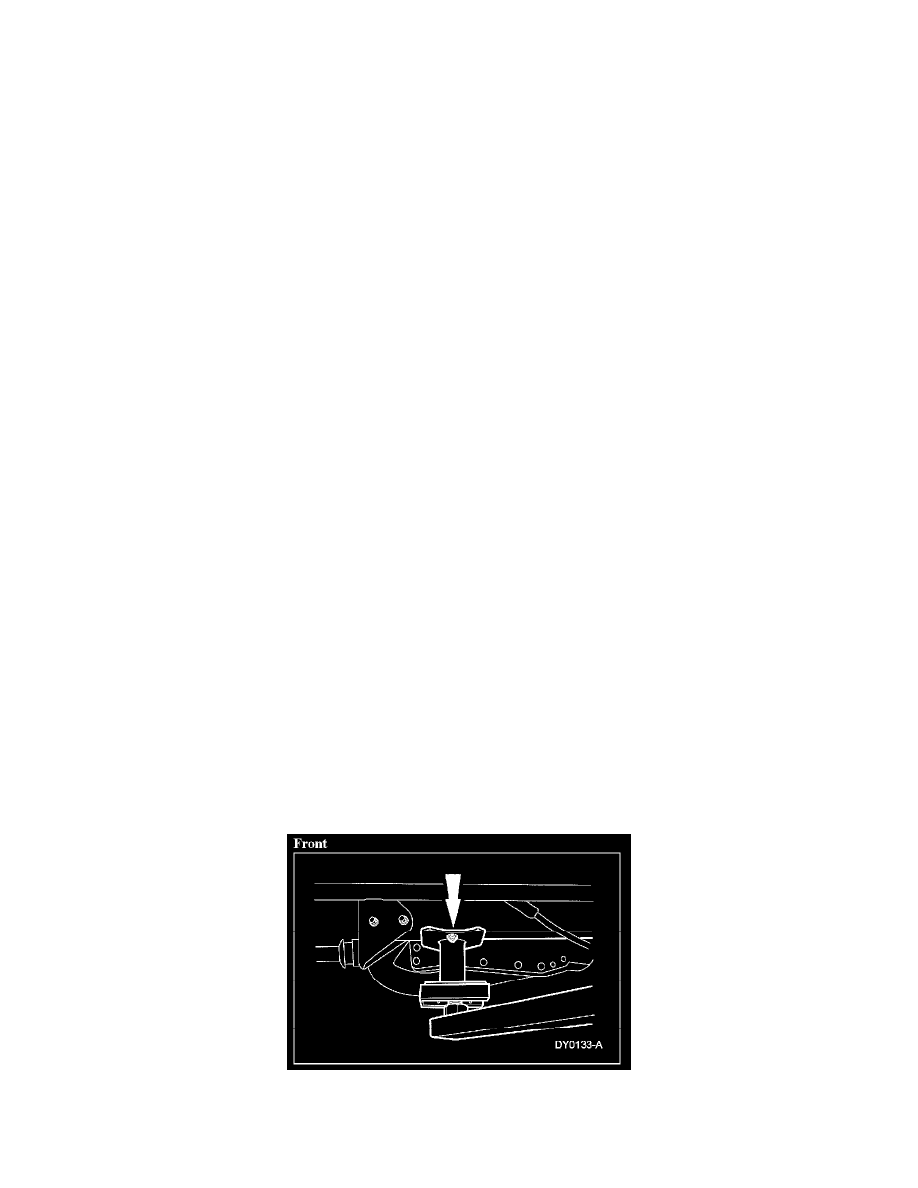
Damage to the suspension or steering linkage system components can occur when positioning the hoist adapters. The front adapter pads should be
positioned carefully to ensure maximum contact under the center of the lower suspension arms or spring supports as near the wheels as practical. The
rear suspension hoist adapters (forks) should be placed under the spring mounting pads or the rear axle housing tubes, but the adapters must not
interfere with the shock absorber mounting brackets or the stabilizer bar mounting brackets.
CAUTION: When raising a vehicle on a twin-post hoist, care should be taken to position the vehicle so that the hoisting adapters (forks) do
not damage the axle housing cover or contact the rear stabilizer bar or brackets.
Adapters may be necessary to clear any vehicle components (front and rear) to lift the vehicle safely. This will provide enough clearance to prevent
damaging the lower body.
Front
Pinch or Ctrl + scroll to zoom. Double-tap to reset.
Parts & tools for this job For 2007 Ford E 150 4.6L
- PARTOil filterSearch: Ford E 150 2007 4.6L oil filter
- TOOLOil filter wrenchSearch: oil filter wrench
- FLUIDEngine oilSearch: Ford E 150 engine oil
Links open Amazon search results in a new tab. As an Amazon Associate I earn from qualifying purchases.