
Alignment: Specifications (page 2 of 3)
- Make
- Isuzu
- Model
- Amigo 4WD
- Engine
- L4-2.2L
- Year
- 1998
- Section
- Alignment
Alignment: Description and Operation
GENERAL DESCRIPTION
"Front End Alignment" refers to the angular relationship between the front wheels, the front suspension attaching parts and the ground. Proper front
end alignment must be maintained in order to insure efficient steering, good directional stability and to prevent abnormal tire wear. The most
important factors of front end alignment are wheel toe-in, wheel camber and axle caster.
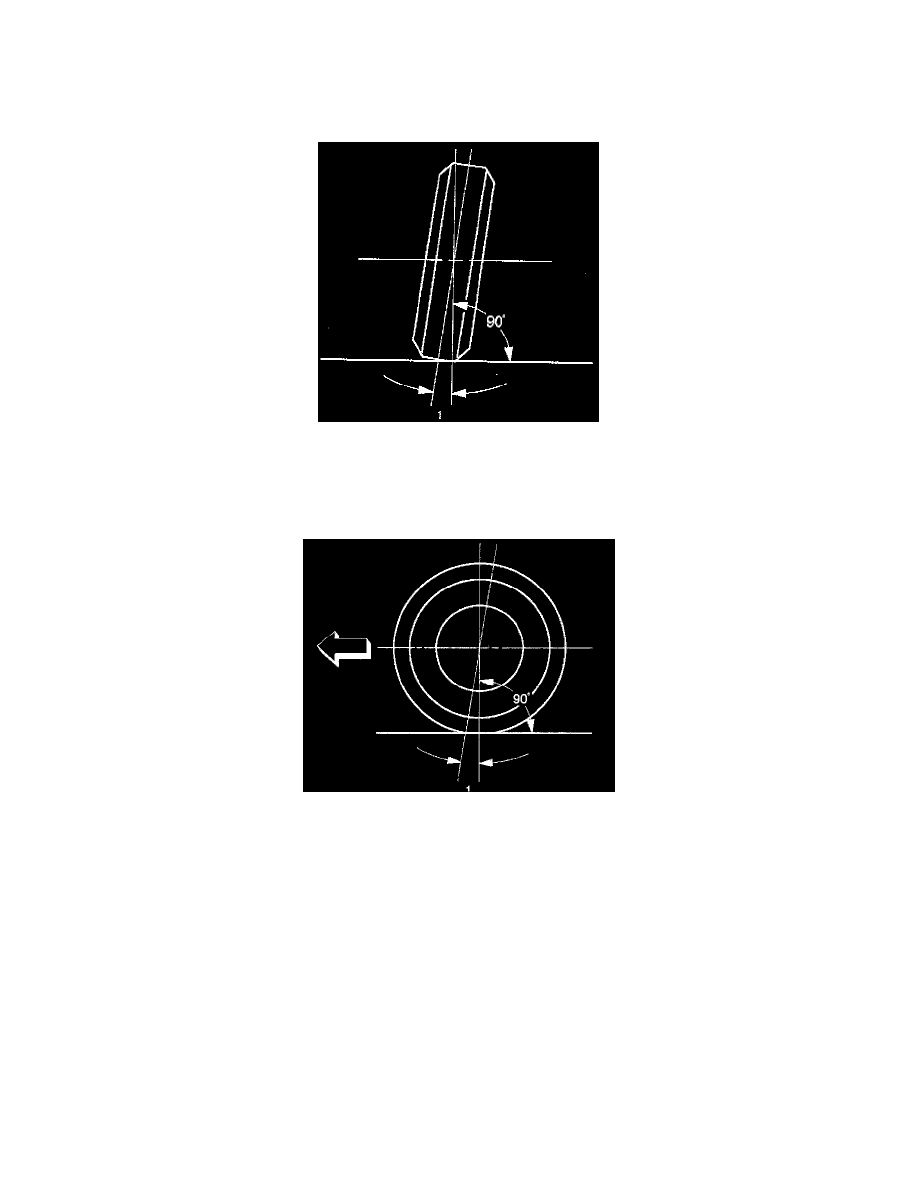
CAMBER:
Camber is the vertical tilting inward or outward of the front wheels. When the wheels tilt outward at the top, the camber is positive (+). When the
wheels tilt inward at the top, the camber is negative (-). The amount of tilt measured in degrees from the vertical is called the camber angle (1). If
camber is extreme or unequal between the wheels, improper steering and excessive tire wear will result. Negative camber causes wear on the inside of
the tire, while positive camber causes wear to the outside.
CASTER:
This illustration shows view from the side of the vehicle. Caster (1) is the vertical tilting of the wheel axis either forward or backward (when viewed
from the side of the vehicle). A backward tilt is positive (+) and a forward tilt is negative (-). On the short and long arm type suspension you cannot
see a caster angle without a special instrument, but if you look straight down from the top of the upper control arm to the ground, the ball joints do not
line up (fore and aft) when a caster angle other than 0 degree is present. With a positive angle, the lower ball joint would be slightly ahead (toward the
front of the vehicle) of the upper ball joint center line.
Pinch or Ctrl + scroll to zoom. Double-tap to reset.
Parts & tools for this job For 1998 Isuzu Amigo 2.2L
- TOOLTie rod end toolSearch: tie rod end puller
- TOOLBall joint separatorSearch: ball joint separator
- FLUIDPower steering fluidSearch: Isuzu power steering fluid
Links open Amazon search results in a new tab. As an Amazon Associate I earn from qualifying purchases.