
Engine misfire-exhaust valve sticking
- Make
- Land Rover
- Model
- Range Rover P38 Technical Bulletins
- Section
- Engine misfire-exhaust valve sticking › Engine misfire-exhaust valve sticking
ENGINE MISFIRE-EXHAUST VALVE STICKING
- Model
- New Range Rover 4.0/4.6 V8 Derivatives Discovery V8 Derivatives Discovery V8 Derivatives
- Affected vehicles
- 302054 onwards 166228 onwards 502787 onwards
- Date
- 1996-10-30
- Reference
- 30/10/96
Bulletin text
Engine Misfire - Exhaust Valve Sticking
MODEL
New Range Rover 4.0/4.6 V8 Derivatives
Discovery V8 Derivatives Discovery V8 Derivatives
DETAIL
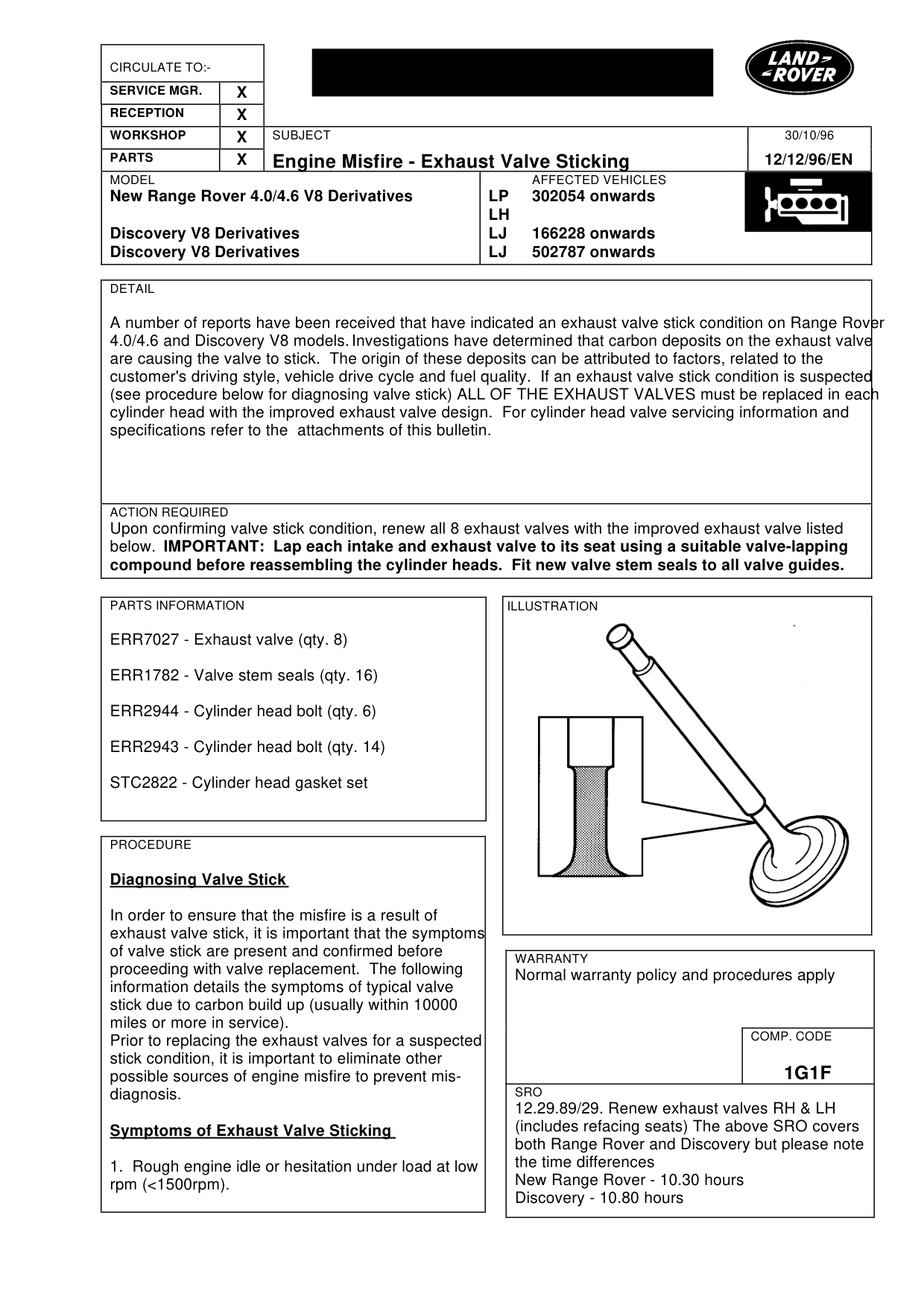
A number of reports have been received that have indicated an exhaust valve stick condition on Range Rover 4.0/4.6 and Discovery V8 models. Investigations have determined that carbon deposits on the exhaust valve are causing the valve to stick. The origin of these deposits can be attributed to factors, related to the customer's driving style, vehicle drive cycle and fuel quality. If an exhaust valve stick condition is suspected (see procedure below for diagnosing valve stick) ALL OF THE EXHAUST VALVES must be replaced in each cylinder head with the improved exhaust valve design. For cylinder head valve servicing information and specifications refer to the attachments of this bulletin.
ACTION REQUIRED
Upon confirming valve stick condition, renew all 8 exhaust valves with the improved exhaust valve listed below. IMPORTANT: Lap each intake and exhaust valve to its seat using a suitable valve-lapping compound before reassembling the cylinder heads. Fit new valve stem seals to all valve guides.
PARTS INFORMATION
ERR7027 - Exhaust valve (qty. 8)
ERR1782 - Valve stem seals (qty. 16)
ERR2944 - Cylinder head bolt (qty. 6)
ERR2943 - Cylinder head bolt (qty. 14)
STC2822 - Cylinder head gasket set
PROCEDURE
Diagnosing Valve Stick
In order to ensure that the misfire is a result of exhaust valve stick, it is important that the symptoms of valve stick are present and confirmed before proceeding with valve replacement. The following information details the symptoms of typical valve stick due to carbon build up (usually within 10000 miles or more in service). Prior to replacing the exhaust valves for a suspected stick condition, it is important to eliminate other possible sources of engine misfire to prevent misdiagnosis.
Symptoms of Exhaust Valve Sticking
1. Rough engine idle or hesitation under load at low rpm (<1500rpm).
30/10/96
12/12/96/EN
AFFECTED VEHICLES
LP 302054 onwards LH LJ 166228 onwards LJ 502787 onwards
WARRANTY
Normal warranty policy and procedures apply
COMP. CODE
1G1F
SRO
12.29.89/29. Renew exhaust valves RH & LH (includes refacing seats) The above SRO covers both Range Rover and Discovery but please note the time differences New Range Rover - 10.30 hours Discovery - 10.80 hours
Engine Misfire - Exhaust Valve Sticking
MODEL
Range Rover 4.0/4.6 V8 Derivatives
Discovery V8 Derivatives Discovery V8 Derivatives
2. Engine manifold vacuum gauge flutters at rough running engine speed, most noticeable on a cold engine.
Eliminating Other Sources of Misfire
The following potential sources of engine misfire must be eliminated before concluding that an exhaust valve stick condition exists.
1. Check all aspects of the engine that can interrupt a cylinder’s ability to burn the air/fuel mixture. includes checking that the flywheel reluctor ring tabs are not bent (each pair must be parallel and spaced evenly with a 5mm gap between each pair) and that the reluctor ring is concentric on the flex plate assembly (best checked with engine running).
2. Ensure the crank sensor tip is not damaged or that the crank sensor mountings are not loose sensor mounting bolts have been torqued to specification.
3. Check spark plug leads, spark plugs, ignition coil, fuel injectors, fuel pressure, air/vacuum leaks, and mechanical cam/crank timing & any abnormal wear in the camshaft/valve train assembly.
If all the above has been checked and the evidence proves that a valve stick exists then refer to attached engine rebuild section for replacement of exhaust valves. NOTE: See previous page for valve replacement information.
Carbon Deposit Prevention
Following the replacement of the exhaust valves, the use of a premium quality fuel will help eliminate carbon build-up within the combustion chambers. These premium fuels contain additives which are designed to prevent deposit build-up. Land Rover recommends that the customer use a "quality fuel' with combustion chamber deposit controlling additives.
30/10/96 12/12/96/EN
AFFECTED VEHICLES
LP 302054 onwards LH LJ 166228 onwards LJ 502787 onwards
This
after the
Parts & tools for this job For Land Rover Range Rover
- PARTExhaust gasketSearch: Land Rover Range Rover exhaust gasket
- TOOLPenetrating oilSearch: penetrating oil
- TOOLOBD2 scannerSearch: OBD2 scanner
Links open Amazon search results in a new tab. As an Amazon Associate I earn from qualifying purchases.